
World
Canada Joins EU’s SAFE Program for Defense Procurement Opportunities

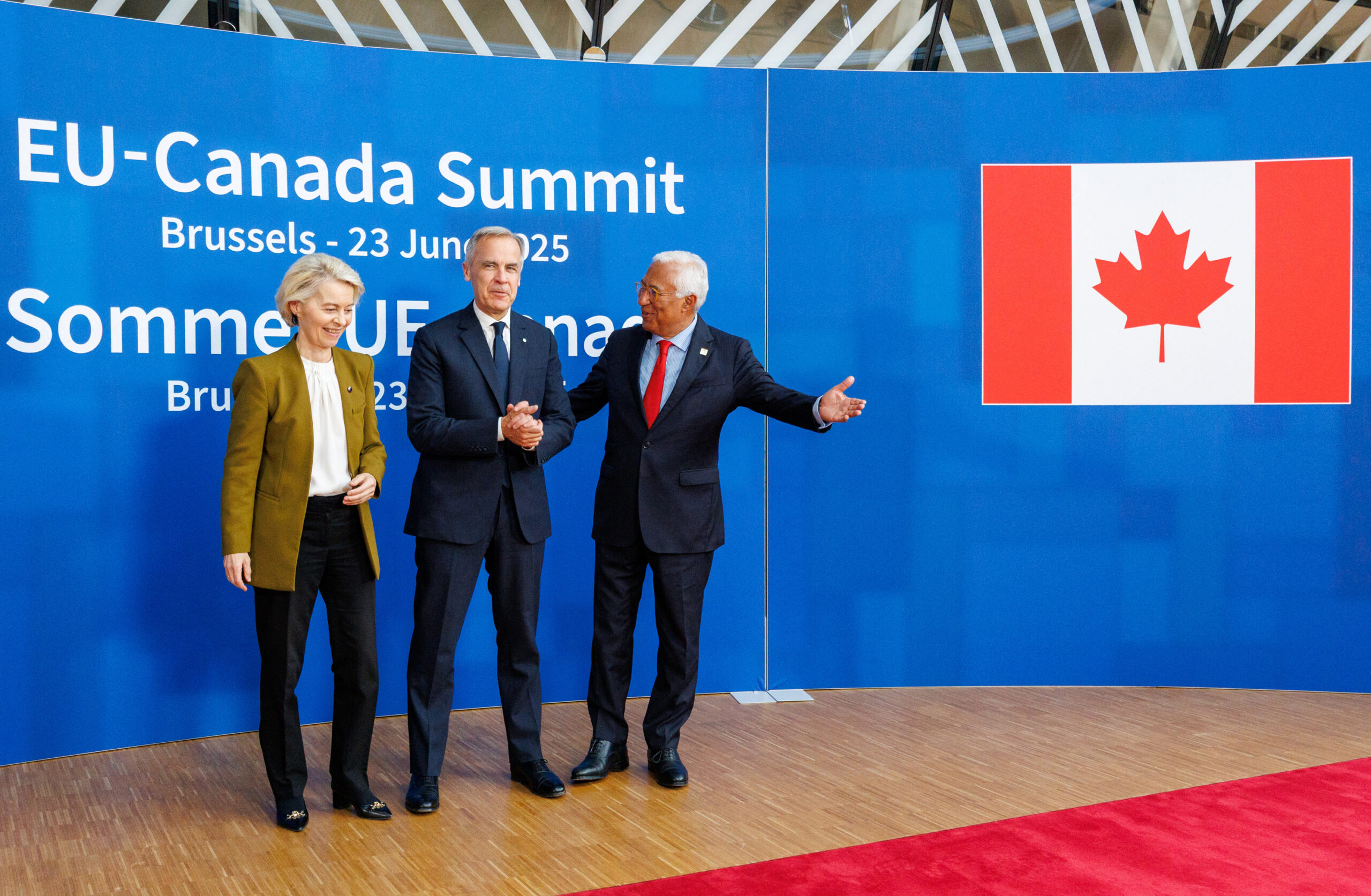
Canada has officially become the first non-European Union (EU) member to join the bloc’s military procurement initiative, known as the Security Action for Europe (SAFE). This significant move, announced by Canadian Prime Minister Mark Carney, opens the door for potential funding to support Ottawa’s purchases of next-generation fighter jets and submarines.
The SAFE program, which has a budget of €150 billion, aims to enhance military readiness across Europe through loans for joint defense procurement. In a statement, Carney highlighted that participation in SAFE could unlock billions in defense opportunities for Canadian businesses and attract new suppliers for the Canadian Armed Forces. He emphasized the potential for national manufacturers to build and export Canadian-made military capabilities.
As Canada evaluates its options for a next-generation fighter jet, it has already committed funds for 16 F-35 aircraft. However, the government is considering a mixed fleet, with the Swedish-made Gripen aircraft also in contention. The details regarding Canada’s involvement in SAFE are still being finalized. Ottawa and the EU are currently negotiating a bilateral agreement to facilitate the process and potentially exempt Canada from specific regulations.
Under the current SAFE guidelines, a project must have no more than 35% of its component costs sourced from outside the EU, the European Economic Area, or Ukraine to be eligible for funding. Nonetheless, countries can secure access through financial contributions, although the specifics of Canada’s commitment remain unclear. It is uncertain whether this financial obligation will be a one-time fee or linked to future procurement commitments.
The negotiations surrounding Canada’s entry into SAFE echo recent challenges faced by the United Kingdom, which stalled last month due to disagreements on financial support levels. The EU proposed a contribution between €4 billion and €6.5 billion, while the UK was willing to commit only €200 million to €300 million.
With ambitious procurement targets on the horizon, Canadian defense expert Roger Hilton, affiliated with the Bratislava-based think tank GLOBSEC, noted that financing through SAFE could extend to various defense projects. These may include next-generation fighter aircraft, conventional submarines, and maritime domain awareness systems. Hilton also suggested that Canada might explore SAFE funding opportunities for drones, anti-submarine warfare platforms, and secure satellite communications.
Another key aspect of SAFE is that funded projects must involve at least two partners. This can consist of either two EU member states or one member state in conjunction with Ukraine or a nation from the European Free Trade Association (EFTA) or the European Economic Area (EEA). Hilton believes Canada will likely collaborate with European nations that share similar strategic priorities, particularly regarding Arctic security and North Atlantic defense.
He pointed out that Canada is expected to gravitate towards countries with robust aerospace and naval industries, such as France, Germany, Italy, Sweden, and Spain. These nations possess the industrial capabilities and design authority that align with SAFE’s objectives.
As Canada moves forward with its defense procurement strategy, the implications of joining SAFE are significant. The collaboration with the EU could reshape Canada’s military capabilities and expand its defense industry, while also fostering deeper ties with European partners in the realm of security and defense.

Urgent Tax Savings Alert: Maximize Deductions Before April 15

Trump’s Administration Faces Uncertainty Over Government Shutdowns

Cosmic Defects: The Mystery of the Universe’s Missing Anomalies

Rapid City Parks Department Opens Registration for Bocce Leagues

Samsung Galaxy Watch 9 to Feature Larger 435mAh Battery Soon

Two Dead After Student Boats Capsize Off Okinawa Coast

Healthy Choice Wellness Reports Earnings with Mixed Results

Prince Harry Positions Himself as Royal Family’s Image Reviver

All Points North Lodge Achieves FSPHP-ETA Accreditation

Send Holiday Parcels for £1.99 with New Comparison Service

University of Hawaiʻi Leads $25M AI Project to Monitor Natural Disasters

Maui County Reopens Upgraded Lānaʻi Fifth Street Courts Today!

Daily Codeword Puzzle Launches on October 21, 2025

Congresswoman Under Fire for Misleading Epstein Donation Claims

Interstellar Object 3I/ATLAS Emits Unique Metal Alloy, Says Scientist

Trump Vows to Resolve Afghanistan-Pakistan Crisis “Very Quickly”

Charles Darwin’s Address Book Reveals Hidden Aspects of His Life

Rediscovering Chrysler: 5 Overlooked Models from the 1980s
-
 Lifestyle8 months ago
Send Holiday Parcels for £1.99 with New Comparison Service
-
Science9 months ago
University of Hawaiʻi Leads $25M AI Project to Monitor Natural Disasters
-
 Top Stories8 months ago
Maui County Reopens Upgraded Lānaʻi Fifth Street Courts Today!
-
 Entertainment10 months ago
Daily Codeword Puzzle Launches on October 21, 2025
-
 Lifestyle9 months ago
Congresswoman Under Fire for Misleading Epstein Donation Claims
-
 Science10 months ago
Interstellar Object 3I/ATLAS Emits Unique Metal Alloy, Says Scientist
-
 Top Stories9 months ago
Trump Vows to Resolve Afghanistan-Pakistan Crisis “Very Quickly”
-
 Science8 months ago
Charles Darwin’s Address Book Reveals Hidden Aspects of His Life
-
 Lifestyle8 months ago
Rediscovering Chrysler: 5 Overlooked Models from the 1980s
-

 Science7 months ago
Understanding Generation Z: Strategies for Engaging the Workforce
-

 Entertainment10 months ago
Kelly McCreary Discusses Future of Maggie and Winston in Grey’s Anatomy
-

 Top Stories8 months ago
aespa Faces Backlash Over G-Dragon Interaction at 2025 MAMAs