
Science
Interstellar Object 3I/ATLAS Emits Unique Metal Alloy, Says Scientist

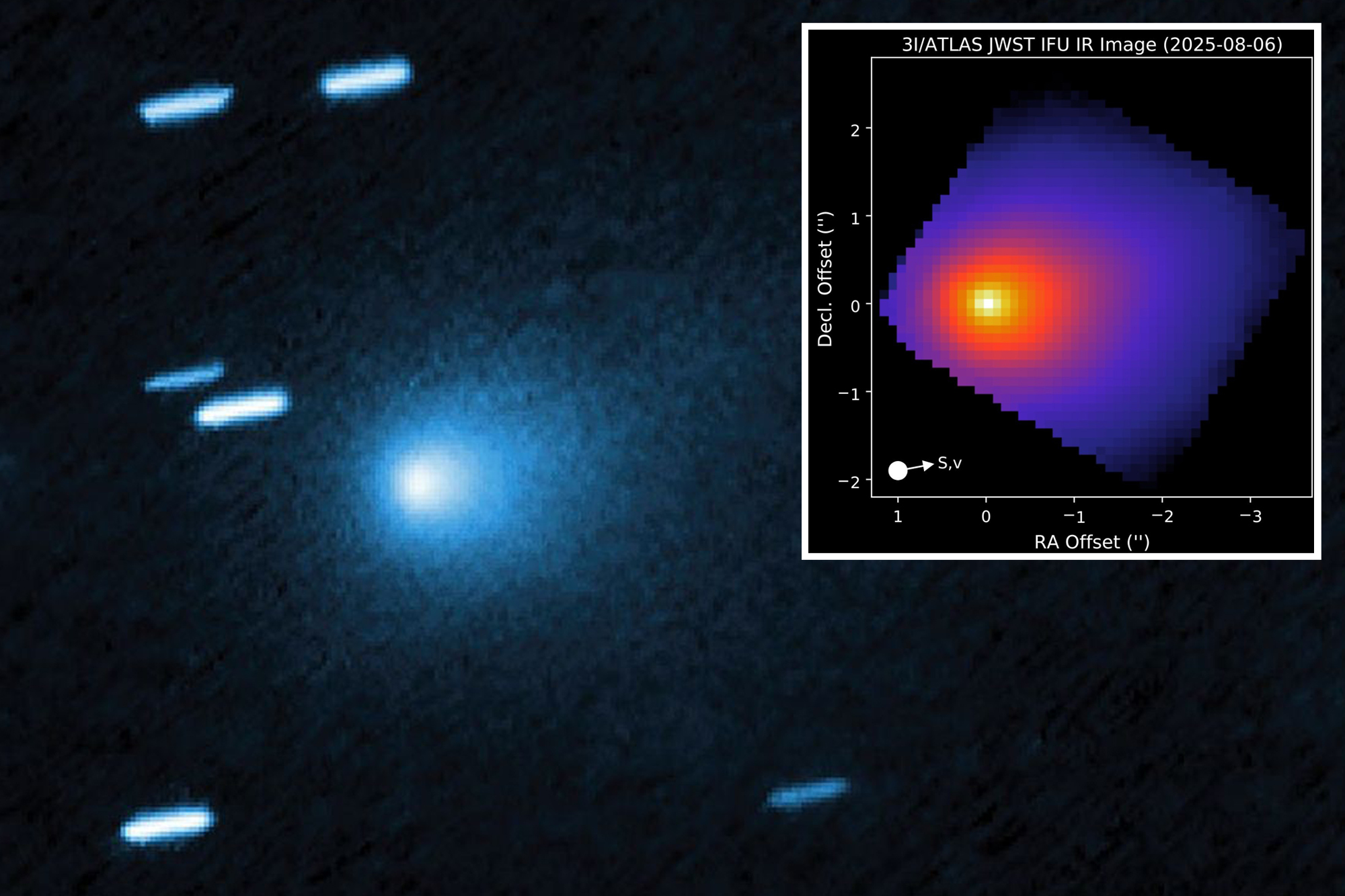
The interstellar object known as 3I/ATLAS, roughly the size of Manhattan, is emitting a metal alloy never before observed in nature, according to a statement from Dr. Avi Loeb, an astrophysicist at Harvard University. New images captured by the Keck II Telescope in Hawaii in August reveal that this unusual object is releasing a plume containing four grams of nickel per second, without any detectable iron. This phenomenon is unprecedented in the study of comets.
The alloy produced by 3I/ATLAS is identified as nickel tetracarbonyl, a compound typically associated with industrial processes. “There is only one place where that is known to exist and that is in industrially produced nickel alloys,” Loeb explained. “This was never observed for any other object.” In contrast, traditional comets, including two previous interstellar comets, typically exhibit comparable amounts of nickel and iron.
Unusual Characteristics of 3I/ATLAS
The study conducted by researchers at the Keck Observatory suggested that the nickel-emitting process could be a natural occurrence. However, Loeb expressed skepticism, emphasizing that such refined compounds have only been manufactured by humans. “This was a process that we can imagine only because it was used in industry,” he stated.
Another intriguing aspect of 3I/ATLAS is its lack of a cometary tail, which is typically observed in these celestial bodies. “We usually see beautiful tails extending from the object away from the Sun, and in this case, there was no evidence for such a tail,” Loeb noted. Instead, the Hubble Space Telescope captured images showing a stream of materials, weighing approximately 330 pounds per second, directed towards the Sun.
Loeb raised questions about this unique jet-like feature, pondering, “Why are we seeing a jet pointed at the Sun?” The material stream primarily consists of carbon dioxide and water, along with trace amounts of cyanide and nickel, but notably absent of iron, according to the American Astronomical Society.
Awaiting Further Observations
As the scientific community continues to analyze this extraordinary object, skywatchers worldwide eagerly anticipate the release of images taken by the Mars Reconnaissance Orbiter from October 4 to October 7, 2023. These images, captured as 3I/ATLAS passed within 12 million miles of Mars, are expected to provide the closest and most detailed views of the object during its brief journey through the inner Solar System.
Unfortunately, the release of these images has been delayed due to the ongoing government shutdown, which has furloughed staff in the NASA communications department. “Who cares about the communication departments? We want to see the data from the scientists,” Loeb remarked, expressing frustration at the situation.
As research continues, the scientific community remains focused on uncovering the mysteries surrounding 3I/ATLAS, a celestial object that challenges our understanding of interstellar materials and their properties.

Urgent Tax Savings Alert: Maximize Deductions Before April 15

Trump’s Administration Faces Uncertainty Over Government Shutdowns

Cosmic Defects: The Mystery of the Universe’s Missing Anomalies

Rapid City Parks Department Opens Registration for Bocce Leagues

Samsung Galaxy Watch 9 to Feature Larger 435mAh Battery Soon

Two Dead After Student Boats Capsize Off Okinawa Coast

Healthy Choice Wellness Reports Earnings with Mixed Results

Prince Harry Positions Himself as Royal Family’s Image Reviver

All Points North Lodge Achieves FSPHP-ETA Accreditation

Send Holiday Parcels for £1.99 with New Comparison Service

University of Hawaiʻi Leads $25M AI Project to Monitor Natural Disasters

Maui County Reopens Upgraded Lānaʻi Fifth Street Courts Today!

Daily Codeword Puzzle Launches on October 21, 2025

Congresswoman Under Fire for Misleading Epstein Donation Claims

Interstellar Object 3I/ATLAS Emits Unique Metal Alloy, Says Scientist

Trump Vows to Resolve Afghanistan-Pakistan Crisis “Very Quickly”

Charles Darwin’s Address Book Reveals Hidden Aspects of His Life

Rediscovering Chrysler: 5 Overlooked Models from the 1980s
-
 Lifestyle8 months ago
Send Holiday Parcels for £1.99 with New Comparison Service
-
Science9 months ago
University of Hawaiʻi Leads $25M AI Project to Monitor Natural Disasters
-
 Top Stories8 months ago
Maui County Reopens Upgraded Lānaʻi Fifth Street Courts Today!
-
 Entertainment9 months ago
Daily Codeword Puzzle Launches on October 21, 2025
-
 Lifestyle8 months ago
Congresswoman Under Fire for Misleading Epstein Donation Claims
-
 Top Stories9 months ago
Trump Vows to Resolve Afghanistan-Pakistan Crisis “Very Quickly”
-
 Science8 months ago
Charles Darwin’s Address Book Reveals Hidden Aspects of His Life
-
 Lifestyle8 months ago
Rediscovering Chrysler: 5 Overlooked Models from the 1980s
-

 Science7 months ago
Understanding Generation Z: Strategies for Engaging the Workforce
-

 Entertainment10 months ago
Kelly McCreary Discusses Future of Maggie and Winston in Grey’s Anatomy
-

 Entertainment7 months ago
Landmark Shift as Iconic Anime Series Concludes After 26 Years
-

 Top Stories8 months ago
aespa Faces Backlash Over G-Dragon Interaction at 2025 MAMAs