
Science
NASA’s James Webb Space Telescope Spots Unusual Lemon-Shaped Exoplanet

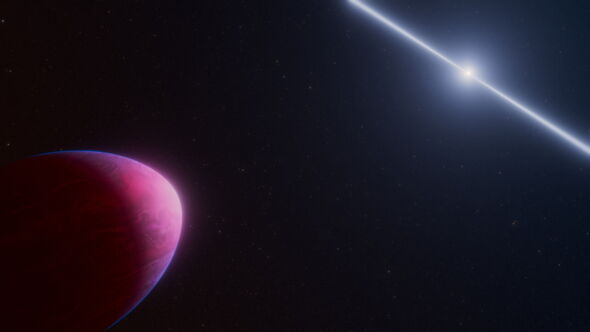
Astronomers using the James Webb Space Telescope (JWST) have made a remarkable discovery of a new exoplanet, designated PSR J2322-2650b, that exhibits an unusual lemon-like shape and an atmosphere unlike any previously observed. This finding has left scientists questioning how such a unique planetary body could exist.
Located approximately 1 million miles from its parent star, a pulsar, PSR J2322-2650b shares a mass similar to that of Jupiter and completes an orbit in about 8 hours. The pulsar, a type of neutron star, is the remnant of a supernova explosion and possesses extreme gravity, which contributes to the planet’s distinctive shape.
Strange Characteristics and Atmosphere
The defining feature of PSR J2322-2650b is its ellipsoid form, likened to a lemon or a football, caused by tidal forces exerted by the pulsar’s intense gravitational pull. According to Peter Gao, a team member from the Carnegie Earth and Planets Laboratory, the discovery has been met with astonishment. “This was an absolute surprise,” Gao stated. “After we received the data, our collective reaction was, ‘What the heck is this?’ It’s extremely different from what we expected.”
The atmosphere of this exoplanet is dominated by helium and carbon, with indications of clouds composed of carbon soot that may condense to form diamonds, creating a surreal environment where carbon rain could occur. Unlike typical exoplanets that often reveal water, methane, and carbon dioxide, this planet displays molecular carbon variants, specifically C3 and C2.
Significance of the Discovery
The uniqueness of this discovery is further enhanced by the ability to observe the planet illuminated by its host star without the star itself being visible. Maya Beleznay, a graduate student at Stanford University, explained, “We get a really pristine spectrum. And we can better study this system in more detail than normal exoplanets.”
PSR J2322-2650b may be classified as part of a “black widow” system, where a rapidly spinning pulsar is paired with a small, low-mass companion that it gradually consumes through intense radiation and high-energy particles. However, in this case, the International Astronomical Union formally recognizes the companion as an exoplanet rather than a star.
The formation process of PSR J2322-2650b raises intriguing questions. Michael Zhang, the principal investigator from the University of Chicago, noted, “Did this thing form like a normal planet? No, because the composition is entirely different. Did it form by stripping the outside of a star, like ‘normal’ black widow systems are formed? Probably not, because nuclear physics does not make pure carbon.”
As research continues, scientists hope to unravel the mysteries surrounding this extraordinary exoplanet and its formation. The findings from the JWST not only expand our understanding of exoplanets but also challenge existing theories about planetary formation and composition.

Packers QB Jordan Love Exits After Head Hit; Concussion Evaluated

First Wheelchair User in Space Captures Global Attention Today

ABC7 Chicago Launches ‘Chicago Proud’ Series Showcasing Local Heroes

Duke vs. Texas Tech: No. 3 Blue Devils Clash at MSG NOW

Oscar Smith’s Johnson Named Offensive Player of the Year

Discover the Top 10 K-Romances of 2025 That Captivated Audiences

Ancient Plague’s Origins Revealed Through Sheep DNA Discovery

Transform Your Home: 9 Tips to Upgrade Style on a Budget

Republicans Clash Over Affordable Care Act Funding Revival

Send Holiday Parcels for £1.99 with New Comparison Service

University of Hawaiʻi Leads $25M AI Project to Monitor Natural Disasters

Interstellar Object 3I/ATLAS Emits Unique Metal Alloy, Says Scientist

Researchers Achieve Fastest Genome Sequencing in Under Four Hours

Iconic Sand Dollar Social Club Listed for $3 Million in Folly Beach

Afghan Refugee Detained by ICE After Asylum Hearing in New York

Peptilogics Secures $78 Million to Combat Prosthetic Joint Infections

McEwen Inc. Secures Tartan Lake Gold Mine Through Acquisition

Jump for Good: San Clemente Pier Fundraiser Allows Legal Leaps
-
 Lifestyle2 weeks ago
Send Holiday Parcels for £1.99 with New Comparison Service
-
Science2 months ago
University of Hawaiʻi Leads $25M AI Project to Monitor Natural Disasters
-
 Science2 months ago
Interstellar Object 3I/ATLAS Emits Unique Metal Alloy, Says Scientist
-
 Science2 months ago
Researchers Achieve Fastest Genome Sequencing in Under Four Hours
-
 Business2 months ago
Iconic Sand Dollar Social Club Listed for $3 Million in Folly Beach
-
 Politics2 months ago
Afghan Refugee Detained by ICE After Asylum Hearing in New York
-
 Health2 months ago
Peptilogics Secures $78 Million to Combat Prosthetic Joint Infections
-
 Business2 months ago
McEwen Inc. Secures Tartan Lake Gold Mine Through Acquisition
-
 Lifestyle2 months ago
Jump for Good: San Clemente Pier Fundraiser Allows Legal Leaps
-
 Science2 months ago
Mars Observed: Detailed Imaging Reveals Dust Avalanche Dynamics
-

 Health2 months ago
Researcher Uncovers Zika Virus Pathway to Placenta Using Nanotubes
-

 Entertainment2 months ago
Jennifer Lopez Addresses A-Rod Split in Candid Interview