
Politics
North Dakota Lawmakers Debate Costs of Treadway’s Inauguration

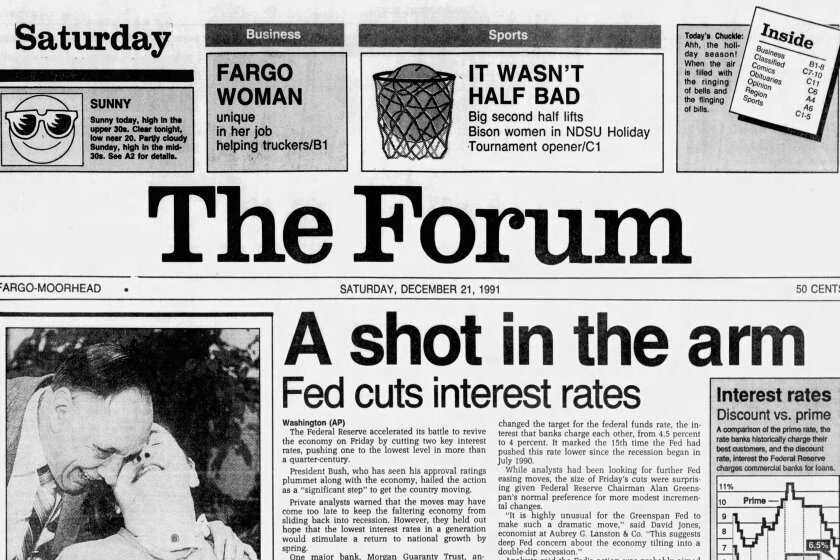
On November 6, 1991, North Dakota higher education officials and lawmakers engaged in a heated debate over the expenses associated with Chancellor Douglas Treadway’s inauguration ceremony. The event, which cost approximately $24,150, was criticized for being overly extravagant, especially in light of recent scrutiny regarding university spending.
The controversy escalated following Treadway’s critique of North Dakota State University’s expensive logo, which was priced at $27,135. Darlene Leinen, president of the North Dakota Board of Higher Education, defended the inauguration, asserting that no state tax dollars or tuition revenues were used to fund the ceremony. Instead, funding was drawn from private sources, primarily alumni organizations and development foundations.
Leinen stated, “I don’t think the two issues are analogous. They’re completely separate.” Despite this defense, some lawmakers expressed strong discontent over the expenditure. Rep. Bob Martinson, a Republican from Bismarck, criticized the use of funds for what he deemed “pomp and circumstance,” suggesting the money would be better allocated to student needs such as scholarships or athletic programs.
Martinson described the inauguration as a “coronation,” questioning the necessity of such a lavish event. “I don’t know what purpose the coronation served,” he remarked. While Treadway did not initiate the planning of the inauguration, Martinson argued that he could have chosen to decline participation.
At a recent meeting of the higher education board, Treadway sought to mitigate public backlash against the logo by labeling it as excessively costly and promoting a more grounded approach to university branding. Leinen, on the other hand, emphasized the importance of the inauguration in unifying the newly formed single university system, stating, “The purpose of it was to inaugurate the system, not to inaugurate Chancellor Treadway.”
Despite the institution’s efforts to present a united front, Martinson maintained that the system remained fragmented, questioning what changes would result from this supposed new beginning. He expressed skepticism about the value of the event, remarking, “It’s a lot of money for certain academics to get together and pat themselves on the back.”
Tradition plays a significant role in higher education inaugurations, with Leinen referencing the 1989 inauguration of NDSU President Jim Ozbun as a precedent. Treadway, who previously served as president of Southwest State University in Minnesota, noted that inaugurations are customary and stated it would have been improper to decline the ceremony, which he viewed as a gesture of welcome.
The celebration, held at the Bismarck Civic Center, attracted an estimated 1,000 to 1,500 guests. Major expenses included $14,542 for meals, $5,794 for printing programs and invitations, and $2,973 for renting the venue. Actual costs were offset by $2,800 collected from meal contributions, bringing the net expense to $24,150.
Funding for the inauguration was shared among state-supported institutions, calculated according to their size. The breakdown included $6,375 from the University of North Dakota, $6,250 from NDSU, and contributions from several smaller colleges. Some foundations expressed reservations about the financial burden, with William Goetz, president of the Dickinson State University Foundation, acknowledging the discomfort surrounding public sentiment towards such expenditures.
Goetz remarked, “Not a lot of pomp and circumstance, but rather one of hunkering down in the trenches and getting the job done.” He further highlighted that for smaller institutions, the decision to contribute felt more like a directive from the board rather than a voluntary choice.
Funding sources varied, with some universities drawing from discretionary accounts. Earl Strinden, head of the University of North Dakota Foundation, explained that although their contribution did not come from scholarship funds, any spending in that account ultimately affects financial aid availability.
Treadway, who assumed his role in the summer of 1991, expressed his commitment to understanding the values of North Dakota’s populace. He stated, “We want to be responsive to the people. We hear what these concerns are and we’re paying attention to them.”
As the debate continues, the implications of spending on higher education ceremonies remain a topic of contention, shedding light on broader issues related to funding and priorities within the state’s university system.

Grandma Shatters Vintage Ornament—Finds Hidden Notes from 1960s!

Urgent: Daughter Struggles with Dad’s Cringey Nicknames for New Wife

Urgent Funeral for Slain Youth Leader Sharif Osman Hadi in Dhaka

Gerald Eugene Stram, Beloved Family Man, Passes Away at 87

Peoples Bancorp of North Carolina Receives Upgraded Hold Rating

Unlocking Peak Performance: Insights from Top Athletes and Scientists

Eagles Secure Back-to-Back NFC East Titles with 29-18 Win

Vigil in London Calls for Release of Palestinian Prisoners

Wall Street Zen Downgrades Palomar Ratings Amid Analyst Activity

Send Holiday Parcels for £1.99 with New Comparison Service

University of Hawaiʻi Leads $25M AI Project to Monitor Natural Disasters

Interstellar Object 3I/ATLAS Emits Unique Metal Alloy, Says Scientist

Researchers Achieve Fastest Genome Sequencing in Under Four Hours

Iconic Sand Dollar Social Club Listed for $3 Million in Folly Beach

Afghan Refugee Detained by ICE After Asylum Hearing in New York

Peptilogics Secures $78 Million to Combat Prosthetic Joint Infections

McEwen Inc. Secures Tartan Lake Gold Mine Through Acquisition

Jump for Good: San Clemente Pier Fundraiser Allows Legal Leaps
-
 Lifestyle2 weeks ago
Send Holiday Parcels for £1.99 with New Comparison Service
-
Science2 months ago
University of Hawaiʻi Leads $25M AI Project to Monitor Natural Disasters
-
 Science2 months ago
Interstellar Object 3I/ATLAS Emits Unique Metal Alloy, Says Scientist
-
 Science2 months ago
Researchers Achieve Fastest Genome Sequencing in Under Four Hours
-
 Business2 months ago
Iconic Sand Dollar Social Club Listed for $3 Million in Folly Beach
-
 Politics2 months ago
Afghan Refugee Detained by ICE After Asylum Hearing in New York
-
 Health2 months ago
Peptilogics Secures $78 Million to Combat Prosthetic Joint Infections
-
 Business2 months ago
McEwen Inc. Secures Tartan Lake Gold Mine Through Acquisition
-
 Lifestyle2 months ago
Jump for Good: San Clemente Pier Fundraiser Allows Legal Leaps
-
 Science2 months ago
Mars Observed: Detailed Imaging Reveals Dust Avalanche Dynamics
-

 Health2 months ago
Researcher Uncovers Zika Virus Pathway to Placenta Using Nanotubes
-
 Entertainment2 months ago
Jennifer Lopez Addresses A-Rod Split in Candid Interview