
World
Trump Advocates Tariffs as Supreme Court Decision Approaches

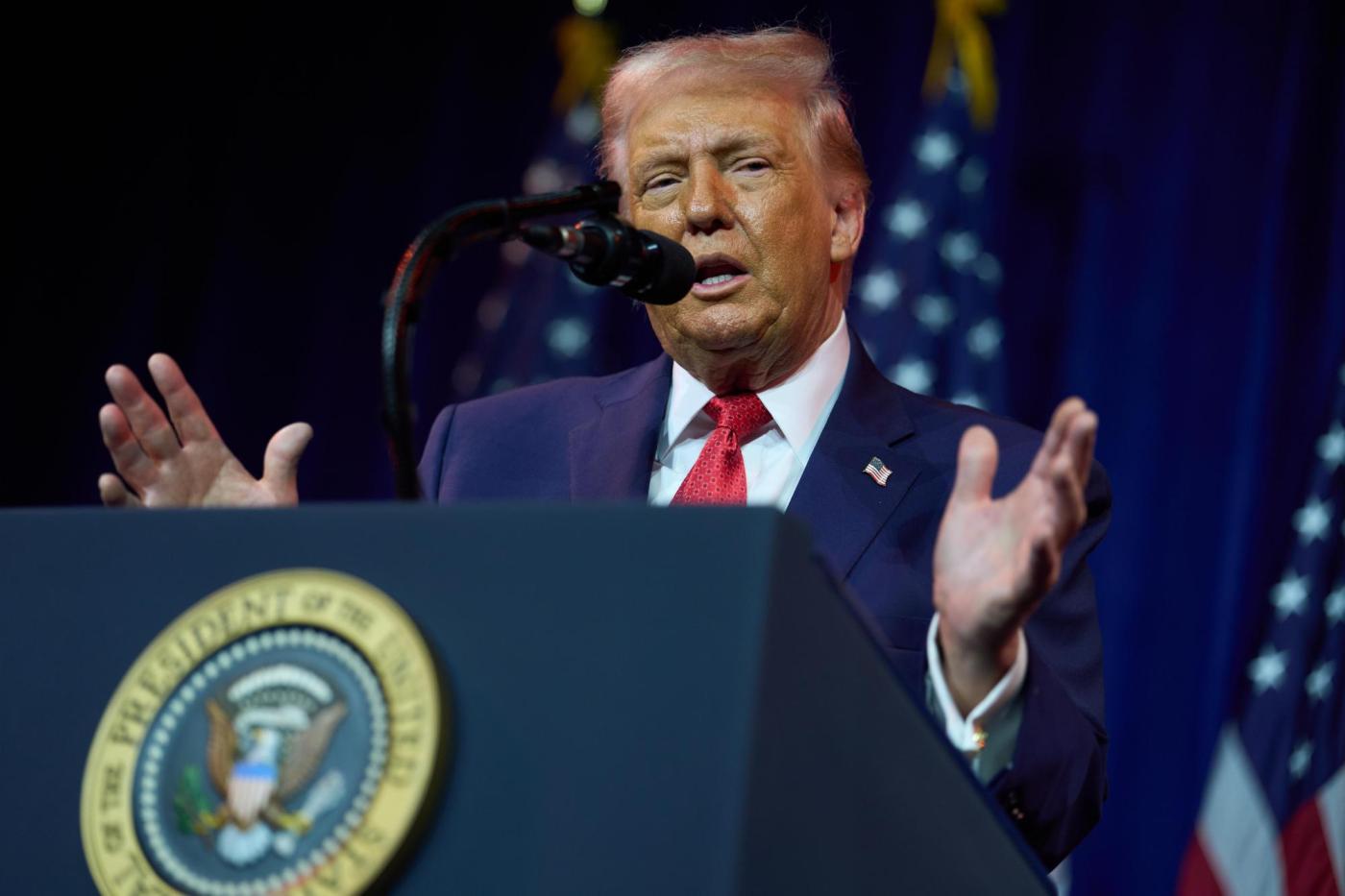
President Donald Trump is amplifying his support for tariffs as the Supreme Court prepares to make a significant ruling on their legality. During a recent retreat with House Republicans, Trump asserted that tariffs are enhancing national security and generating substantial revenue for the United States. “We’re getting rich because of tariffs, by the way,” he stated on Tuesday, claiming that tariffs would soon yield over $650 billion in revenue.
The upcoming Supreme Court decision focuses on Trump’s authority under the International Emergency Economic Powers Act to impose these tariffs. The court heard oral arguments in early November, but a timeline for a ruling remains unclear. Legal experts anticipate that decisions on pending cases, including this one, could be announced shortly.
Economist James Knightley from ING noted that Trump’s recent remarks appear strategically aimed at influencing the court’s opinion. “It does look like it is a concerted effort to convince the Supreme Court that this is needing to happen,” he stated. A ruling against the administration could have implications for existing trade agreements the U.S. has entered into with other countries.
Knightley emphasized that while tariffs are imposed on imports, it is U.S. companies and consumers who ultimately bear the costs. Research from Harvard University and the University of Chicago indicates that approximately 94% of the tariff burden is passed on to American firms. Yet, the overall impact on consumer prices has not been as severe as some analysts feared. Current inflation, measured by the consumer price index, stands at 2.7%.
The effective tariff rate has significantly increased, now hovering around 18%, compared to just 2.5% prior to Trump’s tariff announcements last year. However, the realized rate of tariffs is approximately 11%, suggesting that some importers may be finding ways to mitigate these costs. Knightley pointed out that customs officials are likely overwhelmed and may struggle to thoroughly check every shipment.
In response to tariffs, businesses are adjusting their supply chains and substituting products to minimize financial impact. Knightley noted a phenomenon called “margin squeeze,” where companies absorb higher costs to maintain customer loyalty. “There’s this anxiety, there’s this fear about what it means for household finances and household spending power,” he said, adding that the actual effects of the tariffs may not be as detrimental as previously anticipated.
Federal Reserve Chair Jerome Powell recently indicated that the inflationary effects of tariffs might peak in the first quarter of this year, assuming no new tariff announcements are made. Meanwhile, Mark Hamrick, a senior economic analyst at Bankrate, described tariffs as a type of tax imposed on consumers, contributing to ongoing affordability concerns. “There’s no way that you can construct an argument that says tariffs are a solution for affordability challenges,” he remarked.
Discussions about potential $2,000 rebate checks for Americans, floated by the Trump administration, have met with skepticism. Knightley suggested that these plans could be abandoned if the Supreme Court rules against the tariffs. Hamrick echoed this sentiment, noting that Congress, which controls fiscal policy, appears disinclined to issue such checks.
Despite the pressures created by tariffs, Knightley pointed out that other economic factors are also influencing affordability for Americans. Lower energy prices and reduced housing rents offer some relief, though stagnant wage growth may hinder overall financial improvement for many households.
Both analysts agree that while tariffs have not been as harmful to American consumers as initially feared, they have certainly not provided the benefits required to offset the costs imposed on households. As the Supreme Court decision looms, the implications of these tariffs remain a significant discussion point in the national economic landscape.

Urgent Tax Savings Alert: Maximize Deductions Before April 15

Trump’s Administration Faces Uncertainty Over Government Shutdowns

Cosmic Defects: The Mystery of the Universe’s Missing Anomalies

Rapid City Parks Department Opens Registration for Bocce Leagues

Samsung Galaxy Watch 9 to Feature Larger 435mAh Battery Soon

Two Dead After Student Boats Capsize Off Okinawa Coast

Healthy Choice Wellness Reports Earnings with Mixed Results

Prince Harry Positions Himself as Royal Family’s Image Reviver

All Points North Lodge Achieves FSPHP-ETA Accreditation

Send Holiday Parcels for £1.99 with New Comparison Service

University of Hawaiʻi Leads $25M AI Project to Monitor Natural Disasters

Maui County Reopens Upgraded Lānaʻi Fifth Street Courts Today!

Daily Codeword Puzzle Launches on October 21, 2025

Congresswoman Under Fire for Misleading Epstein Donation Claims

Interstellar Object 3I/ATLAS Emits Unique Metal Alloy, Says Scientist

Trump Vows to Resolve Afghanistan-Pakistan Crisis “Very Quickly”

Charles Darwin’s Address Book Reveals Hidden Aspects of His Life

Rediscovering Chrysler: 5 Overlooked Models from the 1980s
-
 Lifestyle8 months ago
Send Holiday Parcels for £1.99 with New Comparison Service
-
Science9 months ago
University of Hawaiʻi Leads $25M AI Project to Monitor Natural Disasters
-
 Top Stories8 months ago
Maui County Reopens Upgraded Lānaʻi Fifth Street Courts Today!
-
 Entertainment10 months ago
Daily Codeword Puzzle Launches on October 21, 2025
-
 Lifestyle9 months ago
Congresswoman Under Fire for Misleading Epstein Donation Claims
-
 Science10 months ago
Interstellar Object 3I/ATLAS Emits Unique Metal Alloy, Says Scientist
-
 Top Stories9 months ago
Trump Vows to Resolve Afghanistan-Pakistan Crisis “Very Quickly”
-
 Science8 months ago
Charles Darwin’s Address Book Reveals Hidden Aspects of His Life
-
 Lifestyle8 months ago
Rediscovering Chrysler: 5 Overlooked Models from the 1980s
-
 Science7 months ago
Understanding Generation Z: Strategies for Engaging the Workforce
-

 Entertainment10 months ago
Kelly McCreary Discusses Future of Maggie and Winston in Grey’s Anatomy
-

 Top Stories8 months ago
aespa Faces Backlash Over G-Dragon Interaction at 2025 MAMAs