
World
Wall Street Dips as JPMorgan and Delta Begin Earnings Season

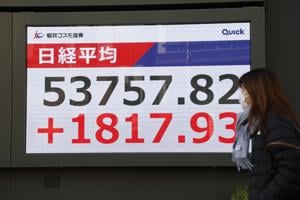
Wall Street experienced a downturn on March 15, 2026, as the latest earnings season commenced with mixed results from major U.S. companies. The S&P 500 index fell by 0.4%, while the Dow Jones Industrial Average dropped 399 points, or 0.8%, at 1:10 p.m. Eastern time. The Nasdaq composite also declined by 0.2%. Both the S&P 500 and the Dow are coming off recent all-time highs, raising expectations for strong profit growth.
Investors are closely monitoring corporate earnings as U.S. companies face pressure to demonstrate robust profitability for the last quarter of 2025. Analysts forecast that firms within the S&P 500 will report an overall earnings per share increase of 8.3% compared to the previous year, according to data from FactSet.
JPMorgan Chase, one of the first major companies to report, posted weaker-than-expected profit and revenue figures, leading to a 3.8% decline in its stock price. This disappointing performance may have stemmed from analysts not updating their estimates following the bank’s acquisition of the Apple Card credit card portfolio. CEO Jamie Dimon expressed a cautiously optimistic view of the U.S. economy, noting, “consumers continue to spend, and businesses generally remain healthy.”
Delta Air Lines also reported its earnings, revealing a stronger profit than anticipated for the end of 2025. Nevertheless, the airline’s stock fell by 3.3% as its revenue fell short of Wall Street expectations, and its profit forecast for 2026 did not meet projections.
In contrast, several health care companies showed positive movements in their stock prices following an industry conference that raised financial forecasts. Notably, Moderna’s stock surged by 13.1%, marking the highest gain in the S&P 500, after the company indicated it expects 2025 revenues to exceed prior estimates. Additionally, Moderna provided updates on several products, including a seasonal flu vaccine that may receive approvals later this year.
Revvity, a life sciences company, saw its stock increase by 2.4% after announcing it anticipates higher profits for 2025, surpassing its earlier forecasts. The firm also reported revenue expectations for the fourth quarter that exceeded analysts’ predictions.
Outside the health sector, L3Harris Technologies’ stock rose by 0.4% following news of its plan to separate its Missile Solutions business into a distinct entity through an initial public offering (IPO). As part of this strategy, the U.S. government has agreed to invest $1 billion in the business, which will convert into common stock during the IPO. L3Harris will retain a controlling interest in the Missile Solutions business post-IPO.
In the bond market, yields remained relatively stable after the inflation report suggested that the Federal Reserve might have the opportunity to reduce its main interest rate at least twice in 2026 to support the job market. Lower interest rates could facilitate cheaper borrowing for U.S. households and potentially boost investment prices, although they may also exacerbate inflation.
According to the latest report, U.S. consumers faced a 2.7% increase in prices for essentials such as gasoline and food last month compared to a year earlier. This figure slightly exceeded economists’ expectations and surpassed the Fed’s 2% inflation target. Nevertheless, a key underlying inflation trend showed signs of improvement, providing the Fed with more flexibility to consider lowering interest rates in the future. Ellen Zentner, chief economic strategist for Morgan Stanley Wealth Management, stated, “We’ve seen this movie before—inflation isn’t reheating, but it remains above target.”
The data contributed to a modest easing in Treasury yields, with the 10-year Treasury dropping to 4.17% from 4.19% late on Monday. The two-year Treasury yield decreased to 3.52% from 3.54%, reflecting market expectations regarding the Fed’s future actions.
Internationally, stock indexes presented a mixed picture, with European and Asian markets displaying varied performance. Japan’s Nikkei 225 index saw a notable rise of 3.1%, attributed in part to gains in technology-related stocks. Investors anticipate that Prime Minister Sanae Takaichi, who took office in October, may leverage her popularity to call for a snap election, aiming to solidify her mandate for increased government spending.
As Wall Street begins to navigate this earnings season, the performance of major companies like JPMorgan and Delta will set the tone for investor sentiment in the coming weeks.

Urgent Tax Savings Alert: Maximize Deductions Before April 15

Trump’s Administration Faces Uncertainty Over Government Shutdowns

Cosmic Defects: The Mystery of the Universe’s Missing Anomalies

Rapid City Parks Department Opens Registration for Bocce Leagues

Samsung Galaxy Watch 9 to Feature Larger 435mAh Battery Soon

Two Dead After Student Boats Capsize Off Okinawa Coast

Healthy Choice Wellness Reports Earnings with Mixed Results

Prince Harry Positions Himself as Royal Family’s Image Reviver

All Points North Lodge Achieves FSPHP-ETA Accreditation

Send Holiday Parcels for £1.99 with New Comparison Service

University of Hawaiʻi Leads $25M AI Project to Monitor Natural Disasters

Maui County Reopens Upgraded Lānaʻi Fifth Street Courts Today!

Daily Codeword Puzzle Launches on October 21, 2025

Congresswoman Under Fire for Misleading Epstein Donation Claims

Interstellar Object 3I/ATLAS Emits Unique Metal Alloy, Says Scientist

Trump Vows to Resolve Afghanistan-Pakistan Crisis “Very Quickly”

Charles Darwin’s Address Book Reveals Hidden Aspects of His Life

Rediscovering Chrysler: 5 Overlooked Models from the 1980s
-
 Lifestyle8 months ago
Send Holiday Parcels for £1.99 with New Comparison Service
-
Science9 months ago
University of Hawaiʻi Leads $25M AI Project to Monitor Natural Disasters
-
 Top Stories8 months ago
Maui County Reopens Upgraded Lānaʻi Fifth Street Courts Today!
-
 Entertainment10 months ago
Daily Codeword Puzzle Launches on October 21, 2025
-
 Lifestyle9 months ago
Congresswoman Under Fire for Misleading Epstein Donation Claims
-
 Science10 months ago
Interstellar Object 3I/ATLAS Emits Unique Metal Alloy, Says Scientist
-
 Top Stories9 months ago
Trump Vows to Resolve Afghanistan-Pakistan Crisis “Very Quickly”
-
 Science8 months ago
Charles Darwin’s Address Book Reveals Hidden Aspects of His Life
-
 Lifestyle8 months ago
Rediscovering Chrysler: 5 Overlooked Models from the 1980s
-

 Science7 months ago
Understanding Generation Z: Strategies for Engaging the Workforce
-

 Entertainment10 months ago
Kelly McCreary Discusses Future of Maggie and Winston in Grey’s Anatomy
-

 Top Stories8 months ago
aespa Faces Backlash Over G-Dragon Interaction at 2025 MAMAs