
Health
Chicago’s Winter Plunge: Swimmers Brave the Cold for Community

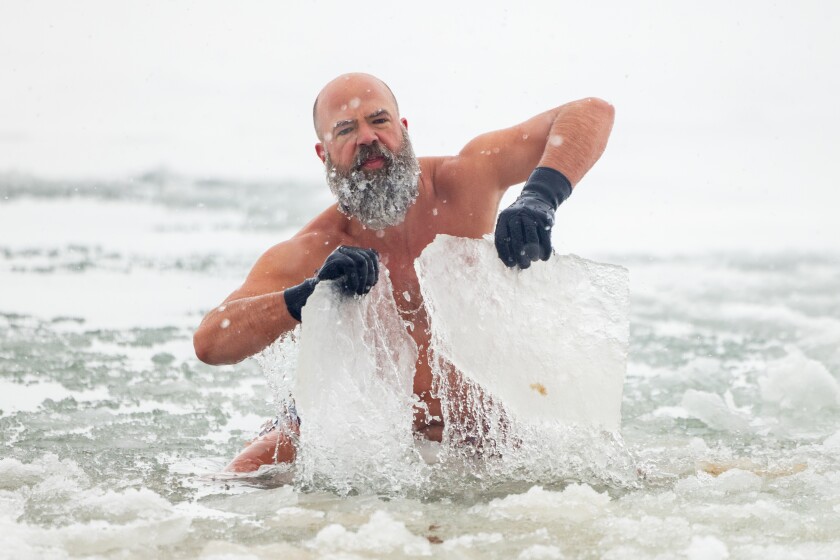
As sub-zero temperatures gripped Chicago, a group of determined winter swimmers took the plunge into the frigid waters of Lake Michigan. Led by local enthusiast George “Iceberg” Miller, the group embraced the extreme cold on a day when many sought refuge indoors. This winter, Miller, a California native who once despised the cold, has committed to daily swims in the lake, fostering a growing community around this unique winter activity.
Miller’s journey began as a recommendation from a yoga instructor, but it has since evolved into a mission to change perceptions of Chicago winters. “Everybody complains about Chicago winters. It’s so cold, yada, yada. Things close down,” he said. Living in Rogers Park, Miller aims to transform Chicago into a winter destination, encouraging residents to embrace the season instead of lamenting it.
On a day marked by a winter storm warning and several inches of snow, Miller, along with his wife Jesy Grose and friends Hayley Kimbrueh and Tom Ashman, braved the icy waters at Oak Street Beach. The air temperature hovered around 18 degrees Fahrenheit, with a wind chill of just 5 degrees. Despite the initial shock, Miller described the experience positively, stating, “It feels really good after the first 30 seconds. It’s terrifying at first, and it’s really cold. But then, a lot of endorphins kick in… all the happy chemicals. So it feels really, really good.”
Research into the health benefits of cold-water immersion suggests potential advantages such as reduced stress and improved sleep. A review of 11 studies published in 2025 noted these benefits, although it did not establish a clear link between cold plunges and mood or immunity enhancements. Miller himself experienced a shift in his mental clarity after his first lake plunge four years ago. “I felt sensations with mental clarity that I think it’s safe to say that I had never experienced before, and I was hooked immediately,” he recalled.
Miller, aged 43 and a leadership coach, encourages others to confront their fears. He believes that embracing such fears can lead to growth and resilience. “I feel afraid every single time, and that’s OK,” he stated. He uses the cold plunge as a method to safely engage with anxiety, noting the importance of understanding personal limits and safety measures.
Preparation is vital for anyone considering a winter swim. Miller advises newcomers to start with gradual exposure to cold water. Without proper acclimatization, the experience can be overwhelming. He emphasizes the necessity of safety protocols, including notifying the Chicago Police Department Marine Unit before plunging. Their presence ensures that the swimmers are monitored during their icy adventure.
Participants wear neoprene boots and gloves to protect against the cold and potential hazards in the water. This gear is essential for preventing injuries that could go unnoticed without proper feeling in the extremities. Miller’s safety rule is clear: never plunge alone. This guideline has fostered a community spirit among winter swimmers, with more than 100 individuals participating in Lake Michigan plunges this winter.
As the group submerges for approximately 15 minutes, they push through the initial shock of the cold. Once they exit the water, they head to a nearby sauna, where warmth and camaraderie await. Miller’s approach to winter swimming not only challenges traditional views of the season but also builds a supportive community among those willing to take the plunge.

Urgent Tax Savings Alert: Maximize Deductions Before April 15

Trump’s Administration Faces Uncertainty Over Government Shutdowns

Cosmic Defects: The Mystery of the Universe’s Missing Anomalies

Rapid City Parks Department Opens Registration for Bocce Leagues

Samsung Galaxy Watch 9 to Feature Larger 435mAh Battery Soon

Two Dead After Student Boats Capsize Off Okinawa Coast

Healthy Choice Wellness Reports Earnings with Mixed Results

Prince Harry Positions Himself as Royal Family’s Image Reviver

All Points North Lodge Achieves FSPHP-ETA Accreditation

Send Holiday Parcels for £1.99 with New Comparison Service

University of Hawaiʻi Leads $25M AI Project to Monitor Natural Disasters

Maui County Reopens Upgraded Lānaʻi Fifth Street Courts Today!

Daily Codeword Puzzle Launches on October 21, 2025

Congresswoman Under Fire for Misleading Epstein Donation Claims

Interstellar Object 3I/ATLAS Emits Unique Metal Alloy, Says Scientist

Trump Vows to Resolve Afghanistan-Pakistan Crisis “Very Quickly”

Charles Darwin’s Address Book Reveals Hidden Aspects of His Life

Rediscovering Chrysler: 5 Overlooked Models from the 1980s
-
 Lifestyle8 months ago
Send Holiday Parcels for £1.99 with New Comparison Service
-
Science9 months ago
University of Hawaiʻi Leads $25M AI Project to Monitor Natural Disasters
-
 Top Stories8 months ago
Maui County Reopens Upgraded Lānaʻi Fifth Street Courts Today!
-
 Entertainment10 months ago
Daily Codeword Puzzle Launches on October 21, 2025
-
 Lifestyle9 months ago
Congresswoman Under Fire for Misleading Epstein Donation Claims
-
 Science10 months ago
Interstellar Object 3I/ATLAS Emits Unique Metal Alloy, Says Scientist
-
 Top Stories9 months ago
Trump Vows to Resolve Afghanistan-Pakistan Crisis “Very Quickly”
-
 Science8 months ago
Charles Darwin’s Address Book Reveals Hidden Aspects of His Life
-
 Lifestyle8 months ago
Rediscovering Chrysler: 5 Overlooked Models from the 1980s
-

 Science7 months ago
Understanding Generation Z: Strategies for Engaging the Workforce
-

 Entertainment10 months ago
Kelly McCreary Discusses Future of Maggie and Winston in Grey’s Anatomy
-

 Top Stories8 months ago
aespa Faces Backlash Over G-Dragon Interaction at 2025 MAMAs