
Science
NOAA Unveils Major Scientific Advancements in 2025 Report

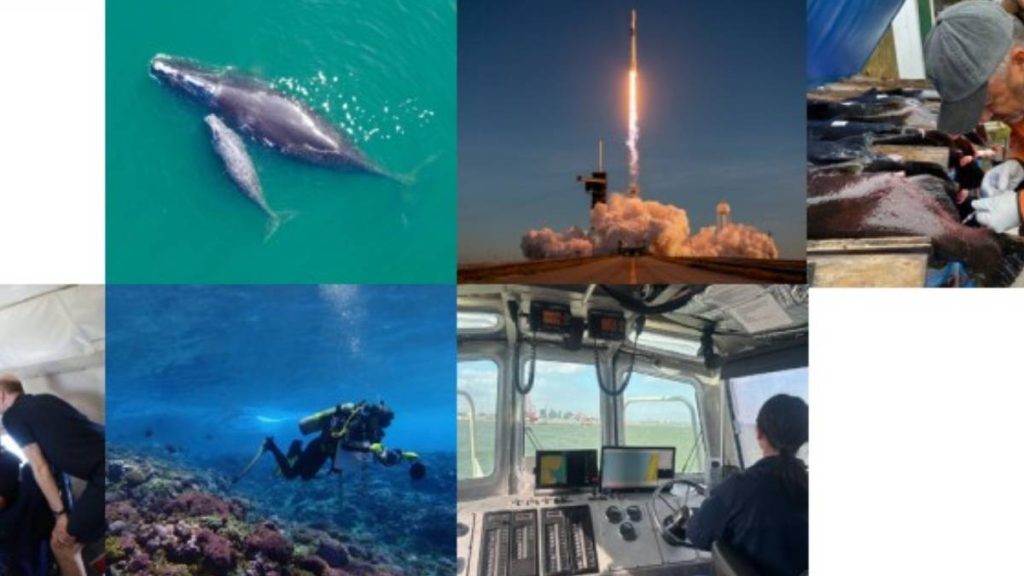
The National Oceanic and Atmospheric Administration (NOAA) has announced significant scientific breakthroughs in its 2025 Science Report, showcasing advancements aimed at improving weather forecasts and understanding environmental impacts. The report details the launch of innovative satellites, deployment of unmanned systems, and research initiatives to enhance the agency’s capacity to address hazardous weather and promote sustainable ocean resources.
Innovative Satellites Enhance Space Weather Monitoring
One of the standout achievements highlighted in the report is the launch of the Space Weather Follow On-Lagrange 1 observatory, America’s first satellite dedicated to continuous operational space weather observations. Launched in September 2025 from the Kennedy Space Center in Florida, the observatory has been renamed to Space weather Observations at L1 to Advance Readiness – 1 (SOLAR-1). This satellite carries advanced instruments, including the Compact Coronagraph-2, designed to provide early warnings of coronal mass ejections and other solar events that may impact Earth.
These space weather phenomena can disrupt astronaut safety, aviation, and electrical power grids, among other critical systems. Data from SOLAR-1 is expected to bolster alerts, warnings, and forecasts issued by NOAA’s Space Weather Prediction Center, benefiting sectors such as agriculture, defense, and human spaceflight.
Rapid Response to California Fires and Ocean Ecosystem Studies
In response to the devastating fires in Los Angeles in 2025, NOAA researchers conducted rapid assessments of the impact on ocean ecosystems along the California coast. By collecting debris and water samples during the crisis, scientists were able to study how fire-related contaminants affect marine life.
This initiative involved altering an ongoing fisheries survey aboard the NOAA Ship Reuben Lasker to gather critical data on the fires’ impact on one of the nation’s most vital marine ecosystems. The findings will provide essential insights into the resilience of marine environments crucial for both commercial and recreational fisheries.
Advanced Technology in Hurricane Data Collection
NOAA has also made strides in hurricane research, utilizing cutting-edge technology to gather data in areas that are typically difficult to access during storms. In 2025, the agency tested various instruments, including the Black Swift S0 drone, which was deployed from NOAA’s WP-3D Hurricane Hunter aircraft. This drone is designed to collect atmospheric data from the lowest levels of tropical cyclones.
The Skyfora StreamSonde, another innovative instrument tested, was able to record a wind gust of 252 mph during Hurricane Melissa, marking the strongest wind ever documented by a dropsonde. Additionally, NOAA employed the Dragoon Coriolis, a long-endurance unmanned aircraft capable of being launched remotely into hurricanes, enhancing real-time data collection efforts.
Artificial Intelligence Supports Marine Conservation
In a groundbreaking initiative, NOAA has launched its Geospatial Artificial Intelligence for Animals program, which uses advanced satellite technology and artificial intelligence to monitor marine life from space. This program aims to assist in the conservation of the critically endangered North Atlantic right whale, whose population is estimated at fewer than 380 individuals.
By detecting and validating potential whale locations, scientists can implement protective measures without imposing broad restrictions that might negatively affect maritime industries. This project exemplifies NOAA’s commitment to public-private partnerships, collaborating with organizations such as the Naval Research Laboratory and Microsoft AI for Good.
Autonomous Vehicles Enhance Environmental Monitoring
In a further demonstration of technological innovation, NOAA and its partners deployed the autonomous surface vehicle known as Seasats Lightfish in 2025. This vehicle was launched off the coast of Washington state to detect harmful algal blooms before they can adversely affect human health and local fisheries.
Seasats Lightfish is capable of traveling up to 100 nautical miles on a single solar charge, significantly increasing the frequency and reducing the costs of offshore sampling compared to traditional methods. The vehicle’s ability to monitor the presence of phytoplankton, like Pseudo-nitzchia, which can produce harmful neurotoxins, underscores NOAA’s efforts to safeguard both marine ecosystems and public health.
Through these initiatives, the 2025 NOAA Science Report underscores the agency’s dedication to advancing scientific knowledge while mitigating the impacts of climate change and environmental hazards on communities and industries worldwide.

Urgent Tax Savings Alert: Maximize Deductions Before April 15

Trump’s Administration Faces Uncertainty Over Government Shutdowns

Cosmic Defects: The Mystery of the Universe’s Missing Anomalies

Rapid City Parks Department Opens Registration for Bocce Leagues

Samsung Galaxy Watch 9 to Feature Larger 435mAh Battery Soon

Two Dead After Student Boats Capsize Off Okinawa Coast

Healthy Choice Wellness Reports Earnings with Mixed Results

Prince Harry Positions Himself as Royal Family’s Image Reviver

All Points North Lodge Achieves FSPHP-ETA Accreditation

Send Holiday Parcels for £1.99 with New Comparison Service

University of Hawaiʻi Leads $25M AI Project to Monitor Natural Disasters

Maui County Reopens Upgraded Lānaʻi Fifth Street Courts Today!

Daily Codeword Puzzle Launches on October 21, 2025

Congresswoman Under Fire for Misleading Epstein Donation Claims

Interstellar Object 3I/ATLAS Emits Unique Metal Alloy, Says Scientist

Trump Vows to Resolve Afghanistan-Pakistan Crisis “Very Quickly”

Charles Darwin’s Address Book Reveals Hidden Aspects of His Life

Rediscovering Chrysler: 5 Overlooked Models from the 1980s
-
 Lifestyle8 months ago
Send Holiday Parcels for £1.99 with New Comparison Service
-
Science9 months ago
University of Hawaiʻi Leads $25M AI Project to Monitor Natural Disasters
-
 Top Stories8 months ago
Maui County Reopens Upgraded Lānaʻi Fifth Street Courts Today!
-
 Entertainment10 months ago
Daily Codeword Puzzle Launches on October 21, 2025
-
 Lifestyle9 months ago
Congresswoman Under Fire for Misleading Epstein Donation Claims
-
 Science10 months ago
Interstellar Object 3I/ATLAS Emits Unique Metal Alloy, Says Scientist
-
 Top Stories9 months ago
Trump Vows to Resolve Afghanistan-Pakistan Crisis “Very Quickly”
-
 Science8 months ago
Charles Darwin’s Address Book Reveals Hidden Aspects of His Life
-
 Lifestyle8 months ago
Rediscovering Chrysler: 5 Overlooked Models from the 1980s
-

 Science7 months ago
Understanding Generation Z: Strategies for Engaging the Workforce
-

 Entertainment10 months ago
Kelly McCreary Discusses Future of Maggie and Winston in Grey’s Anatomy
-

 Entertainment7 months ago
Landmark Shift as Iconic Anime Series Concludes After 26 Years