
Science
Charles Darwin’s Address Book Reveals Hidden Aspects of His Life

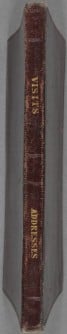
The National University of Singapore (NUS) has made a significant contribution to historical scholarship by publishing a previously unseen document: Charles Darwin‘s personal Address Book. This publication, available on the Darwin Online project website, offers a unique look into the life and work of the renowned scientist.
The Address Book, a small leather notebook spanning just 48 pages, contains approximately 500 entries. It was initiated by Darwin’s wife, Emma Darwin, shortly after their marriage in January 1839. Following their move to Down, a village in Kent, in 1842, Darwin continued to document contacts throughout his life. This notebook provides insights not only into his personal relationships but also into the broader social network that supported his scientific endeavors.
Uncovering a Rich Social History
One of the most intriguing aspects of the Address Book is the wealth of individuals and businesses it references, many of whom have not been documented in previous literature about Darwin. While the Darwin Correspondence Project has produced 30 volumes detailing 15,000 letters, the Address Book reveals connections to numerous others that have remained largely unnoticed. This includes pigeon breeders, tradesmen, and even the optician who provided eyewear to Queen Victoria and later to Winston Churchill.
Among the entries are unique references to articles from the Gardeners’ Chronicle, which Darwin used for research, and practical notes such as recipes for cleaning animal skeletons and preparing rat poison. The Address Book also contains valuable information regarding alternative medical treatments, product prices, and the daily life of a scientist in the 19th century.
Notably, one entry points to Alfred Russel Wallace’s shipping agent in Singapore, highlighting a connection between Darwin and Wallace during a pivotal time in the history of evolutionary theory. In 1858, both men independently conceived the theory of evolution by natural selection, and their ideas were publicly shared together for the first time.
Preservation and Accessibility of Historical Documents
The Address Book remained with the Darwin family until after his death, with most of his papers donated to Cambridge University Library in 1942. By 1948, the Address Book was transferred to Down House, where it is preserved today. Dr. John van Wyhe, a historian of science at NUS, emphasized the importance of this publication, stating, “It’s incredible that this little treasure-trove of details by Darwin has remained unpublished until now. It offers fascinating new insights into his life and the way he worked.”
Since its inception in 2005, the Darwin Online project has aimed to make Darwin’s work accessible to the public, reconstructing his complete library and transcribing virtually all of his publications. The Address Book is now part of that effort, providing a lens through which the public can better understand the personal side of one of history’s most influential scientists.
Those interested in exploring this newly available resource can find the Address Book online at the Darwin Online project website.

Urgent Tax Savings Alert: Maximize Deductions Before April 15

Trump’s Administration Faces Uncertainty Over Government Shutdowns

Cosmic Defects: The Mystery of the Universe’s Missing Anomalies

Rapid City Parks Department Opens Registration for Bocce Leagues

Samsung Galaxy Watch 9 to Feature Larger 435mAh Battery Soon

Two Dead After Student Boats Capsize Off Okinawa Coast

Healthy Choice Wellness Reports Earnings with Mixed Results

Prince Harry Positions Himself as Royal Family’s Image Reviver

All Points North Lodge Achieves FSPHP-ETA Accreditation

Send Holiday Parcels for £1.99 with New Comparison Service

University of Hawaiʻi Leads $25M AI Project to Monitor Natural Disasters

Maui County Reopens Upgraded Lānaʻi Fifth Street Courts Today!

Interstellar Object 3I/ATLAS Emits Unique Metal Alloy, Says Scientist

Kelly McCreary Discusses Future of Maggie and Winston in Grey’s Anatomy

Daily Codeword Puzzle Launches on October 21, 2025

Congresswoman Under Fire for Misleading Epstein Donation Claims

Trump Vows to Resolve Afghanistan-Pakistan Crisis “Very Quickly”

Researchers Achieve Fastest Genome Sequencing in Under Four Hours
-
 Lifestyle4 months ago
Send Holiday Parcels for £1.99 with New Comparison Service
-
Science5 months ago
University of Hawaiʻi Leads $25M AI Project to Monitor Natural Disasters
-
 Top Stories4 months ago
Maui County Reopens Upgraded Lānaʻi Fifth Street Courts Today!
-
 Science6 months ago
Interstellar Object 3I/ATLAS Emits Unique Metal Alloy, Says Scientist
-
 Entertainment6 months ago
Kelly McCreary Discusses Future of Maggie and Winston in Grey’s Anatomy
-
 Entertainment6 months ago
Daily Codeword Puzzle Launches on October 21, 2025
-
 Lifestyle5 months ago
Congresswoman Under Fire for Misleading Epstein Donation Claims
-
 Top Stories5 months ago
Trump Vows to Resolve Afghanistan-Pakistan Crisis “Very Quickly”
-
 Science6 months ago
Researchers Achieve Fastest Genome Sequencing in Under Four Hours
-
 Business6 months ago
Iconic Sand Dollar Social Club Listed for $3 Million in Folly Beach
-

 Politics6 months ago
Afghan Refugee Detained by ICE After Asylum Hearing in New York
-

 Health6 months ago
Peptilogics Secures $78 Million to Combat Prosthetic Joint Infections