
Science
Chang’e-6 Returns Unique Lunar Samples from Far Side, Reveals Cohesion

On June 25, 2024, China’s Chang’e-6 mission successfully returned lunar soil samples from the South Pole–Aitken Basin, marking a significant achievement in lunar exploration. The samples, weighing 1,935.3 grams, offer critical insights into the geological composition of the moon’s far side, an area that has remained largely unexplored compared to the near side.
Previous missions, including Apollo, Luna, and Chang’e-5, gathered around 383 kilograms of lunar material from the near side. However, the absence of far-side samples has hindered comprehensive studies of its unique geological history. The return of these new samples is expected to bridge the gap between orbital remote sensing and ground-truth measurements, providing a clearer understanding of lunar evolution.
Insights into Lunar Soil Properties
The chief designer of the Chang’e-6 mission, Hu Hao, noted that the samples exhibited “slightly more viscous and somewhat clumpier” characteristics compared to the looser material collected by Chang’e-5. To explore this phenomenon further, a research team led by Prof. Qi Shengwen from the Institute of Geology and Geophysics of the Chinese Academy of Sciences conducted experiments to measure the angle of repose of the lunar soil. This parameter is vital in understanding the flowability of granular materials.
Published in Nature Astronomy, the study revealed that the soil from Chang’e-6 displays a significantly higher angle of repose than near-side samples. This indicates a flow behavior consistent with cohesive soils. The researchers ruled out magnetic and cementation effects as contributing factors, finding only trace amounts of magnetic minerals and no clay minerals in the samples.
Instead, the elevated angle of repose was attributed to three main interparticle forces: friction, van der Waals forces, and electrostatic forces. As particle size decreases, the effects of van der Waals and electrostatic forces become more pronounced. Utilizing the D 60 metric, which measures particle diameter at which 60% of the sample is finer, the team identified a critical size threshold of approximately 100 micrometers. Below this size, fine non-clay mineral particles start to show cohesive behavior.
Unique Characteristics of Chang’e-6 Samples
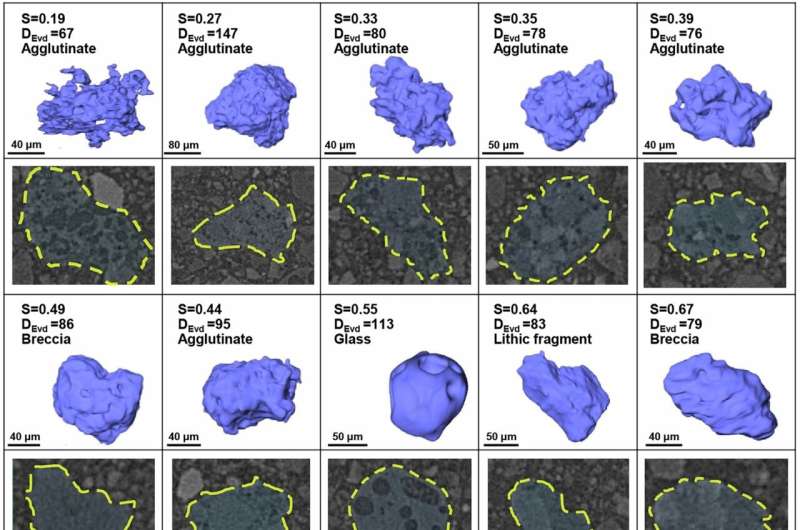
High-resolution CT imaging revealed that the Chang’e-6 samples have a D 60 of only 48.4 micrometers, indicating they are considerably finer and more irregularly shaped than near-side soils, with lower particle sphericity. “This is unusual,” remarked Prof. Qi. “Finer particles are typically more spherical. Despite being fine-grained, Chang’e-6 soil displays more complex particle morphologies.”
Two factors may contribute to this phenomenon: a higher feldspar content of approximately 32.6%, which is prone to fragmentation, and more intense space weathering on the far side of the moon. These textural and morphological characteristics strengthen interparticle forces, resulting in the observed high cohesion of the lunar soil.
This groundbreaking study provides the first systematic explanation of the cohesive behavior of lunar soil from a granular mechanics perspective, paving the way for future research on the physical properties of far-side regolith. As lunar exploration advances, the findings from the Chang’e-6 mission may significantly enhance our understanding of the moon’s geological history and evolution.
More information can be found in the article by Shengwen Qi et al titled “Strongly cohesive lunar soil identified at the Chang’e-6 landing site,” published in Nature Astronomy (2025). DOI: 10.1038/s41550-025-02715-3.

Urgent Tax Savings Alert: Maximize Deductions Before April 15

Trump’s Administration Faces Uncertainty Over Government Shutdowns

Cosmic Defects: The Mystery of the Universe’s Missing Anomalies

Rapid City Parks Department Opens Registration for Bocce Leagues

Samsung Galaxy Watch 9 to Feature Larger 435mAh Battery Soon

Two Dead After Student Boats Capsize Off Okinawa Coast

Healthy Choice Wellness Reports Earnings with Mixed Results

Prince Harry Positions Himself as Royal Family’s Image Reviver

All Points North Lodge Achieves FSPHP-ETA Accreditation

Send Holiday Parcels for £1.99 with New Comparison Service

University of Hawaiʻi Leads $25M AI Project to Monitor Natural Disasters

Maui County Reopens Upgraded Lānaʻi Fifth Street Courts Today!

Daily Codeword Puzzle Launches on October 21, 2025

Congresswoman Under Fire for Misleading Epstein Donation Claims

Interstellar Object 3I/ATLAS Emits Unique Metal Alloy, Says Scientist

Trump Vows to Resolve Afghanistan-Pakistan Crisis “Very Quickly”

Charles Darwin’s Address Book Reveals Hidden Aspects of His Life

Rediscovering Chrysler: 5 Overlooked Models from the 1980s
-
 Lifestyle8 months ago
Send Holiday Parcels for £1.99 with New Comparison Service
-
Science9 months ago
University of Hawaiʻi Leads $25M AI Project to Monitor Natural Disasters
-
 Top Stories8 months ago
Maui County Reopens Upgraded Lānaʻi Fifth Street Courts Today!
-
 Entertainment10 months ago
Daily Codeword Puzzle Launches on October 21, 2025
-
 Lifestyle9 months ago
Congresswoman Under Fire for Misleading Epstein Donation Claims
-
 Science10 months ago
Interstellar Object 3I/ATLAS Emits Unique Metal Alloy, Says Scientist
-
 Top Stories9 months ago
Trump Vows to Resolve Afghanistan-Pakistan Crisis “Very Quickly”
-
 Science8 months ago
Charles Darwin’s Address Book Reveals Hidden Aspects of His Life
-
 Lifestyle8 months ago
Rediscovering Chrysler: 5 Overlooked Models from the 1980s
-

 Science7 months ago
Understanding Generation Z: Strategies for Engaging the Workforce
-

 Entertainment10 months ago
Kelly McCreary Discusses Future of Maggie and Winston in Grey’s Anatomy
-

 Top Stories8 months ago
aespa Faces Backlash Over G-Dragon Interaction at 2025 MAMAs