
World
Bill Gates Invests in Lab-Made Butter That Cuts Emissions

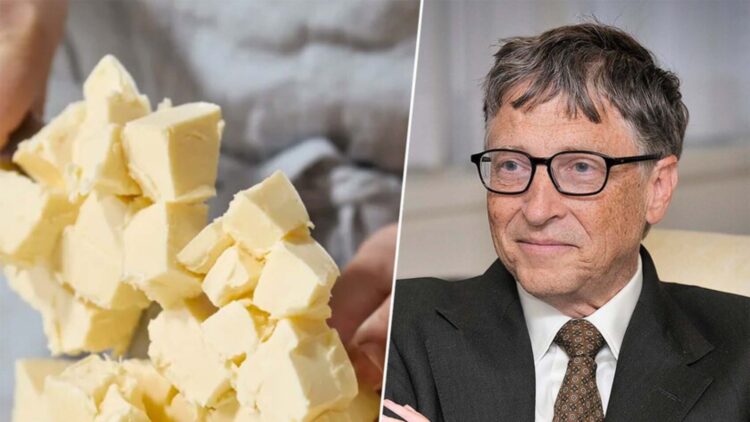
A groundbreaking development in food production has emerged as the company Savor, backed by Orca Sciences, unveils a method for creating butter without traditional agricultural processes. This innovative approach claims to replicate the taste and texture of conventional butter while significantly reducing carbon emissions associated with its production.
Savor’s lab-made butter is produced using advanced biochemical processes that convert carbon dioxide from the atmosphere and hydrogen from water into edible fats. This method has been validated by researchers at the University of California, Irvine, who published their findings in the journal Nature Sustainability. According to the study, this new production technique emits less than one-third of the CO2 emissions generated by conventional agriculture, a significant reduction that aligns with global sustainability goals.
Steven Davis, the lead author of the study, emphasized the environmental benefits of this process. He stated, “The synthesis of food without agricultural raw materials could prevent enormous amounts of emissions and protect the planet’s biodiverse lands.” This innovative method eliminates the need for livestock and agricultural land, offering a promising alternative to conventional food production.
Bill Gates, a prominent investor in Savor, shared insights on his blog about the project’s potential. He noted that the lab-created butter “does not release greenhouse gases and uses less than one-thousandth of the water required by traditional agriculture.” Gates described it as a “sustainable, scalable, and delicious” option, asserting that its taste is comparable to real butter because, chemically, it is identical.
Revolutionizing Food Production
The vision behind Savor is to create food without the reliance on traditional farming methods. The molecular structure of their product mirrors that of real butter, allowing for a seamless transition to a more sustainable food source. The implications of this innovation extend beyond butter, as the company is also developing fats that can replicate those found in meat, milk, and palm oil, all while striving for a “farm-free” food system.
This ambitious project highlights a shift in how food may be produced in the future. The ability to generate fats from basic elements like CO2 and water opens up a world where food production is less dependent on climate conditions, soil health, and animal husbandry. Davis further explained, “At any scale, this would ease the competition between ecosystems and agriculture.”
Despite the promise of this technology, the current costs associated with lab-produced food are high. However, researchers believe that as production scales up, the economic viability of these methods will improve in the near to medium term. Davis remarked, “The beauty of fats is that it’s all chemistry: they can be produced under high pressures and temperatures with great efficiency.”
Environmental and Economic Impact
The potential impact of producing butter from CO2 goes beyond curiosity; it raises the prospect of a future where food can be made sustainably without harming the environment. If companies like Savor can effectively reduce production costs, the economic and environmental implications could be substantial.
This new approach to food production represents a significant step towards addressing the pressing challenges of climate change and resource depletion. With global populations rising and traditional agricultural practices facing increasing scrutiny, the development of lab-made foods could play a crucial role in ensuring food security while protecting the planet.
As Savor continues to innovate, the world watches closely to see if this vision of sustainable, lab-created butter can become a reality on grocery store shelves. The journey towards a more sustainable food system is just beginning, and innovations like this could be pivotal in shaping the future of food production.

Urgent Tax Savings Alert: Maximize Deductions Before April 15

Trump’s Administration Faces Uncertainty Over Government Shutdowns

Cosmic Defects: The Mystery of the Universe’s Missing Anomalies

Rapid City Parks Department Opens Registration for Bocce Leagues

Samsung Galaxy Watch 9 to Feature Larger 435mAh Battery Soon

Two Dead After Student Boats Capsize Off Okinawa Coast

Healthy Choice Wellness Reports Earnings with Mixed Results

Prince Harry Positions Himself as Royal Family’s Image Reviver

All Points North Lodge Achieves FSPHP-ETA Accreditation

Send Holiday Parcels for £1.99 with New Comparison Service

University of Hawaiʻi Leads $25M AI Project to Monitor Natural Disasters

Maui County Reopens Upgraded Lānaʻi Fifth Street Courts Today!

Daily Codeword Puzzle Launches on October 21, 2025

Congresswoman Under Fire for Misleading Epstein Donation Claims

Interstellar Object 3I/ATLAS Emits Unique Metal Alloy, Says Scientist

Trump Vows to Resolve Afghanistan-Pakistan Crisis “Very Quickly”

Charles Darwin’s Address Book Reveals Hidden Aspects of His Life

Rediscovering Chrysler: 5 Overlooked Models from the 1980s
-
 Lifestyle8 months ago
Send Holiday Parcels for £1.99 with New Comparison Service
-
Science9 months ago
University of Hawaiʻi Leads $25M AI Project to Monitor Natural Disasters
-
 Top Stories8 months ago
Maui County Reopens Upgraded Lānaʻi Fifth Street Courts Today!
-
 Entertainment10 months ago
Daily Codeword Puzzle Launches on October 21, 2025
-
 Lifestyle9 months ago
Congresswoman Under Fire for Misleading Epstein Donation Claims
-
 Science10 months ago
Interstellar Object 3I/ATLAS Emits Unique Metal Alloy, Says Scientist
-
 Top Stories9 months ago
Trump Vows to Resolve Afghanistan-Pakistan Crisis “Very Quickly”
-
 Science8 months ago
Charles Darwin’s Address Book Reveals Hidden Aspects of His Life
-
 Lifestyle8 months ago
Rediscovering Chrysler: 5 Overlooked Models from the 1980s
-

 Science7 months ago
Understanding Generation Z: Strategies for Engaging the Workforce
-

 Entertainment10 months ago
Kelly McCreary Discusses Future of Maggie and Winston in Grey’s Anatomy
-

 Top Stories8 months ago
aespa Faces Backlash Over G-Dragon Interaction at 2025 MAMAs