
Health
New Glowing Sensor Revolutionizes DNA Damage Monitoring in Cells

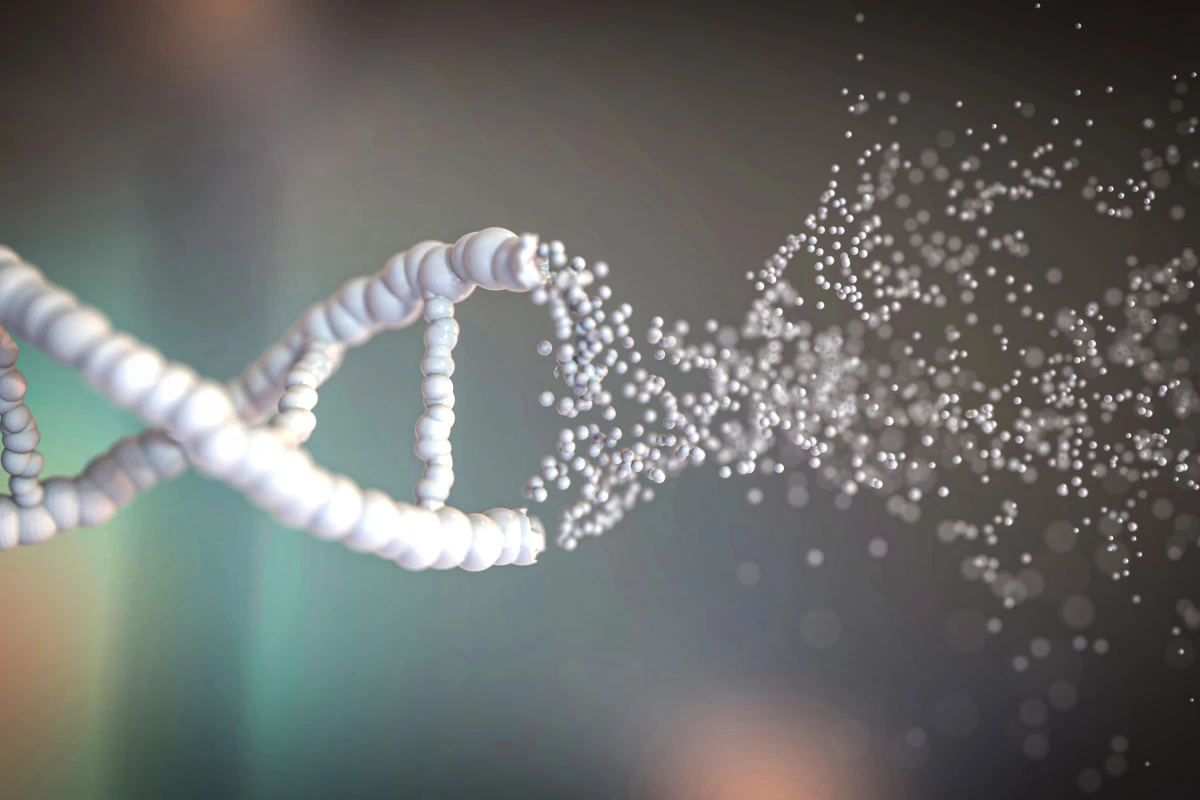
Researchers at Utrecht University have developed a groundbreaking tool that enables real-time monitoring of DNA damage within cells. This innovative sensor, which emits a glowing signal, allows scientists to observe how cells respond to and repair double strand breaks, one of the most severe forms of DNA damage. Understanding this process is crucial, as ineffective DNA repair systems can lead to various diseases, including cancer.
Double strand breaks pose a significant threat to genomic stability and trigger immediate cellular repair mechanisms. Until now, scientists faced challenges in visualizing these repairs as existing methods typically required halting and preserving cells, resulting in static snapshots rather than dynamic observations of the repair process. The new technology marks a significant advancement in this field.
Revolutionary Real-Time Monitoring
The glowing sensors developed by the research team provide a live view of DNA damage and repair within cells. Lead researcher Tuncay Baubec describes the unique capabilities of the sensor, stating, “Our sensor is different. It’s built from parts taken from a natural protein that the cell already uses.” This design enables the sensor to attach and detach from the damage site autonomously, thereby revealing the genuine behavior of the cell during the repair process.
The tool functions effectively in both fixed and live cells, acting as an antibody substitute in standard laboratory techniques. By utilizing the Cas9 protein to create targeted DNA breaks, researchers demonstrated that the sensor could detect individual breaks even in densely packed heterochromatin. This versatility makes it a valuable resource for studying DNA repair in various chromatin environments.
Applications and Implications for Research
The sensor operates using a glowing tag connected to a small protein domain that interacts briefly with broken DNA. This binding does not interfere with the natural repair process, allowing researchers to monitor DNA damage in living cells and organisms. The team successfully tested the sensor in the common model organism, the nematode worm, revealing natural DNA breaks during its development. This indicates that the sensor’s application extends beyond laboratory conditions, offering insights into DNA damage in real biological systems.
Additionally, the sensor’s design allows it to be linked with other molecules, enabling scientists to map the locations of DNA breaks, track the proteins that respond to damage, and even manipulate damaged DNA within the nucleus. Baubec elaborates on the potential impact of this tool on medical research, stating, “Right now, clinical researchers often use antibodies to assess this. Our tool could make these tests cheaper, faster, and more accurate.”
The study detailing this innovative technology has been published in the journal Nature Communications. The advancement represents a significant step forward in molecular biology, offering new avenues for understanding DNA repair mechanisms and their implications for human health.

Urgent Tax Savings Alert: Maximize Deductions Before April 15

Trump’s Administration Faces Uncertainty Over Government Shutdowns

Cosmic Defects: The Mystery of the Universe’s Missing Anomalies

Rapid City Parks Department Opens Registration for Bocce Leagues

Samsung Galaxy Watch 9 to Feature Larger 435mAh Battery Soon

Two Dead After Student Boats Capsize Off Okinawa Coast

Healthy Choice Wellness Reports Earnings with Mixed Results

Prince Harry Positions Himself as Royal Family’s Image Reviver

All Points North Lodge Achieves FSPHP-ETA Accreditation

Send Holiday Parcels for £1.99 with New Comparison Service

University of Hawaiʻi Leads $25M AI Project to Monitor Natural Disasters

Maui County Reopens Upgraded Lānaʻi Fifth Street Courts Today!

Daily Codeword Puzzle Launches on October 21, 2025

Congresswoman Under Fire for Misleading Epstein Donation Claims

Interstellar Object 3I/ATLAS Emits Unique Metal Alloy, Says Scientist

Trump Vows to Resolve Afghanistan-Pakistan Crisis “Very Quickly”

Charles Darwin’s Address Book Reveals Hidden Aspects of His Life

Rediscovering Chrysler: 5 Overlooked Models from the 1980s
-
 Lifestyle8 months ago
Send Holiday Parcels for £1.99 with New Comparison Service
-
Science9 months ago
University of Hawaiʻi Leads $25M AI Project to Monitor Natural Disasters
-
 Top Stories8 months ago
Maui County Reopens Upgraded Lānaʻi Fifth Street Courts Today!
-
 Entertainment10 months ago
Daily Codeword Puzzle Launches on October 21, 2025
-
 Lifestyle9 months ago
Congresswoman Under Fire for Misleading Epstein Donation Claims
-
 Science10 months ago
Interstellar Object 3I/ATLAS Emits Unique Metal Alloy, Says Scientist
-
 Top Stories9 months ago
Trump Vows to Resolve Afghanistan-Pakistan Crisis “Very Quickly”
-
 Science9 months ago
Charles Darwin’s Address Book Reveals Hidden Aspects of His Life
-
 Lifestyle8 months ago
Rediscovering Chrysler: 5 Overlooked Models from the 1980s
-

 Science7 months ago
Understanding Generation Z: Strategies for Engaging the Workforce
-

 Entertainment10 months ago
Kelly McCreary Discusses Future of Maggie and Winston in Grey’s Anatomy
-

 Top Stories8 months ago
aespa Faces Backlash Over G-Dragon Interaction at 2025 MAMAs