
Health
New Robotic Therapy Offers Hope for Children with Cerebral Palsy

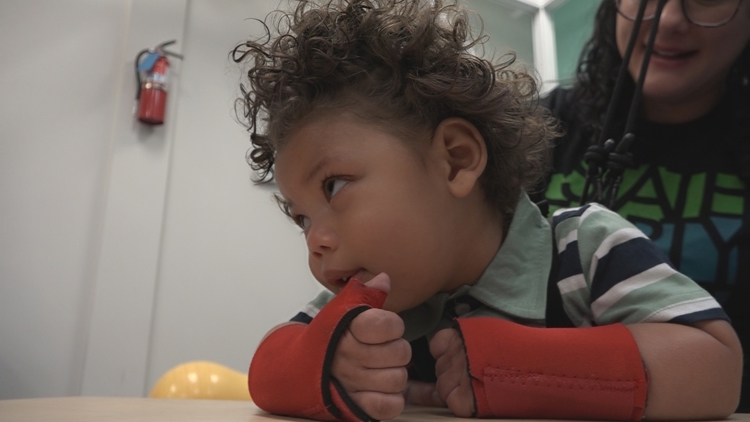
In Phoenix, Arizona, a groundbreaking therapy session is transforming the lives of children with cerebral palsy. At UCP of Central Arizona’s downtown east campus, Gigi Smith and her 15-month-old son Eren are working with physical therapist Laura Graziano to utilize the innovative “Baby G” Early Mobilization System. This robotic trainer is designed specifically for infants and toddlers, providing critical support for those with motor impairments.
At six months old, Eren was diagnosed with cerebral palsy, a condition impacting his body’s functioning due to brain damage. Gigi recalls the difficult conversation with the neurologist, who conveyed a bleak outlook: “He said that my son would not walk or talk and just not to expect much from him.” Despite this prognosis, Gigi chose to focus on Eren’s strengths. “He’s laughing, communicating, and developing relationships,” she noted. “He can bear his own body weight.”
Transformative Technology in Therapy
As an advocate for early diagnosis and intervention, Gigi has embraced the potential of the Baby G system in Eren’s therapy. “It’s a dream, because we get to work on all the things that we might be doing already, but in a way that really supports the kiddo to reach the goals that they’re working on too,” said Graziano. She has witnessed remarkable progress in Eren and other children using the system. “Being able to see him even initiate the smallest of things, which are really huge milestones, has been incredible,” she added.
The Baby G system incorporates a robotic body-weight support mechanism within a 3D play space, enabling infants as young as six months to practice balance and motor skills in a secure environment. UCP of Central Arizona is the world’s first therapy clinic to implement this technology, marking a significant advancement in pediatric physical therapy. The system helps children like Eren learn essential movements such as sitting, crawling, standing, and eventually walking.
“He’s a miracle every day,” Gigi expressed. “Every session that we have, he does something new.” The Baby G system provides a life-changing resource for families facing similar challenges, and Gigi is grateful that her insurance covers the costs associated with it. “He uses every limb of his body, and he’s trying so hard,” she stated. “He was able to stand on his own two feet and take a couple of steps, so it gives me a lot of hope.”
A Vision for the Future
The investment in the Baby G system was made possible through a generous contribution of nearly $400,000 from Thunderbirds Charities and the Arizona Board of Visitors, enabling the clinic to provide this innovative therapy to children in need.
For Gigi, hope is the most vital aspect of Eren’s journey. “He’s going to be up and walking,” she asserted. “I have hope for him… I’m not going to put a rush on it, but I can see it in his future, and it’s exciting.” As families like Gigi’s look to the future, the Baby G system offers not just therapy, but a renewed sense of possibility for children with cerebral palsy.
For more information about the Baby G system, interested families can visit the UCP of Central Arizona’s website.

Urgent Tax Savings Alert: Maximize Deductions Before April 15

Trump’s Administration Faces Uncertainty Over Government Shutdowns

Cosmic Defects: The Mystery of the Universe’s Missing Anomalies

Rapid City Parks Department Opens Registration for Bocce Leagues

Samsung Galaxy Watch 9 to Feature Larger 435mAh Battery Soon

Two Dead After Student Boats Capsize Off Okinawa Coast

Healthy Choice Wellness Reports Earnings with Mixed Results

Prince Harry Positions Himself as Royal Family’s Image Reviver

All Points North Lodge Achieves FSPHP-ETA Accreditation

Send Holiday Parcels for £1.99 with New Comparison Service

University of Hawaiʻi Leads $25M AI Project to Monitor Natural Disasters

Maui County Reopens Upgraded Lānaʻi Fifth Street Courts Today!

Interstellar Object 3I/ATLAS Emits Unique Metal Alloy, Says Scientist

Kelly McCreary Discusses Future of Maggie and Winston in Grey’s Anatomy

Daily Codeword Puzzle Launches on October 21, 2025

Congresswoman Under Fire for Misleading Epstein Donation Claims

Trump Vows to Resolve Afghanistan-Pakistan Crisis “Very Quickly”

Researchers Achieve Fastest Genome Sequencing in Under Four Hours
-
 Lifestyle4 months ago
Send Holiday Parcels for £1.99 with New Comparison Service
-
Science5 months ago
University of Hawaiʻi Leads $25M AI Project to Monitor Natural Disasters
-
 Top Stories4 months ago
Maui County Reopens Upgraded Lānaʻi Fifth Street Courts Today!
-
 Science6 months ago
Interstellar Object 3I/ATLAS Emits Unique Metal Alloy, Says Scientist
-
 Entertainment6 months ago
Kelly McCreary Discusses Future of Maggie and Winston in Grey’s Anatomy
-
 Entertainment6 months ago
Daily Codeword Puzzle Launches on October 21, 2025
-
 Lifestyle5 months ago
Congresswoman Under Fire for Misleading Epstein Donation Claims
-
 Top Stories6 months ago
Trump Vows to Resolve Afghanistan-Pakistan Crisis “Very Quickly”
-
 Science6 months ago
Researchers Achieve Fastest Genome Sequencing in Under Four Hours
-

 Science5 months ago
Charles Darwin’s Address Book Reveals Hidden Aspects of His Life
-

 Business6 months ago
Iconic Sand Dollar Social Club Listed for $3 Million in Folly Beach
-

 Politics6 months ago
Afghan Refugee Detained by ICE After Asylum Hearing in New York