
Politics
British Infantry Embraces Drones, Yet Classic Warfare Persists

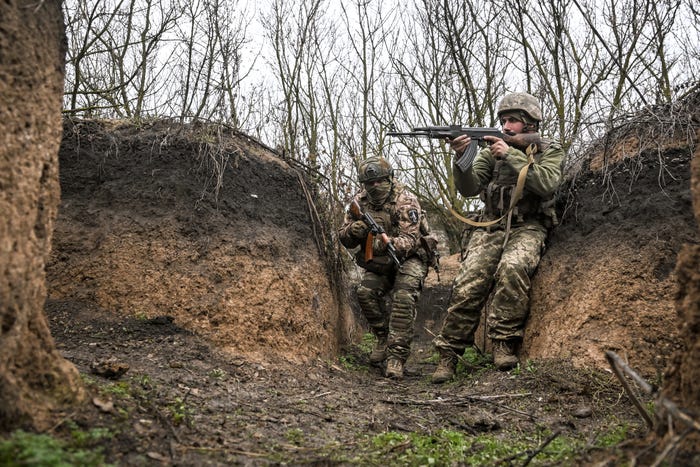
The British Army’s Irish Guards are adopting drone technology as a significant element of modern warfare. Despite this shift, the unit’s commanding officer, Lt. Col Ben Irwin-Clark, asserts that traditional infantry combat will remain largely unchanged, with soldiers still engaging in classic fighting scenarios, such as “slugging it out in a muddy hole.”
Drones have become increasingly prevalent in the ongoing conflict in Ukraine, where they are being employed extensively due to shortages of traditional weaponry. In response to this evolving landscape, the Irish Guards have intensively trained their personnel to operate drones, drawing lessons from Ukrainian soldiers who have firsthand experience with this technology.
Irwin-Clark, leading the 1st Battalion of the Irish Guards, expressed his views on the enduring nature of infantry combat. “To me, it feels like 80% of the job of an infantryman is exactly the same as it was in the Napoleonic era,” he stated. He emphasized that the foundational requirements of being fit, robust, and capable of surviving in the field have not changed. “You need to be able to dig a hole. That hasn’t changed, and I doubt it’s going to change for a while longer.”
This perspective highlights a characteristic of land warfare that Irwin-Clark described as “regressive.” He noted that regardless of technological advancements, land combat often devolves to close-quarters fighting, unlike naval or aerial engagements that cease once a vessel sinks or an aircraft is downed. “Once the tank’s gone, you just regress to the next type of technology,” he explained.
The incorporation of drone technology into the Irish Guards’ operations is not merely a replacement for traditional methods but rather an enhancement. Irwin-Clark pointed out that of the battalion’s 300 members, 78 are now trained as drone pilots or instructors. The unit has established a “drone hub,” the first of its kind within the British Army, allowing for drone repairs and development using modern technologies such as 3D printing.
This hub plays a vital role in integrating drones into training exercises, including a dedicated obstacle course for soldiers to practice their skills. The focus on drones reflects not only the lessons learned from Ukraine’s conflict but also the proactive measures being taken by NATO militaries to adapt to new warfare strategies.
Irwin-Clark’s insights on the future of warfare resonate with broader opinions within military circles. Maj. Rachel Martin, director of the US Army’s Unmanned Advanced Lethality Course, echoed this sentiment, stating, “Yes, warfare, the tools of warfare are changing, but the fundamentals of warfare have not changed.” She emphasized that drones serve as a tool for specific missions but do not necessarily replace all traditional methods of combat.
Former head of Army Futures Command, Gen. James Rainey, remarked in 2024 that while drone technology is having a disruptive impact on land warfare, it remains fundamentally a human endeavor. This perspective highlights the ongoing balance between technological advancements and the intrinsic human elements of combat.
Despite the continued relevance of traditional infantry tactics, Irwin-Clark recognized the important role drones will play in future conflicts. He noted the impressive adaptability of his soldiers, who quickly learned to operate the technology, contrasting it with the more rigid and formulaic training approaches associated with traditional military skills.
Reflecting on the rapid integration of drone warfare, Irwin-Clark stated, “I was pretty blown away by how quickly soldiers were confidently flying using drones.” His observations underscore a significant evolution within military training and operations, marking a new era in warfare that, while still anchored in traditional practices, increasingly embraces technological advancements.
As the Irish Guards continue to refine their approach to drone warfare, they embody a broader shift within the military landscape, one that acknowledges the past while preparing for the future. The lessons learned from Ukraine’s experience with drones are likely to inform military strategies across NATO, ensuring that armed forces are equipped for the complexities of modern conflict.

Mayo Spartans Crush Winona with 97-37 Victory; Mills Scores 30

Marvel’s Wonder Man Redeems 2013’s Controversial Iron Man Twist

Researchers Unveil Method to Predict Glacier Surges and Ecosystem Changes

Seahawks Set to Unleash ‘X-Factors’ in Super Bowl Showdown

Navy Secretary John Phelan Listed on Epstein Flight Manifest

New Relief Payments Rumored for 2026, But Are They Coming?

Denver Housing Market Faces Historic Low Sales as Activity Surges

Discover the Sci-Fi Legacy of ‘Star Blazers’ That Redefined TV

RFK Jr. Claims Keto Diet Can ‘Cure’ Mental Illness: A Fact Check

Send Holiday Parcels for £1.99 with New Comparison Service

University of Hawaiʻi Leads $25M AI Project to Monitor Natural Disasters

Interstellar Object 3I/ATLAS Emits Unique Metal Alloy, Says Scientist

Maui County Reopens Upgraded Lānaʻi Fifth Street Courts Today!

Kelly McCreary Discusses Future of Maggie and Winston in Grey’s Anatomy

Researchers Achieve Fastest Genome Sequencing in Under Four Hours

Iconic Sand Dollar Social Club Listed for $3 Million in Folly Beach

Afghan Refugee Detained by ICE After Asylum Hearing in New York

Peptilogics Secures $78 Million to Combat Prosthetic Joint Infections
-
 Lifestyle2 months ago
Send Holiday Parcels for £1.99 with New Comparison Service
-
Science3 months ago
University of Hawaiʻi Leads $25M AI Project to Monitor Natural Disasters
-
 Science4 months ago
Interstellar Object 3I/ATLAS Emits Unique Metal Alloy, Says Scientist
-
 Top Stories2 months ago
Maui County Reopens Upgraded Lānaʻi Fifth Street Courts Today!
-
 Entertainment4 months ago
Kelly McCreary Discusses Future of Maggie and Winston in Grey’s Anatomy
-
 Science4 months ago
Researchers Achieve Fastest Genome Sequencing in Under Four Hours
-
 Business4 months ago
Iconic Sand Dollar Social Club Listed for $3 Million in Folly Beach
-
 Politics4 months ago
Afghan Refugee Detained by ICE After Asylum Hearing in New York
-
 Health4 months ago
Peptilogics Secures $78 Million to Combat Prosthetic Joint Infections
-

 Business4 months ago
McEwen Inc. Secures Tartan Lake Gold Mine Through Acquisition
-

 Lifestyle4 months ago
Jump for Good: San Clemente Pier Fundraiser Allows Legal Leaps
-

 Health4 months ago
Researcher Uncovers Zika Virus Pathway to Placenta Using Nanotubes