
Politics
Minnesota Senate Considers Major Overhaul of Medicaid Insurance Model

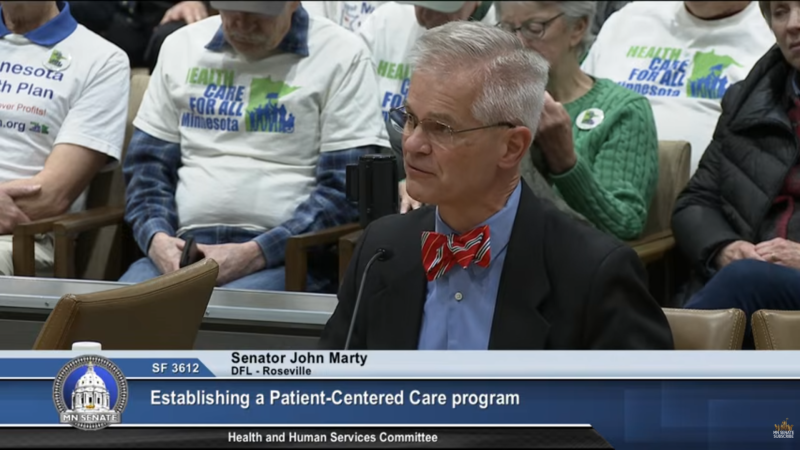
Members of the Minnesota Senate’s Health and Human Services Committee convened on March 10, 2024, to discuss a significant bill aimed at reforming the state’s Medicaid and MinnesotaCare programs. The proposed legislation, known as SF 3612, seeks to eliminate health insurance companies from these public health programs and replace them with a more streamlined administrative model.
Senator John Marty, a member of the Democratic-Farmer-Labor Party representing Roseville and the chief author of the bill, emphasized the need for change. “This proposal would eliminate that middleman for the two public programs because they create barriers to patient care using limited networks and varying drug formularies,” he stated. The current system primarily utilizes managed care organizations (MCOs), which are health insurers authorized to manage patient care.
Under the proposed legislation, the MCO system would be replaced by a Patient-Centered Care program. This new framework would allow the Minnesota Department of Human Services to contract with a single administrative services organization, which would provide care benefits without the financial risks associated with insurance companies. “I presume one of the existing MCOs, which already deals with claims payment, would continue that part of their business,” Marty added, ensuring that the administrative workload remains manageable.
In support of the bill, attorney Sheldon Toubman from Disability Rights Connecticut testified about his state’s successful transition from an MCO system to an administrative services model in 2012. Toubman highlighted that this shift has saved Connecticut over $4 billion. “We have very high medical cost ratios, around 97%, meaning almost all the taxpayers’ money is actually going to health care, very little to administrative cost,” he explained.
However, the proposal has faced opposition. Chelsea Olson, representing the Minnesota Council of Health Plans, raised concerns that eliminating MCOs could lead to fewer healthcare providers accepting Medicaid patients due to low reimbursement rates. “Managed care organizations leverage their commercial contracts and require in-network doctors to see patients on both their commercial and Medical Assistance lines of business,” Olson pointed out. She questioned how the state would maintain this leverage under the new system.
Senator Bill Lieske, a Republican from Lonsdale and a practicing chiropractor, echoed these concerns. He cautioned that a single administrative option might limit negotiations with healthcare providers, potentially leading to less favorable conditions for patients relying on Medicaid.
Among the testimonies, Nancy Westman, a psychiatric nurse practitioner at Hennepin Health, shared her frustrations with the current system’s administrative hurdles, which she argued can delay vital care for patients. “I may have to trial three different psychiatric medications to support and stabilize a patient,” Westman stated. “It’s ridiculous.”
The committee ultimately decided to lay the bill over for further consideration, and a fiscal note detailing the anticipated costs associated with the proposed legislation has yet to be released. As Minnesota grapples with reforming its public health programs, the outcome of this bill could have lasting implications for healthcare access and delivery in the state.

Urgent Tax Savings Alert: Maximize Deductions Before April 15

Trump’s Administration Faces Uncertainty Over Government Shutdowns

Cosmic Defects: The Mystery of the Universe’s Missing Anomalies

Rapid City Parks Department Opens Registration for Bocce Leagues

Samsung Galaxy Watch 9 to Feature Larger 435mAh Battery Soon

Two Dead After Student Boats Capsize Off Okinawa Coast

Healthy Choice Wellness Reports Earnings with Mixed Results

Prince Harry Positions Himself as Royal Family’s Image Reviver

All Points North Lodge Achieves FSPHP-ETA Accreditation

Send Holiday Parcels for £1.99 with New Comparison Service

University of Hawaiʻi Leads $25M AI Project to Monitor Natural Disasters

Maui County Reopens Upgraded Lānaʻi Fifth Street Courts Today!

Daily Codeword Puzzle Launches on October 21, 2025

Congresswoman Under Fire for Misleading Epstein Donation Claims

Interstellar Object 3I/ATLAS Emits Unique Metal Alloy, Says Scientist

Trump Vows to Resolve Afghanistan-Pakistan Crisis “Very Quickly”

Charles Darwin’s Address Book Reveals Hidden Aspects of His Life

Rediscovering Chrysler: 5 Overlooked Models from the 1980s
-
 Lifestyle8 months ago
Send Holiday Parcels for £1.99 with New Comparison Service
-
Science9 months ago
University of Hawaiʻi Leads $25M AI Project to Monitor Natural Disasters
-
 Top Stories8 months ago
Maui County Reopens Upgraded Lānaʻi Fifth Street Courts Today!
-
 Entertainment10 months ago
Daily Codeword Puzzle Launches on October 21, 2025
-
 Lifestyle9 months ago
Congresswoman Under Fire for Misleading Epstein Donation Claims
-
 Science10 months ago
Interstellar Object 3I/ATLAS Emits Unique Metal Alloy, Says Scientist
-
 Top Stories9 months ago
Trump Vows to Resolve Afghanistan-Pakistan Crisis “Very Quickly”
-
 Science8 months ago
Charles Darwin’s Address Book Reveals Hidden Aspects of His Life
-
 Lifestyle8 months ago
Rediscovering Chrysler: 5 Overlooked Models from the 1980s
-

 Science7 months ago
Understanding Generation Z: Strategies for Engaging the Workforce
-

 Entertainment10 months ago
Kelly McCreary Discusses Future of Maggie and Winston in Grey’s Anatomy
-

 Top Stories8 months ago
aespa Faces Backlash Over G-Dragon Interaction at 2025 MAMAs