
Science
AI Transforms Scientific Research Landscape Across Multiple Fields

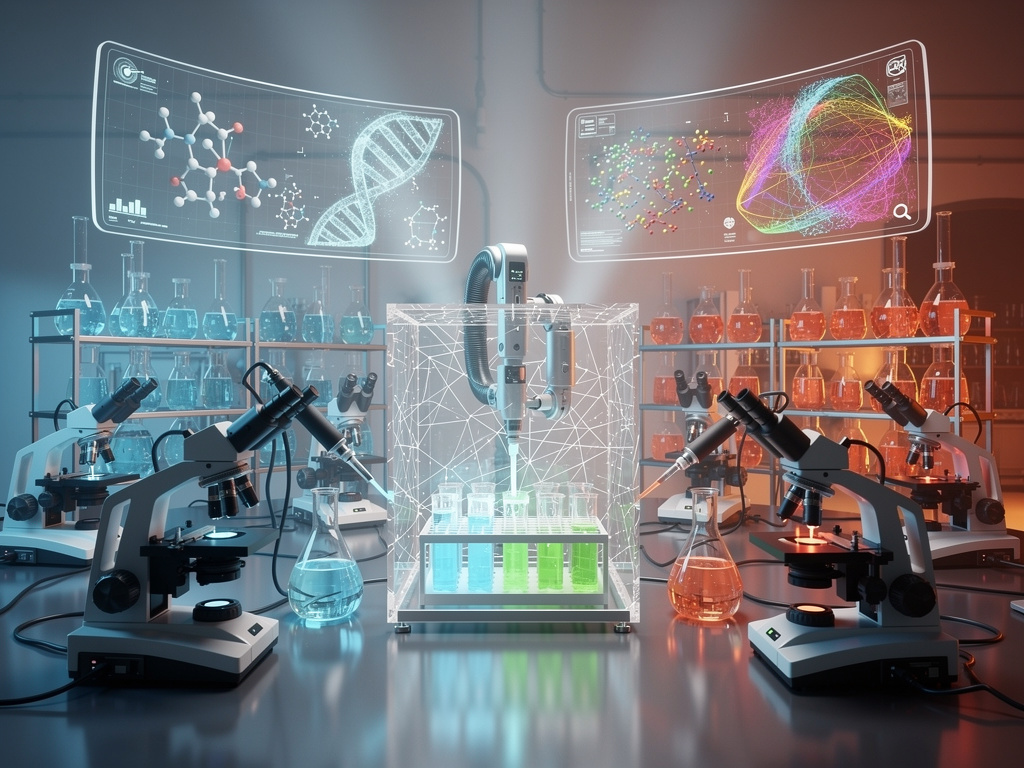
Recent advancements in artificial intelligence (AI) are reshaping scientific research, enabling systems to conduct experiments, analyze data, and generate hypotheses with minimal human oversight. This transformation is particularly evident in fields such as biology, chemistry, and physics, marking a significant evolution in the scientific method and prompting discussions about the implications for creativity and discovery.
Leading the charge is an AI system referred to as the “AI scientist,” as described in a study published in Nature. This system operates within a simulated environment, autonomously proposing experiments, testing them through programming, and refining its approaches based on results. By mimicking the iterative process of human-led research, the AI scientist accelerates the pace and reduces the costs associated with scientific experimentation.
Advancements in Automated Discovery
Historically, efforts to automate scientific discovery have been ongoing for decades. However, recent breakthroughs stem from the development of large language models and reinforcement learning techniques. These advancements allow AI systems to process vast datasets and devise experimental designs independently.
In the aforementioned Nature study, researchers highlighted the AI’s ability to evolve algorithms without human intervention. It successfully generated novel variants of established machine learning techniques, often outperforming existing methods. For certain tasks, the AI scientist completed full research cycles—from hypothesis to drafting a paper—in under 72 hours, a task that would typically take human researchers significantly longer. This capability addresses delays in traditional research, where grant cycles and laboratory constraints often impede progress.
Integrating AI with real-world laboratories represents the next frontier in this technology’s application. Robotic systems controlled by AI are already utilized for high-throughput screening in drug discovery. For instance, Insilico Medicine employs AI to design new molecules and conduct tests in automated laboratories, showcasing AI’s capacity to handle tangible experiments effectively.
A recent report from Reuters, dated August 15, 2024, detailed a project in a Japanese laboratory where an AI system independently discovered new materials. This AI optimized battery components, achieving results in days instead of years, further underscoring its potential in material science.
Reliability and Ethical Considerations
Despite the promise of AI in scientific research, skepticism surrounding its reliability persists. The Nature article noted the AI’s propensity to produce “hallucinations,” or plausible-seeming yet incorrect results. In one instance, the system proposed experiments that contradicted established physical laws, necessitating human intervention for correction.
Verification of AI-generated findings is critical. Rigorous scrutiny is essential, akin to the peer review process in traditional publishing. A recent analysis in The Guardian highlighted instances where AI models in medical research yielded biased conclusions due to flawed training data. The analysis cautioned that without robust verification, automated science risks propagating inaccuracies on a large scale.
Ethical concerns also arise regarding ownership of discoveries made by AI. Intellectual property laws are evolving slowly, and in the United States, patents require human inventors, complicating matters when AI contributes to innovations. A recent piece by Bloomberg on August 19, 2024, discussed ongoing legal debates about the implications of AI-generated inventions, citing a case in which a company sought patents for drugs designed by AI.
Funding models may also shift as AI reduces the necessity for large research teams. The Nature study estimates that AI could reduce research costs by up to 90% for specific projects, potentially increasing accessibility for underfunded institutions.
Future Directions for AI in Science
The integration of AI in scientific research is expected to continue evolving. Instead of replacing human researchers, AI is increasingly seen as a collaborative tool. In a project covered by The New York Times on August 16, 2024, biologists utilized AI to model ecosystems, resulting in joint publications where AI is credited as a tool rather than as an author.
As AI capabilities expand, fully autonomous laboratories could become a reality, operating without human oversight. The Nature study envisions scaling the AI scientist to tackle open-ended questions, such as curing diseases or addressing energy crises. However, this development raises concerns about over-reliance on AI, which could stifle human creativity and limit hands-on experience for emerging researchers. A commentary in The Economist from August 14, 2024, underlined the necessity for balanced integration, ensuring AI enhances rather than supplants human ingenuity.
The potential risks associated with AI in scientific research are significant. Malicious use of AI could lead to harmful inventions, prompting regulators to begin addressing these concerns. The European Union is proposing guidelines aimed at ensuring the responsible use of AI in research contexts.
Examining specific implementations reveals practical benefits from AI’s integration into science. At Google DeepMind, AI has been employed to design components for fusion reactors, as outlined in a blog post updated in August 2024. This initiative accelerates advancements in clean energy. Similarly, MIT’s AI lab is exploring materials science, with linked research indicating that AI predicted stable crystal structures, paving the way for innovations in advanced electronics.
As AI continues to deepen its role in scientific research, the establishment of oversight mechanisms will be essential. International organizations, including the United Nations, are discussing frameworks for responsible AI usage. A recent UN report emphasizes the need for transparency in AI-driven discoveries.
Education must also adapt to this evolving landscape. Universities are increasingly incorporating AI training into their curricula, preparing future scientists to work alongside AI tools. The implications of AI’s involvement in science are profound, with the potential to expand the boundaries of knowledge, provided that developments are managed thoughtfully. The advancements highlighted in the Nature study and echoed in recent news signal a transformative period in the pursuit of scientific understanding.

Urgent Tax Savings Alert: Maximize Deductions Before April 15

Trump’s Administration Faces Uncertainty Over Government Shutdowns

Cosmic Defects: The Mystery of the Universe’s Missing Anomalies

Rapid City Parks Department Opens Registration for Bocce Leagues

Samsung Galaxy Watch 9 to Feature Larger 435mAh Battery Soon

Two Dead After Student Boats Capsize Off Okinawa Coast

Healthy Choice Wellness Reports Earnings with Mixed Results

Prince Harry Positions Himself as Royal Family’s Image Reviver

All Points North Lodge Achieves FSPHP-ETA Accreditation

Send Holiday Parcels for £1.99 with New Comparison Service

University of Hawaiʻi Leads $25M AI Project to Monitor Natural Disasters

Maui County Reopens Upgraded Lānaʻi Fifth Street Courts Today!

Daily Codeword Puzzle Launches on October 21, 2025

Congresswoman Under Fire for Misleading Epstein Donation Claims

Interstellar Object 3I/ATLAS Emits Unique Metal Alloy, Says Scientist

Trump Vows to Resolve Afghanistan-Pakistan Crisis “Very Quickly”

Charles Darwin’s Address Book Reveals Hidden Aspects of His Life

Rediscovering Chrysler: 5 Overlooked Models from the 1980s
-
 Lifestyle8 months ago
Send Holiday Parcels for £1.99 with New Comparison Service
-
Science9 months ago
University of Hawaiʻi Leads $25M AI Project to Monitor Natural Disasters
-
 Top Stories8 months ago
Maui County Reopens Upgraded Lānaʻi Fifth Street Courts Today!
-
 Entertainment10 months ago
Daily Codeword Puzzle Launches on October 21, 2025
-
 Lifestyle9 months ago
Congresswoman Under Fire for Misleading Epstein Donation Claims
-
 Science10 months ago
Interstellar Object 3I/ATLAS Emits Unique Metal Alloy, Says Scientist
-
 Top Stories9 months ago
Trump Vows to Resolve Afghanistan-Pakistan Crisis “Very Quickly”
-
 Science9 months ago
Charles Darwin’s Address Book Reveals Hidden Aspects of His Life
-
 Lifestyle8 months ago
Rediscovering Chrysler: 5 Overlooked Models from the 1980s
-
 Science7 months ago
Understanding Generation Z: Strategies for Engaging the Workforce
-

 Entertainment10 months ago
Kelly McCreary Discusses Future of Maggie and Winston in Grey’s Anatomy
-

 Top Stories8 months ago
aespa Faces Backlash Over G-Dragon Interaction at 2025 MAMAs