
Science
Archaeologists Unearth Possible Remains of Noah’s Ark in Turkey

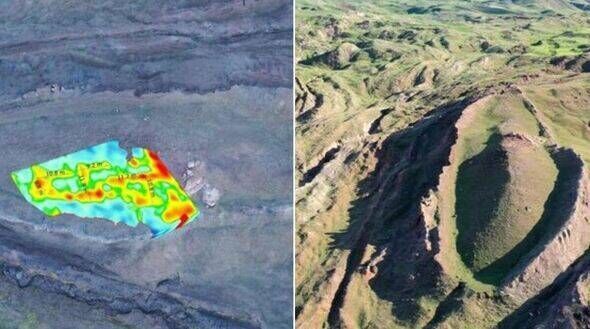
Archaeologists have reported a significant discovery that may point to the remains of Noah’s Ark, using advanced radar technology to examine the Durupinar Formation in Turkey. Ground Penetrating Radar (GPR) analysis has revealed what researchers believe to be a “chemical imprint,” along with “pieces of wood” and indications of a structured “hall.” This follows the biblical narrative of a massive vessel that preserved human and animal life during a catastrophic flood over 4,300 years ago.
The research team, led by independent researcher Andrew Jones from Noah’s Ark Scans, focused on the site located near Mount Ararat, approximately 18 miles south of the peak. Their findings include angular formations and a hollow space deep within the formation, which they suspect might correspond to the dimensions described in sacred texts.
In an interview with The Christian Broadcasting Network (CBN), Jones stated, “We’re not expecting something that’s fully preserved. What’s left is the chemical imprint, pieces of wood in the ground, the shape of a hall.” The scans indicate a corridor that measures around 13 feet, suggesting potential walkways throughout the structure.
Biblical texts specify that Noah’s Ark was built with three levels, as detailed in Genesis 6:16, which says, “Make a roof for the ark, and finish it to a cubit above, and set the door of the ark in its side. Make it with lower, second, and third decks.” The GPR data from the Durupinar Formation appears to corroborate this description, revealing three distinct layers beneath the surface.
Significant Discoveries and Controversies
The discovery of this formation has sparked a longstanding debate among scholars regarding its nature. Some dismiss it as a mere geological formation, while others, including the researchers at Noah’s Ark Scans, argue it could indicate a man-made structure consistent with the biblical account of the ark.
Jones highlighted features that extend approximately 20 feet below the surface, which could indicate compartments typically associated with a vessel. He emphasized, “This is not what you’d expect to see if the site were simply a solid block of rock or the result of random mudflow debris.” Instead, he claims, “It is exactly what you’d expect to find if this were a man-made boat.”
In addition to radar analysis, the team has conducted soil tests that have revealed intriguing findings. The grass within the boat-shaped formation appears to differ in color from the surrounding area, suggesting a possible artificial origin. Fellow researcher William Crabtree pointed out that a passageway appears to lead from the tip of the formation toward its center, wide enough for a person to walk through.
Their soil examination indicated organic matter levels inside the formation are double those in adjacent soils. Crabtree noted, “If this was a wooden boat and the wood had rotted over time, we would expect to see elevated levels of potassium, changes in pH, and higher organic content—and that’s exactly what we’re finding.”
Future Research Directions
The team plans to expand their testing efforts beyond the 22 soil samples already collected. They are also preparing for core drilling and additional GPR surveys at the site. Jones stated, “We want to compare what’s inside the formation to what’s outside. That could give us a much clearer picture of whether this is truly something man-made.”
The Durupinar Formation has intrigued researchers and enthusiasts alike since its discovery in 1948, when heavy rains and seismic activity uncovered its features, previously obscured by mud. Biblical accounts suggest that Noah’s Ark came to rest on the “mountains of Ararat” after a 150-day deluge, and this formation’s shape remarkably mirrors the ark’s specified dimensions of approximately 515 feet long, 86 feet wide, and 52 feet tall.
As these investigations continue, the quest to confirm whether this site is indeed linked to the legendary vessel remains a focal point for both archaeological scholarship and public fascination. Researchers are eager to provide more conclusive evidence that could reshape our understanding of this ancient narrative.

Timothy K. Miller, 63, Remembered for His Passion and Dedication

Grant Private Wealth Boosts NVIDIA Stake by Over 300% in Q3

NASA’s James Webb Space Telescope Spots Unusual Lemon-Shaped Exoplanet

Anthony Joshua Knocks Out Jake Paul in Sixth Round of Heavyweight Clash

Libya’s Youth Movement Offers U.S. a Strategic Opportunity

Thrivent Financial Expands Stake in Monster Beverage by 247%

Bears vs. Packers: High-Stakes Showdown Kicks Off at 7:20 PM

Urgent: Fligor Announces Candidacy for Santa Clara County Assessor

Philip Rivers Banned from Hall of Fame for 5 More Years

Send Holiday Parcels for £1.99 with New Comparison Service

University of Hawaiʻi Leads $25M AI Project to Monitor Natural Disasters

Interstellar Object 3I/ATLAS Emits Unique Metal Alloy, Says Scientist

Researchers Achieve Fastest Genome Sequencing in Under Four Hours

Iconic Sand Dollar Social Club Listed for $3 Million in Folly Beach

Afghan Refugee Detained by ICE After Asylum Hearing in New York

Peptilogics Secures $78 Million to Combat Prosthetic Joint Infections

McEwen Inc. Secures Tartan Lake Gold Mine Through Acquisition

Jump for Good: San Clemente Pier Fundraiser Allows Legal Leaps
-
 Lifestyle2 weeks ago
Send Holiday Parcels for £1.99 with New Comparison Service
-
Science2 months ago
University of Hawaiʻi Leads $25M AI Project to Monitor Natural Disasters
-
 Science2 months ago
Interstellar Object 3I/ATLAS Emits Unique Metal Alloy, Says Scientist
-
 Science2 months ago
Researchers Achieve Fastest Genome Sequencing in Under Four Hours
-
 Business2 months ago
Iconic Sand Dollar Social Club Listed for $3 Million in Folly Beach
-
 Politics2 months ago
Afghan Refugee Detained by ICE After Asylum Hearing in New York
-
 Health2 months ago
Peptilogics Secures $78 Million to Combat Prosthetic Joint Infections
-
 Business2 months ago
McEwen Inc. Secures Tartan Lake Gold Mine Through Acquisition
-
 Lifestyle2 months ago
Jump for Good: San Clemente Pier Fundraiser Allows Legal Leaps
-
 Science2 months ago
Mars Observed: Detailed Imaging Reveals Dust Avalanche Dynamics
-

 Health2 months ago
Researcher Uncovers Zika Virus Pathway to Placenta Using Nanotubes
-

 Entertainment2 months ago
Jennifer Lopez Addresses A-Rod Split in Candid Interview