
Science
Astronomers Uncover Evidence of Early “Monster Stars” in Universe

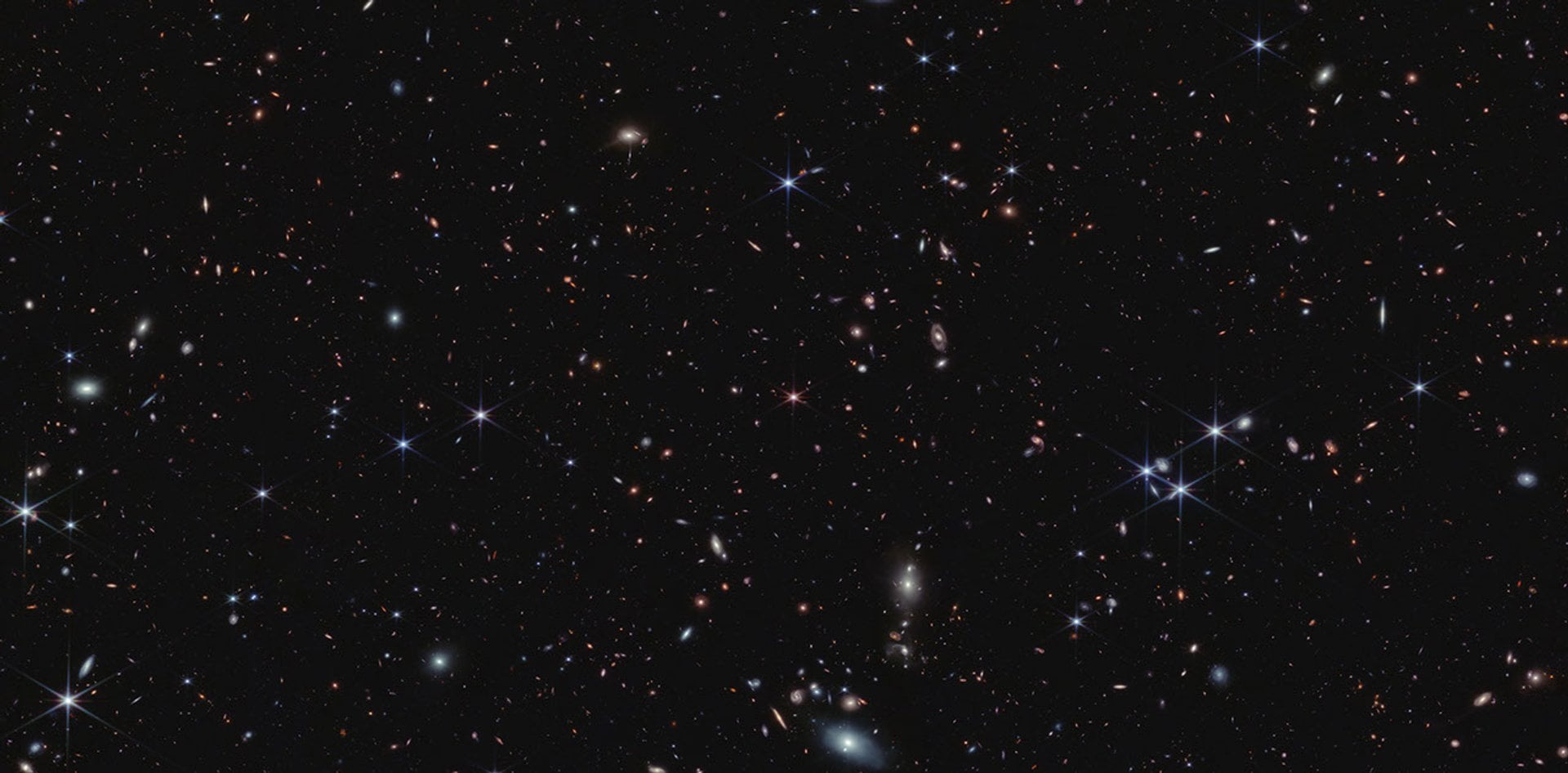
Astronomers using the James Webb Space Telescope (JWST) have made a groundbreaking discovery, providing the first compelling evidence of “monster stars” in the early Universe. This finding could reshape our understanding of how supermassive black holes (SMBHs), which weigh millions to billions of solar masses, formed less than a billion years after the Big Bang.
For over two decades, scientists have grappled with the question of how these massive black holes could exist so soon after the Universe’s inception. Traditional cosmological models suggest that there was insufficient time for SMBHs to form through standard black hole formation processes. Recent observations challenge these models and support an alternative hypothesis: that the seeds of SMBHs originated directly from collapsing clouds of cosmic gas, termed direct collapse black holes (DCBHs). Another possibility is that early stars, classified as Population III stars, were sufficiently massive to ultimately collapse into black holes.
Key Findings from JWST Observations
The research team, led by Devesh Nandal, a Postdoctoral Fellow at the University of Virginia and the Institute for Theory and Computation at the Harvard & Smithsonian Center for Astrophysics, discovered evidence supporting the existence of these enormous stars, which are estimated to have masses between 1,000 and 10,000 solar masses. Joining Nandal were notable researchers including Daniel Whalen, a Senior Lecturer in Cosmology at the University of Portsmouth; Muhammad A. Latif, an astrophysicist from United Arab Emirates University; and Alexander Heger from the School of Physics and Astronomy at Monash University.
Using the JWST, the team analyzed chemical signatures in a galaxy cataloged as GS 3073, which was previously identified in 2022. The discovery team noted an unusually high nitrogen-to-oxygen ratio of 0.46, a figure that could not be accounted for by known types of stars or stellar explosions. This prompted the hypothesis that the first stars, or Population III stars, emerged from turbulent flows of cold gas shortly after the Big Bang.
The presence of a feeding black hole at the center of GS 3073 suggests it may be a remnant of one of these monster stars. The team believes that this discovery helps explain the presence of multiple quasars detected by JWST, which existed less than a billion years after the Big Bang. Quasars, also known as Active Galactic Nuclei (AGNs), are powered by SMBHs that accelerate gas and dust to nearly the speed of light, releasing vast amounts of energy.
Mechanisms Behind the Chemical Signatures
To further validate their theory, Latif, Whalen, and their colleagues created models detailing how stars with masses between 1,000 and 10,000 solar masses would evolve and the chemicals they would produce. They identified a mechanism that accounts for the nitrogen-to-oxygen ratio observed in GS 3073. This process begins with monster stars fusing helium in their cores to produce carbon, which then interacts with hydrogen in the outer layers of the star to form nitrogen.
This nitrogen is eventually distributed into the surrounding environment, enriching the gas cloud over millions of years. The researchers found that these monster stars likely do not explode as supernovae at the end of their life cycles. Instead, they collapse directly into massive black holes, which could serve as seeds for the SMBHs observed today. Notably, the nitrogen signature was absent in stars that do not fall within this specific mass range.
If confirmed, these findings could address two significant mysteries arising from JWST’s previous observations. They also provide new insights into the Universe during the “Cosmic Dark Ages,” a period between 380,000 and 1 billion years after the Big Bang, which has remained largely elusive due to its faint light.
Recent advancements in infrared optics, like those employed by JWST, have allowed researchers to probe this previously inaccessible epoch. The team anticipates that future surveys will uncover more galaxies exhibiting similar nitrogen excesses, further exploring the potential existence of monster stars.
As Daniel Whalen remarked on the significance of these findings, they pave the way for a deeper understanding of the early Universe and the formation of its most massive structures. The implications of this research extend beyond individual discoveries, offering a fresh perspective on cosmic evolution.

Draymond Green Ejected After Quick Techs Against Suns

Packers QB Jordan Love Exits After Head Hit; Concussion Evaluated

First Wheelchair User in Space Captures Global Attention Today

ABC7 Chicago Launches ‘Chicago Proud’ Series Showcasing Local Heroes

Duke vs. Texas Tech: No. 3 Blue Devils Clash at MSG NOW

Oscar Smith’s Johnson Named Offensive Player of the Year

Discover the Top 10 K-Romances of 2025 That Captivated Audiences

Ancient Plague’s Origins Revealed Through Sheep DNA Discovery

Transform Your Home: 9 Tips to Upgrade Style on a Budget

Send Holiday Parcels for £1.99 with New Comparison Service

University of Hawaiʻi Leads $25M AI Project to Monitor Natural Disasters

Interstellar Object 3I/ATLAS Emits Unique Metal Alloy, Says Scientist

Researchers Achieve Fastest Genome Sequencing in Under Four Hours

Iconic Sand Dollar Social Club Listed for $3 Million in Folly Beach

Afghan Refugee Detained by ICE After Asylum Hearing in New York

Peptilogics Secures $78 Million to Combat Prosthetic Joint Infections

McEwen Inc. Secures Tartan Lake Gold Mine Through Acquisition

Jump for Good: San Clemente Pier Fundraiser Allows Legal Leaps
-
 Lifestyle2 weeks ago
Send Holiday Parcels for £1.99 with New Comparison Service
-
Science2 months ago
University of Hawaiʻi Leads $25M AI Project to Monitor Natural Disasters
-
 Science2 months ago
Interstellar Object 3I/ATLAS Emits Unique Metal Alloy, Says Scientist
-
 Science2 months ago
Researchers Achieve Fastest Genome Sequencing in Under Four Hours
-
 Business2 months ago
Iconic Sand Dollar Social Club Listed for $3 Million in Folly Beach
-
 Politics2 months ago
Afghan Refugee Detained by ICE After Asylum Hearing in New York
-
 Health2 months ago
Peptilogics Secures $78 Million to Combat Prosthetic Joint Infections
-
 Business2 months ago
McEwen Inc. Secures Tartan Lake Gold Mine Through Acquisition
-
 Lifestyle2 months ago
Jump for Good: San Clemente Pier Fundraiser Allows Legal Leaps
-
 Science2 months ago
Mars Observed: Detailed Imaging Reveals Dust Avalanche Dynamics
-

 Health2 months ago
Researcher Uncovers Zika Virus Pathway to Placenta Using Nanotubes
-

 Entertainment2 months ago
Jennifer Lopez Addresses A-Rod Split in Candid Interview