
Science
Japanese Researchers Uncover Mars’ Climate History in Ice Deposits

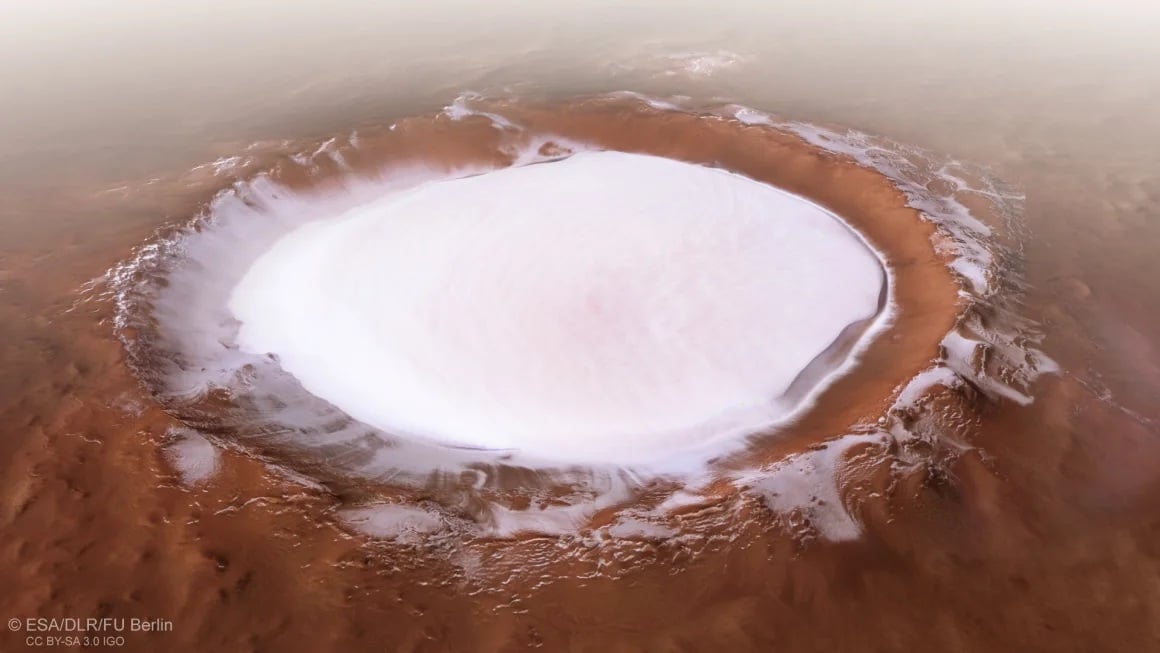
Research conducted by a team from Japan has revealed significant insights into Mars’ climatic history, suggesting that ice deposits within the planet’s craters serve as a record of its past environmental conditions. For decades, scientists have examined various features on Mars that indicate a warmer, wetter planet, characterized by rivers, lakes, and an ocean that once dominated its northern hemisphere.
The study, published in the journal Geology, was led by Trishit Ruj, an associate professor at the Institute for Planetary Materials at Okayama University. The research highlights how these ice deposits have recorded multiple ice ages over the last hundreds of millions of years. The findings suggest a gradual decline in the amount of ice, indicating that Mars has been losing its water over extensive geological time.
Insights from Martian Craters
The research team focused on glacial landforms preserved in craters located between 20°N and 45°N latitude. Using high-resolution images from the Context Camera and the High-Resolution Imaging Science Experiment aboard NASA’s Mars Reconnaissance Orbiter, they identified features indicative of past glaciation, such as ridges and maze-like pit formations.
They found that the ice consistently clustered on the shadowed southwestern walls of the craters, a pattern that remained stable throughout multiple glacial periods during the Amazonian period, which spanned from approximately 640 million to 98 million years ago. Ruj noted that shifts in Mars’ axial tilt, or obliquity, influenced these climatic changes, similar to Earth’s own axial variations. While Mars’ obliquity can change dramatically over time, leading to cycles of glaciation and warming, Earth’s tilt remains more stable.
Implications for Future Exploration
This research not only sheds light on the historical climate of Mars but also has substantial implications for future crewed missions. As astronauts prepare for exploration, understanding the locations and accessibility of water ice will be vital for sustaining human life on Mars. Water ice can be utilized for growing food, producing oxygen, and creating fuel. Given the logistical challenges of travel between Earth and Mars, with conventional spacecraft taking six to nine months for a one-way journey, in-situ resource utilization (ISRU) becomes essential.
The study’s findings could also inform efforts to address climate challenges on Earth. As rising global temperatures lead to shrinking glaciers and ice caps, the same imaging and modeling techniques applied to examine Martian ice could assist scientists in monitoring our planet’s water resources.
Dr. Hasegawa from Kochi University remarked, “Mars serves as a natural laboratory for understanding how ice behaves over vast timescales. The insights we gain here can sharpen our understanding of climate processes on Earth as well.”
As researchers continue to unravel the mysteries of Mars, the knowledge gained may not only pave the way for interplanetary exploration but also provide valuable lessons for managing Earth’s changing climate.

Urgent Tax Savings Alert: Maximize Deductions Before April 15

Trump’s Administration Faces Uncertainty Over Government Shutdowns

Cosmic Defects: The Mystery of the Universe’s Missing Anomalies

Rapid City Parks Department Opens Registration for Bocce Leagues

Samsung Galaxy Watch 9 to Feature Larger 435mAh Battery Soon

Two Dead After Student Boats Capsize Off Okinawa Coast

Healthy Choice Wellness Reports Earnings with Mixed Results

Prince Harry Positions Himself as Royal Family’s Image Reviver

All Points North Lodge Achieves FSPHP-ETA Accreditation

Send Holiday Parcels for £1.99 with New Comparison Service

University of Hawaiʻi Leads $25M AI Project to Monitor Natural Disasters

Maui County Reopens Upgraded Lānaʻi Fifth Street Courts Today!

Interstellar Object 3I/ATLAS Emits Unique Metal Alloy, Says Scientist

Kelly McCreary Discusses Future of Maggie and Winston in Grey’s Anatomy

Daily Codeword Puzzle Launches on October 21, 2025

Congresswoman Under Fire for Misleading Epstein Donation Claims

Trump Vows to Resolve Afghanistan-Pakistan Crisis “Very Quickly”

Researchers Achieve Fastest Genome Sequencing in Under Four Hours
-
 Lifestyle4 months ago
Send Holiday Parcels for £1.99 with New Comparison Service
-
Science5 months ago
University of Hawaiʻi Leads $25M AI Project to Monitor Natural Disasters
-
 Top Stories4 months ago
Maui County Reopens Upgraded Lānaʻi Fifth Street Courts Today!
-
 Science6 months ago
Interstellar Object 3I/ATLAS Emits Unique Metal Alloy, Says Scientist
-
 Entertainment6 months ago
Kelly McCreary Discusses Future of Maggie and Winston in Grey’s Anatomy
-
 Entertainment6 months ago
Daily Codeword Puzzle Launches on October 21, 2025
-
 Lifestyle5 months ago
Congresswoman Under Fire for Misleading Epstein Donation Claims
-
 Top Stories5 months ago
Trump Vows to Resolve Afghanistan-Pakistan Crisis “Very Quickly”
-
 Science6 months ago
Researchers Achieve Fastest Genome Sequencing in Under Four Hours
-

 Business6 months ago
Iconic Sand Dollar Social Club Listed for $3 Million in Folly Beach
-

 Politics6 months ago
Afghan Refugee Detained by ICE After Asylum Hearing in New York
-

 Science4 months ago
Charles Darwin’s Address Book Reveals Hidden Aspects of His Life