
Science
Michigan State University Launches $14M Facility for Chip Testing

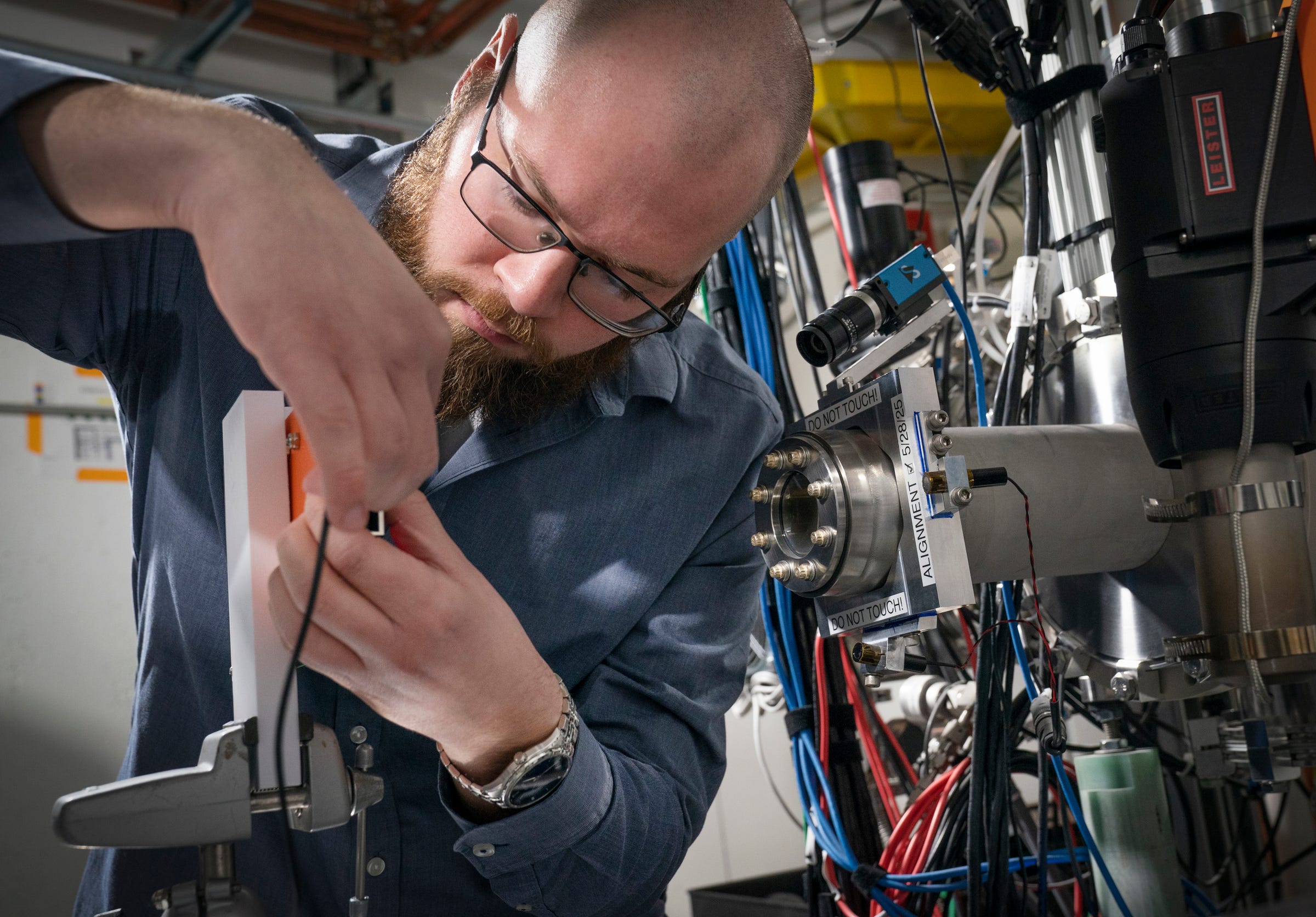
Michigan State University (MSU) has inaugurated a new facility designed to test microelectronics against cosmic rays, a critical advancement for industries reliant on robust technology. The $14 million K500 Chip Testing Facility, located at the university’s Facility for Rare Isotope Beams (FRIB), aims to simulate decades of cosmic ray exposure in mere minutes. This facility is one of only three heavy ion cyclotron facilities in the United States dedicated to chip testing for applications in space, defense, and automotive sectors.
Microelectronics have become indispensable in daily life, found in everything from smartphones to satellites. Yet, these sensitive chips face threats from cosmic rays—high-energy particles that can cause malfunctions ranging from minor glitches to catastrophic failures. To mitigate these risks, manufacturers must ensure their chips can withstand such hostile environments. Traditionally, replicating the effects of cosmic rays on Earth has posed significant challenges, but the new facility at MSU addresses this gap.
The K500 facility was established through funding from the U.S. Department of Defense and repurposes the campus’ K500 superconducting cyclotron, originally completed in 1982 for high-energy nuclear research. According to Thomas Glasmacher, laboratory director at FRIB, the facility allows for rapid testing of chips to determine their durability against cosmic rays. “Self-driving cars, airplanes, all of the technology humans rely on has to last as the chips get smaller and smaller,” Glasmacher noted.
Cosmic rays are primarily composed of protons and atomic nuclei traveling through space at nearly the speed of light. Originating from various cosmic events, they consistently bombard Earth, with most being deflected by the planet’s magnetic field. When these rays strike electronic devices, they can disrupt functions. A notable incident occurred in October 2025, when a JetBlue Airbus A320 experienced an uncontrolled altitude drop due to a cosmic ray-induced malfunction in its flight control systems. This incident resulted in injuries to 15 passengers and triggered widespread disruptions when Airbus grounded 6,000 aircraft for software updates.
The K500 facility enables chip manufacturers to simulate extensive cosmic ray exposure in a fraction of the time. Glasmacher explained, “We can give 50 years of cosmic rays in, say, five minutes or five seconds.” MSU now joins the ranks of the Lawrence Berkeley National Laboratory in California and Texas A&M University as one of the few U.S. facilities offering such testing capabilities.
The facility operates by accelerating ions using powerful energy—between 20 million to 40 million electron volts per unit mass—and directing these ions at prepared chip samples. Steve Lidia, manager of the FRIB beam instrumentation and measurement department, remarked, “We give customers a menu, and they order off the menu.” This flexibility allows companies, including Texas Instruments, to customize their testing based on specific needs.
Since opening at the start of 2023, the K500 Chip Testing Facility has operated at approximately 40% capacity, providing around 2,500 hours of beam time for testing this year. Plans are underway to expand the facility by adding a 5,500-square-foot section to accommodate more simultaneous testing activities.
The K500 facility not only serves the needs of government and private sector clients but also offers valuable educational opportunities for MSU students. This hands-on experience allows students to engage with potential employers and enhances workforce development in critical areas such as semiconductors and electronics. “This facility gives us more opportunity because we have more available hours to train more and more students,” said John Papapolymerou, interim dean of MSU’s College of Engineering.
Additionally, MSU is planning the Leinweber Center for Engineering and Digital Innovation, set to open in August 2028. This new center will integrate research and education in fields like data science, artificial intelligence, and semiconductor research, further strengthening the university’s role in advancing technology.
The K500 Chip Testing Facility represents a significant investment in both technological innovation and workforce readiness, positioning Michigan State University as a leader in space electronics testing and research.

Urgent Tax Savings Alert: Maximize Deductions Before April 15

Trump’s Administration Faces Uncertainty Over Government Shutdowns

Cosmic Defects: The Mystery of the Universe’s Missing Anomalies

Rapid City Parks Department Opens Registration for Bocce Leagues

Samsung Galaxy Watch 9 to Feature Larger 435mAh Battery Soon

Two Dead After Student Boats Capsize Off Okinawa Coast

Healthy Choice Wellness Reports Earnings with Mixed Results

Prince Harry Positions Himself as Royal Family’s Image Reviver

All Points North Lodge Achieves FSPHP-ETA Accreditation

Send Holiday Parcels for £1.99 with New Comparison Service

University of Hawaiʻi Leads $25M AI Project to Monitor Natural Disasters

Maui County Reopens Upgraded Lānaʻi Fifth Street Courts Today!

Daily Codeword Puzzle Launches on October 21, 2025

Congresswoman Under Fire for Misleading Epstein Donation Claims

Interstellar Object 3I/ATLAS Emits Unique Metal Alloy, Says Scientist

Trump Vows to Resolve Afghanistan-Pakistan Crisis “Very Quickly”

Charles Darwin’s Address Book Reveals Hidden Aspects of His Life

Rediscovering Chrysler: 5 Overlooked Models from the 1980s
-
 Lifestyle8 months ago
Send Holiday Parcels for £1.99 with New Comparison Service
-
Science9 months ago
University of Hawaiʻi Leads $25M AI Project to Monitor Natural Disasters
-
 Top Stories8 months ago
Maui County Reopens Upgraded Lānaʻi Fifth Street Courts Today!
-
 Entertainment10 months ago
Daily Codeword Puzzle Launches on October 21, 2025
-
 Lifestyle9 months ago
Congresswoman Under Fire for Misleading Epstein Donation Claims
-
 Science10 months ago
Interstellar Object 3I/ATLAS Emits Unique Metal Alloy, Says Scientist
-
 Top Stories9 months ago
Trump Vows to Resolve Afghanistan-Pakistan Crisis “Very Quickly”
-
 Science9 months ago
Charles Darwin’s Address Book Reveals Hidden Aspects of His Life
-
 Lifestyle8 months ago
Rediscovering Chrysler: 5 Overlooked Models from the 1980s
-

 Science7 months ago
Understanding Generation Z: Strategies for Engaging the Workforce
-

 Entertainment10 months ago
Kelly McCreary Discusses Future of Maggie and Winston in Grey’s Anatomy
-

 Top Stories8 months ago
aespa Faces Backlash Over G-Dragon Interaction at 2025 MAMAs