
Science
NASA’s Juno Redefines Jupiter’s Size: New Measurements Revealed

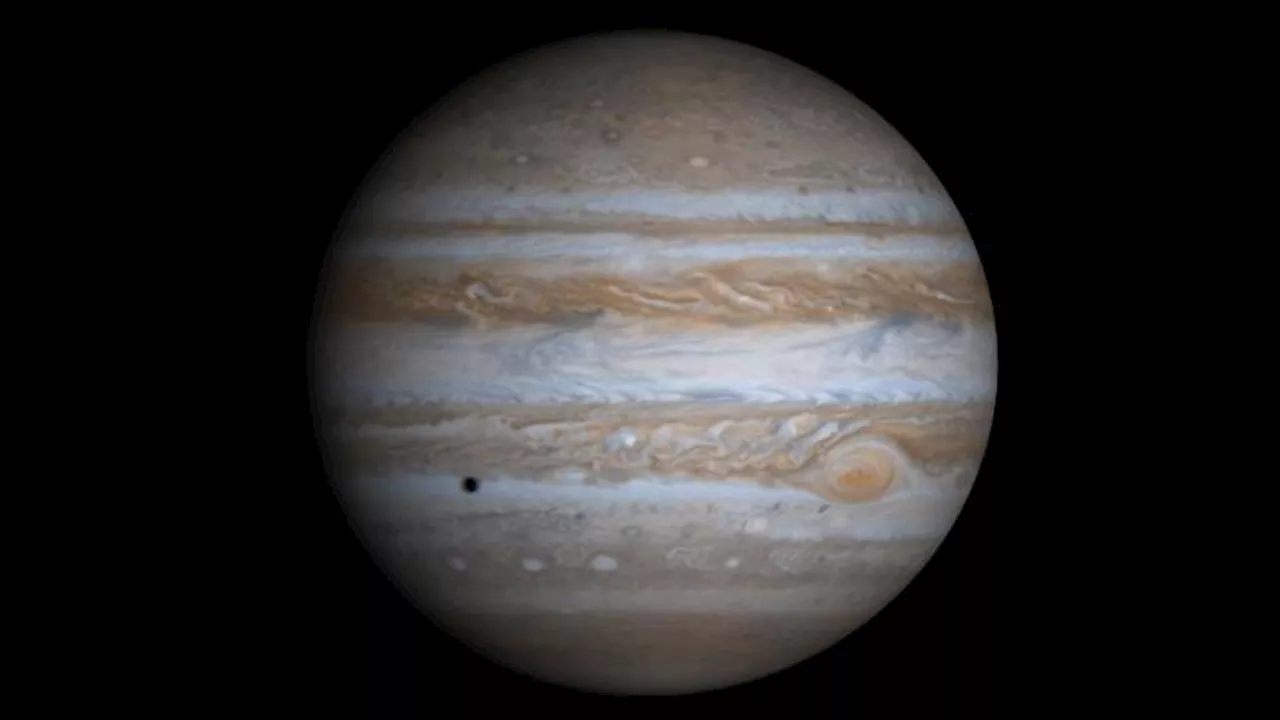
NASA’s Juno mission has delivered surprising new insights into Jupiter, revealing that the gas giant is smaller and more flattened than previously estimated. According to recent findings, the planet’s equatorial radius is now believed to be approximately 5 miles less than earlier calculations, while the distance from pole to pole is around 15 miles smaller than once thought.
This significant update comes from data gathered by the Juno spacecraft, which has been orbiting Jupiter since 2016. By employing a technique known as radio occultation, Juno was able to measure alterations in radio signals as they passed through Jupiter’s dense atmosphere. During its multiple flybys, the spacecraft transmitted radio waves back to Earth while moving behind Jupiter, allowing scientists to analyze how the signals bent and slowed. This method provided crucial information about the planet’s temperature, pressure, and atmospheric structure, enabling researchers to refine their understanding of Jupiter’s dimensions.
Understanding Jupiter’s Shape and Its Implications
The updated measurements indicate that Jupiter is not only smaller than previously believed but also more noticeably squashed. This flattening results from the planet’s rapid rotation, which completes a full spin in under 10 hours. The implications of accurately defining Jupiter’s shape extend beyond our solar system. As a reference point for studying gas giants and distant exoplanets, even minor adjustments to Jupiter’s known dimensions can enhance how scientists interpret observations of exoplanets orbiting other stars.
NASA emphasizes that understanding Jupiter’s shape is vital for comprehending its massive gravitational field, the energy dynamics within its atmosphere, and the mysteries hidden beneath its swirling cloud tops. The findings challenge long-held perceptions and highlight the importance of ongoing research in planetary science.
Since its arrival at Jupiter, Juno has revealed a wealth of information about the planet’s magnetic field, deep atmospheric jets, and enigmatic interior. As scientists continue to analyze the data, it is evident that while Jupiter itself remains unchanged, our understanding of the planet is evolving rapidly.
The Future of Planetary Research
As astronomy enthusiasts eagerly anticipate upcoming events such as the return of a total solar eclipse and the Artemis II mission, the revelations about Jupiter’s size and shape may prompt a reevaluation of educational materials and scientific models. The findings could lead to updates in textbooks and scholarly articles as the scientific community integrates these new insights into their understanding of both Jupiter and gas giants at large.
The Juno mission, with its groundbreaking methodology and innovative approach to studying one of the solar system’s most fascinating planets, continues to foster a deeper understanding of our cosmic neighborhood. Jupiter, often seen as a giant among planets, is now being viewed through a new lens, reminding us that our knowledge of the universe is always subject to change and evolution.
RFK Jr. Claims Keto Diet Can ‘Cure’ Mental Illness: A Fact Check

Alabama Lawmakers Push Major Utility Reforms with New Bills

GUESS JEANS Launches Flagship Store in Los Angeles, Emphasizing Community

New Orleans Welcomes Parade Enthusiasts as Mardi Gras Approaches

Research Reveals Limits of Quantum Correlations in Materials

Goku’s Most Defining Losses: Five Key Battles in Dragon Ball

DJI Mini 5 Pro Combo Available for $1,078 with Free Shipping

Urgent Update: Alex Garland’s Annihilation Gains Cult Status After Box Office Struggles

QuinStreet Reports Strong Q2 2026 Earnings, Sees Growth Ahead

Send Holiday Parcels for £1.99 with New Comparison Service

University of Hawaiʻi Leads $25M AI Project to Monitor Natural Disasters

Interstellar Object 3I/ATLAS Emits Unique Metal Alloy, Says Scientist

Maui County Reopens Upgraded Lānaʻi Fifth Street Courts Today!

Kelly McCreary Discusses Future of Maggie and Winston in Grey’s Anatomy

Researchers Achieve Fastest Genome Sequencing in Under Four Hours

Iconic Sand Dollar Social Club Listed for $3 Million in Folly Beach

Afghan Refugee Detained by ICE After Asylum Hearing in New York

McEwen Inc. Secures Tartan Lake Gold Mine Through Acquisition
-
 Lifestyle2 months ago
Send Holiday Parcels for £1.99 with New Comparison Service
-
Science3 months ago
University of Hawaiʻi Leads $25M AI Project to Monitor Natural Disasters
-
 Science4 months ago
Interstellar Object 3I/ATLAS Emits Unique Metal Alloy, Says Scientist
-
 Top Stories2 months ago
Maui County Reopens Upgraded Lānaʻi Fifth Street Courts Today!
-
 Entertainment4 months ago
Kelly McCreary Discusses Future of Maggie and Winston in Grey’s Anatomy
-
 Science4 months ago
Researchers Achieve Fastest Genome Sequencing in Under Four Hours
-
 Business4 months ago
Iconic Sand Dollar Social Club Listed for $3 Million in Folly Beach
-
 Politics4 months ago
Afghan Refugee Detained by ICE After Asylum Hearing in New York
-
 Business4 months ago
McEwen Inc. Secures Tartan Lake Gold Mine Through Acquisition
-

 Lifestyle4 months ago
Jump for Good: San Clemente Pier Fundraiser Allows Legal Leaps
-

 Health4 months ago
Peptilogics Secures $78 Million to Combat Prosthetic Joint Infections
-

 Health4 months ago
Researcher Uncovers Zika Virus Pathway to Placenta Using Nanotubes