
Science
NASA’s Perseverance Rover Captures Electric Sounds on Mars

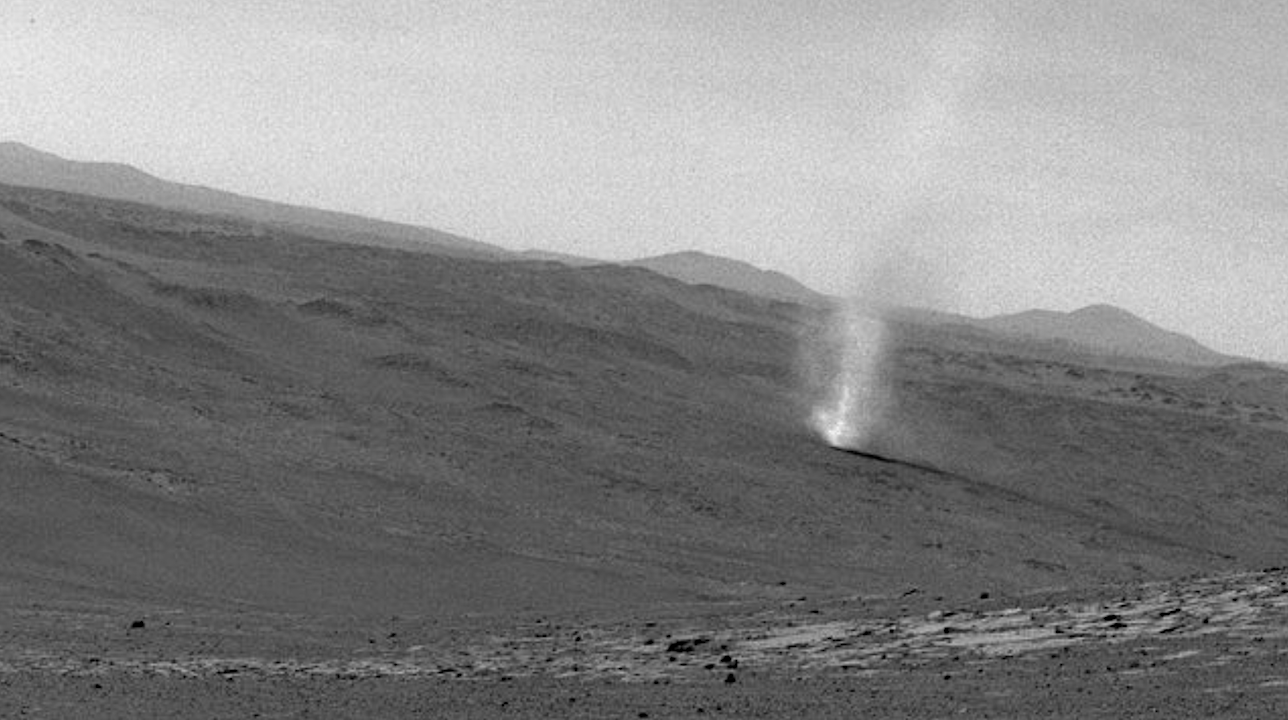
NASA’s Perseverance rover has made a remarkable discovery by detecting the sounds of electrical discharges and mini-sonic booms generated by dust devils on Mars. This phenomenon, long theorized by scientists, has now been confirmed through audio and electromagnetic recordings captured by the rover’s SuperCam microphone. The findings were published on November 26, 2023, in the journal Nature, highlighting significant implications for Martian atmospheric chemistry, climate, and the potential for habitability.
Dust devils, which are common on the Red Planet, are formed when warm air near the surface rises and rotates, creating columns of swirling air. This process occurs as air heated by contact with the ground ascends through denser, cooler air above. As surrounding air moves to fill the void left by the rising air, it begins to rotate, similar to how ice skaters spin faster by drawing their arms closer to their bodies. The SuperCam microphone recorded the electrical discharge sounds as a dust devil passed over the rover on October 12, 2024, producing distinct crackles between the sounds of the dust devil’s front and trailing walls.
Since its landing, Perseverance has recorded 55 distinct electrical events, starting on the mission’s 215th Martian day, or sol, in 2021. Sixteen of these recordings were linked to dust devils that passed directly over the rover.
Understanding the Triboelectric Effect
Before Perseverance’s arrival, scientists speculated that the friction generated by tiny dust grains in Martian dust devils could create enough electrical charge to produce sparks. This is known as the triboelectric effect, similar to the static electricity experienced when walking across a carpet in socks and then touching a metal doorknob. According to Baptiste Chide, a member of the Perseverance science team and a planetary scientist at L’Institut de Recherche en Astrophysique et Planétologie in France, “Triboelectric charging of sand and snow particles is well documented on Earth, particularly in desert regions, but it rarely results in actual electrical discharges.”
On Mars, the thinner atmosphere allows for easier charge generation, as the amount of charge required to create sparks is significantly lower than on Earth. The discovery of these electrical discharges offers new insights into the Martian environment.
While exploring the rim of Jezero Crater, the Perseverance rover captured images of multiple dust devils in January 2025. These phenomena have been documented for decades by NASA’s Mars robotic explorers.
The Impact of Electrical Discharges on Mars
Perseverance’s SuperCam instrument not only analyzes sounds from its laser interactions with rocks but has also recorded wind and the first audio of a Martian dust devil. Researchers were uncertain whether electromagnetic disturbances and electrical discharge sounds would occur frequently enough for documentation. However, as they analyzed data from the mission, they quickly identified recognizable sounds of electrical activity.
“We got some good ones where you can clearly hear the ‘snap’ sound of the spark,” said Ralph Lorenz, a Perseverance scientist at the Johns Hopkins Applied Physics Lab. “In the Sol 215 dust devil recording, you can hear not only the electrical sound, but also the wall of the dust devil moving over the rover.”
In addition to the dust devils, 35 discharges were recorded during the passage of convective fronts associated with regional dust storms. These fronts, characterized by intense turbulence, facilitate triboelectric charging and charge separation, which is the process of transferring electrons between two objects.
Interestingly, researchers found that the frequency of electrical discharges did not increase during seasons with higher dust storms. This suggests that the buildup of electrical charge is more closely related to localized turbulence rather than merely the density of dust in the atmosphere.
The confirmation of electrical discharges transforms our understanding of Mars. Their existence indicates that the Martian atmosphere can become sufficiently charged to initiate chemical reactions, resulting in the creation of highly oxidizing compounds such as chlorates and perchlorates. These substances can disrupt organic molecules that are essential for life, altering the overall chemical balance of the Martian atmosphere.
Furthermore, these findings may explain the rapid disappearance of Martian methane, providing crucial insights into the challenges life may have encountered and the planet’s potential for habitability.
Given the prevalence of dust on Mars, the presence of electrical charges generated by particles colliding could significantly influence dust movement on the planet. Understanding dust transport is vital for comprehending Martian climate, which remains poorly understood.
The discovery of triboelectric discharges also poses potential risks to the electronic equipment of current robotic missions. However, the absence of adverse electrostatic discharge effects during decades of Mars surface operations suggests effective grounding practices. These findings will also help inform safety measures for future astronauts exploring the Red Planet.
Managed for NASA by Caltech, the Jet Propulsion Laboratory built and oversees the operations of the Perseverance rover as part of the agency’s Mars Exploration Program. For more information about the Perseverance mission, visit the NASA website.

Urgent Tax Savings Alert: Maximize Deductions Before April 15

Trump’s Administration Faces Uncertainty Over Government Shutdowns

Cosmic Defects: The Mystery of the Universe’s Missing Anomalies

Rapid City Parks Department Opens Registration for Bocce Leagues

Samsung Galaxy Watch 9 to Feature Larger 435mAh Battery Soon

Two Dead After Student Boats Capsize Off Okinawa Coast

Healthy Choice Wellness Reports Earnings with Mixed Results

Prince Harry Positions Himself as Royal Family’s Image Reviver

All Points North Lodge Achieves FSPHP-ETA Accreditation

Send Holiday Parcels for £1.99 with New Comparison Service

University of Hawaiʻi Leads $25M AI Project to Monitor Natural Disasters

Maui County Reopens Upgraded Lānaʻi Fifth Street Courts Today!

Daily Codeword Puzzle Launches on October 21, 2025

Congresswoman Under Fire for Misleading Epstein Donation Claims

Interstellar Object 3I/ATLAS Emits Unique Metal Alloy, Says Scientist

Trump Vows to Resolve Afghanistan-Pakistan Crisis “Very Quickly”

Charles Darwin’s Address Book Reveals Hidden Aspects of His Life

Rediscovering Chrysler: 5 Overlooked Models from the 1980s
-
 Lifestyle8 months ago
Send Holiday Parcels for £1.99 with New Comparison Service
-
Science9 months ago
University of Hawaiʻi Leads $25M AI Project to Monitor Natural Disasters
-
 Top Stories8 months ago
Maui County Reopens Upgraded Lānaʻi Fifth Street Courts Today!
-
 Entertainment10 months ago
Daily Codeword Puzzle Launches on October 21, 2025
-
 Lifestyle9 months ago
Congresswoman Under Fire for Misleading Epstein Donation Claims
-
 Science10 months ago
Interstellar Object 3I/ATLAS Emits Unique Metal Alloy, Says Scientist
-
 Top Stories9 months ago
Trump Vows to Resolve Afghanistan-Pakistan Crisis “Very Quickly”
-
 Science8 months ago
Charles Darwin’s Address Book Reveals Hidden Aspects of His Life
-
 Lifestyle8 months ago
Rediscovering Chrysler: 5 Overlooked Models from the 1980s
-

 Science7 months ago
Understanding Generation Z: Strategies for Engaging the Workforce
-

 Entertainment10 months ago
Kelly McCreary Discusses Future of Maggie and Winston in Grey’s Anatomy
-

 Top Stories8 months ago
aespa Faces Backlash Over G-Dragon Interaction at 2025 MAMAs