
Science
Researchers Discover Ancient Elephant Footprints in Murcia Dunes

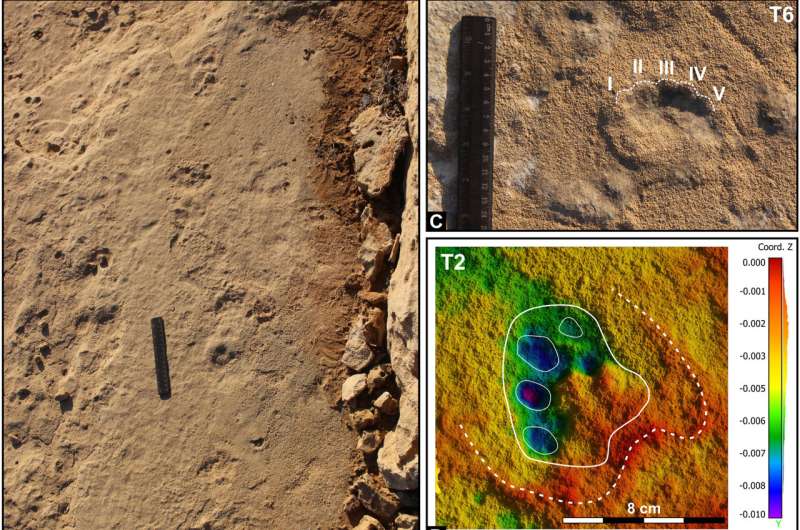
An international research team has documented the first fossilized footprints of prehistoric elephants in the coastal dunes of Murcia, Spain. The footprints, attributed to the species Palaeoloxodon antiquus, commonly known as the straight-tusked elephant, date back to the Quaternary period, approximately 125,000 years ago. This groundbreaking study was published in the journal Quaternary Science Reviews on December 17, 2025.
New Insights into Prehistoric Ecosystems
The research was a collaborative effort involving experts from the University of Seville, the Andalusian Institute of Earth Sciences in Granada, and the University of Huelva. The study, titled “New vertebrate footprint sites in the latest interglacial dune deposits on the coast of Murcia (southeast Spain). Ecological corridors for elephants in Iberia?” reconstructs the movement patterns of megafauna during the Last Interglacial period.
Fieldwork concentrated on regions like Calblanque and Torre de Cope, coordinated by Carlos Neto de Carvalho from the Geology Office of Idanha-a-Nova and the University of Lisbon. The team included notable researchers such as Fernando Muñiz Guinea and Miguel Cortés-Sánchez from the University of Seville, alongside other experts from Portugal.
This discovery sheds light on the biodiversity of a coastal forest ecosystem during the marine isotopic stage (MIS 5e). Researchers confirmed the presence of four fossil footprint sites that indicate a diverse community of mammals. Among the most significant findings is a 2.75-meter-long trackway at Torre de Cope, featuring four rounded footprints measuring between 40–50 cm in diameter. This arrangement is characteristic of the quadrupedal gait of elephants and suggests that the trackway belonged to an adult Palaeoloxodon antiquus, approximately 2.3 meters tall at the hip and weighing around 2.6 tonnes.
Evidence of Diverse Fauna
In addition to the elephant footprints, the study revealed traces of other species. In Calblanque, researchers found a trail left by a medium-sized mustelid, measuring one and a half meters long, consisting of ten circular footprints. These footprints indicate slow movements near water sources. Further discoveries included an isolated footprint of a canid, measuring 10 × 8 cm, suggesting the presence of predators like wolves (Canis lupus) in the area.
Moreover, bifid footprints compatible with red deer (Cervus elaphus) were identified, indicating their movement through the dunes. A young equid (Equus ferus) also left footprints measuring approximately 10 × 12 cm, representing the most recent record of this species in southeastern Spain.
Together, these findings support the hypothesis of coastal ecological corridors that facilitated seasonal migrations, linking Mediterranean forests with more humid coastal landscapes.
The research not only expands knowledge of paleoecology but also suggests the Iberian Peninsula acted as a climate refuge for various species during the Pleistocene. The connection between these ancient ecological corridors and paleoanthropology highlights the geographical overlap between elephant migration routes and Neanderthal habitation sites, indicating rich resources for hunting and subsistence.
This study opens new avenues for understanding the intricate relationships between climate, wildlife, and human populations in prehistoric Iberia. Further exploration of these coastal corridors could provide valuable insights into the life and migration patterns of early humans and the megafauna that coexisted with them.
For more information, refer to the full study by Carlos Neto de Carvalho et al., published in Quaternary Science Reviews.

PETA Condemns Simone Biles for Getting Puppy with Cropped Ears

Researchers Uncover Distinct Cold Sensors in Skin and Organs

Russia’s Sabotage Campaign Targets Europe, Western Officials Report

EUR/GBP Rises as Bank of England Set to Cut Rates

Ana Urushadze’s ‘Supporting Role’ Trailer Unveiled Ahead of Premiere

City Council Proposes New Community Safety Agency Under Mamdani

French Business Confidence Soars to Highest Level Since June 2024

Urgent Power Restoration Efforts Underway in Clark County

Lee Junho Reveals Painful Truths of “Beast Idol” Life in Urgent Interview

Send Holiday Parcels for £1.99 with New Comparison Service

University of Hawaiʻi Leads $25M AI Project to Monitor Natural Disasters

Interstellar Object 3I/ATLAS Emits Unique Metal Alloy, Says Scientist

Researchers Achieve Fastest Genome Sequencing in Under Four Hours

Iconic Sand Dollar Social Club Listed for $3 Million in Folly Beach

Afghan Refugee Detained by ICE After Asylum Hearing in New York

McEwen Inc. Secures Tartan Lake Gold Mine Through Acquisition

Peptilogics Secures $78 Million to Combat Prosthetic Joint Infections

Jump for Good: San Clemente Pier Fundraiser Allows Legal Leaps
-
 Lifestyle1 week ago
Send Holiday Parcels for £1.99 with New Comparison Service
-
Science2 months ago
University of Hawaiʻi Leads $25M AI Project to Monitor Natural Disasters
-
 Science2 months ago
Interstellar Object 3I/ATLAS Emits Unique Metal Alloy, Says Scientist
-
 Science2 months ago
Researchers Achieve Fastest Genome Sequencing in Under Four Hours
-
 Business2 months ago
Iconic Sand Dollar Social Club Listed for $3 Million in Folly Beach
-
 Politics2 months ago
Afghan Refugee Detained by ICE After Asylum Hearing in New York
-
 Business2 months ago
McEwen Inc. Secures Tartan Lake Gold Mine Through Acquisition
-
 Health2 months ago
Peptilogics Secures $78 Million to Combat Prosthetic Joint Infections
-
 Lifestyle2 months ago
Jump for Good: San Clemente Pier Fundraiser Allows Legal Leaps
-
 Science2 months ago
Mars Observed: Detailed Imaging Reveals Dust Avalanche Dynamics
-

 Health2 months ago
Researcher Uncovers Zika Virus Pathway to Placenta Using Nanotubes
-

 Entertainment2 months ago
Jennifer Lopez Addresses A-Rod Split in Candid Interview