
Science
Researchers Launch LimbNET to Revolutionize Limb Development Study

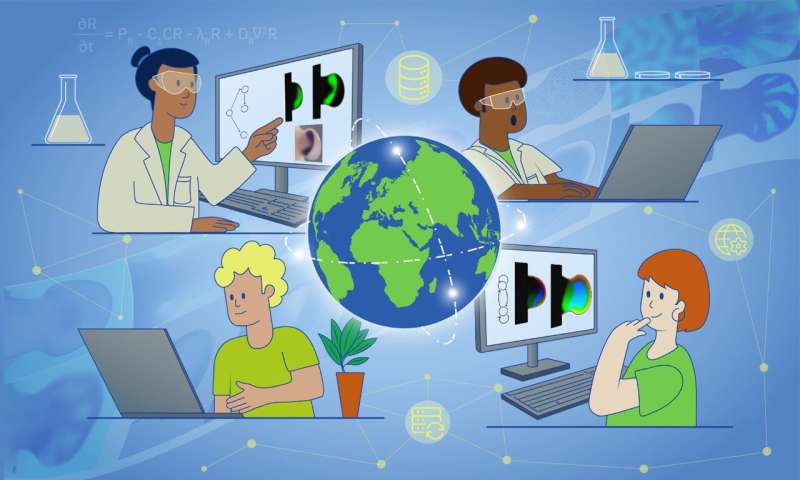
Researchers at the European Molecular Biology Laboratory (EMBL) in Barcelona have unveiled LimbNET, an innovative open-access online platform designed to transform the study of limb development. This new tool allows scientists to simulate and manipulate gene regulatory networks, enhancing collaborative research and fostering deeper understanding of biological processes. The details of this groundbreaking initiative were published on December 4, 2025, in the journal Molecular Systems Biology.
Features of LimbNET and its Collaborative Potential
LimbNET is not merely a repository of data; it represents a significant leap forward in how researchers can interact with and build upon existing models. By enabling users to define and simulate custom gene regulatory networks, LimbNET streamlines the process of hypothesis testing and comparison within a unified framework. As Antoni Matyjaszkiewicz, first author and Research Staff Scientist in EMBL’s Sharpe Group, stated, “Our aim with LimbNET is to have everything in one place, so that the data, the models and the simulations are not scattered across research groups, countries and institutes.”
This platform is designed for ease of access, requiring no downloads or installations. Any researcher worldwide can access it through their browser, democratizing advanced modeling tools and making them available to a broader scientific community.
Transforming Scientific Publishing and Engagement
A standout feature of LimbNET is its potential to change how scientists publish their findings. According to James Sharpe, Head of EMBL Barcelona and senior author of the study, researchers can now present an interactive version of their work. This approach captures the entire logic of their ideas, allowing others to engage with and modify the simulations. “This is like going from a static cookbook with text and photos to a kitchen where you can try the recipe yourself,” Sharpe explained.
LimbNET fosters a new model of scientific publishing, making all aspects of a study openly accessible. This allows other researchers to challenge, validate, or replicate published work, promoting reproducibility and critical engagement within the scientific community. The platform creates a dynamic ecosystem of models that can evolve as new data emerges.
While it is still early in the project’s development, the authors believe that LimbNET will encourage broader participation in modeling, particularly among those with limited experience in computational simulations. The user-friendly interface enables researchers to start with existing models, facilitating interdisciplinary collaboration and dialogue.
Matyjaszkiewicz emphasized the importance of fostering conversations between experimentalists and computational researchers. “This tool can help us refine experiments and rethink how we approach hypotheses,” he said. The goal is to translate qualitative descriptions of mechanisms into tangible and reproducible computational models.
The scientific community has responded positively to LimbNET, recognizing its potential to innovate the study of limb development. Rolf Zeller, a professor at the University of Basel, remarked, “LimbNET opens an exciting new avenue as it facilitates moving from studying gene interactions to integrative analysis of complex networks.” His endorsement highlights the platform’s accessibility and collaborative spirit.
In conclusion, LimbNET represents a significant advancement in the field of developmental biology, promising to enhance research collaboration and open new avenues for scientific inquiry. By providing a platform where models can be tested and shared, it aims to foster a more integrated approach to understanding limb development.

Urgent Tax Savings Alert: Maximize Deductions Before April 15

Trump’s Administration Faces Uncertainty Over Government Shutdowns

Cosmic Defects: The Mystery of the Universe’s Missing Anomalies

Rapid City Parks Department Opens Registration for Bocce Leagues

Samsung Galaxy Watch 9 to Feature Larger 435mAh Battery Soon

Two Dead After Student Boats Capsize Off Okinawa Coast

Healthy Choice Wellness Reports Earnings with Mixed Results

Prince Harry Positions Himself as Royal Family’s Image Reviver

All Points North Lodge Achieves FSPHP-ETA Accreditation

Send Holiday Parcels for £1.99 with New Comparison Service

University of Hawaiʻi Leads $25M AI Project to Monitor Natural Disasters

Maui County Reopens Upgraded Lānaʻi Fifth Street Courts Today!

Daily Codeword Puzzle Launches on October 21, 2025

Congresswoman Under Fire for Misleading Epstein Donation Claims

Interstellar Object 3I/ATLAS Emits Unique Metal Alloy, Says Scientist

Trump Vows to Resolve Afghanistan-Pakistan Crisis “Very Quickly”

Charles Darwin’s Address Book Reveals Hidden Aspects of His Life

Rediscovering Chrysler: 5 Overlooked Models from the 1980s
-
 Lifestyle8 months ago
Send Holiday Parcels for £1.99 with New Comparison Service
-
Science9 months ago
University of Hawaiʻi Leads $25M AI Project to Monitor Natural Disasters
-
 Top Stories8 months ago
Maui County Reopens Upgraded Lānaʻi Fifth Street Courts Today!
-
 Entertainment10 months ago
Daily Codeword Puzzle Launches on October 21, 2025
-
 Lifestyle9 months ago
Congresswoman Under Fire for Misleading Epstein Donation Claims
-
 Science10 months ago
Interstellar Object 3I/ATLAS Emits Unique Metal Alloy, Says Scientist
-
 Top Stories9 months ago
Trump Vows to Resolve Afghanistan-Pakistan Crisis “Very Quickly”
-
 Science8 months ago
Charles Darwin’s Address Book Reveals Hidden Aspects of His Life
-
 Lifestyle8 months ago
Rediscovering Chrysler: 5 Overlooked Models from the 1980s
-

 Science7 months ago
Understanding Generation Z: Strategies for Engaging the Workforce
-

 Entertainment10 months ago
Kelly McCreary Discusses Future of Maggie and Winston in Grey’s Anatomy
-

 Top Stories8 months ago
aespa Faces Backlash Over G-Dragon Interaction at 2025 MAMAs