
Science
Researchers Unveil Method to Use Gravitational Waves for Dark Matter Insights

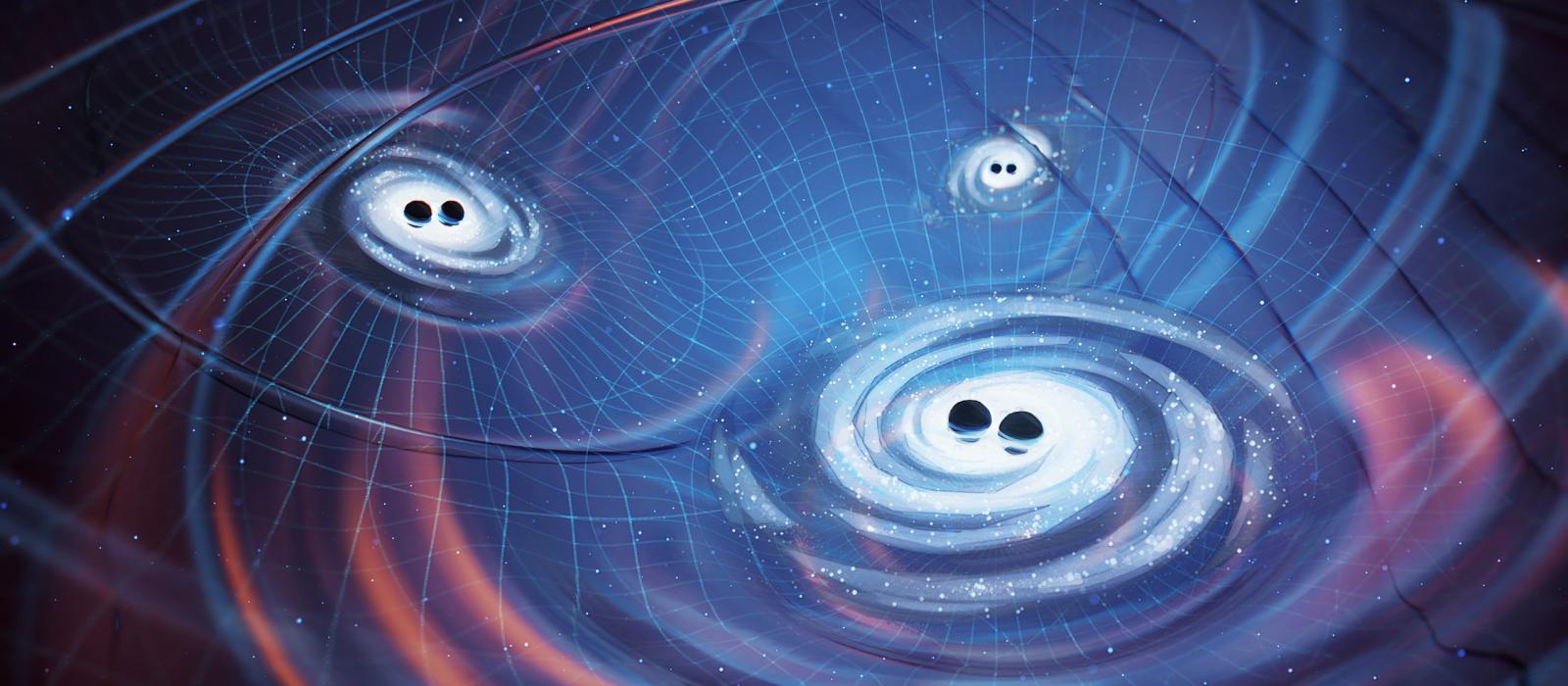
The detection of gravitational waves (GWs) has opened new avenues in astrophysics, and researchers from the University of Amsterdam have proposed a groundbreaking method to utilize these waves in the quest to understand dark matter. The study, published in the journal Physical Review Letters, suggests that GWs produced by merging black holes could provide critical insights into the elusive nature of dark matter, which is believed to constitute approximately 65% of the universe’s mass.
Since the first detection of GWs in 2015, which confirmed a key aspect of Albert Einstein’s Theory of General Relativity, the field of astronomy has undergone a significant transformation. Gravitational waves are generated when massive objects, such as black holes and neutron stars, collide, producing ripples in spacetime that can be detected across vast distances.
New Insights from Gravitational Wave Research
The research team, led by Rodrigo Vicente, Theophanes K. Karydas, and Gianfranco Bertone from the university’s Institute of Physics and the Gravitation & Astroparticle Physics Amsterdam (GRAPPA), has developed an advanced model to analyze how dark matter interacts with GWs from black hole mergers. Their work significantly enhances previous studies, which often relied on simplified models of black hole environments.
The new findings focus on the phenomenon of extreme mass-ratio inspirals (EMRIs), where smaller compact objects spiral into larger black holes, resulting in the production of GWs. By employing a fully relativistic framework, the researchers have shown how dense accumulations of dark matter might create distinctive signatures in GW signals, offering a potential method for mapping dark matter’s distribution in the universe.
The implications of this research are profound. As the European Space Agency (ESA) prepares to launch the Laser Interferometer Space Antenna (LISA) in approximately a decade, the new models developed by the University of Amsterdam team could inform expectations about the types of GWs that will be detected. LISA, equipped with three spacecraft and advanced laser technology, aims to capture over 10,000 GW signals during its mission.
Mapping Dark Matter Through Gravitational Waves
This research marks a significant step in a broader effort to leverage GWs as a tool for understanding the cosmos. The ability to discern the presence of dark matter through gravitational wave analysis could illuminate not only its distribution but also its fundamental characteristics and composition.
The findings also align with ongoing research at other gravitational wave observatories, including the Laser Interferometer Gravitational Wave Observatory (LIGO) and the Virgo Collaboration, as well as the Kamioka Gravitational-wave Detector (KAGRA). The collaborative efforts across these organizations are expected to enhance the understanding of dark matter, advancing the field of cosmology.
As scientists continue to unravel the mysteries of the universe, the potential to decode dark matter through gravitational waves represents a fascinating frontier in astrophysics. With advancements in technology and research methodologies, the next decade could yield unprecedented insights into one of the universe’s greatest enigmas.

Urgent Tax Savings Alert: Maximize Deductions Before April 15

Trump’s Administration Faces Uncertainty Over Government Shutdowns

Cosmic Defects: The Mystery of the Universe’s Missing Anomalies

Rapid City Parks Department Opens Registration for Bocce Leagues

Samsung Galaxy Watch 9 to Feature Larger 435mAh Battery Soon

Two Dead After Student Boats Capsize Off Okinawa Coast

Healthy Choice Wellness Reports Earnings with Mixed Results

Prince Harry Positions Himself as Royal Family’s Image Reviver

All Points North Lodge Achieves FSPHP-ETA Accreditation

Send Holiday Parcels for £1.99 with New Comparison Service

University of Hawaiʻi Leads $25M AI Project to Monitor Natural Disasters

Maui County Reopens Upgraded Lānaʻi Fifth Street Courts Today!

Daily Codeword Puzzle Launches on October 21, 2025

Congresswoman Under Fire for Misleading Epstein Donation Claims

Interstellar Object 3I/ATLAS Emits Unique Metal Alloy, Says Scientist

Trump Vows to Resolve Afghanistan-Pakistan Crisis “Very Quickly”

Charles Darwin’s Address Book Reveals Hidden Aspects of His Life

Rediscovering Chrysler: 5 Overlooked Models from the 1980s
-
 Lifestyle8 months ago
Send Holiday Parcels for £1.99 with New Comparison Service
-
Science9 months ago
University of Hawaiʻi Leads $25M AI Project to Monitor Natural Disasters
-
 Top Stories8 months ago
Maui County Reopens Upgraded Lānaʻi Fifth Street Courts Today!
-
 Entertainment10 months ago
Daily Codeword Puzzle Launches on October 21, 2025
-
 Lifestyle9 months ago
Congresswoman Under Fire for Misleading Epstein Donation Claims
-
 Science10 months ago
Interstellar Object 3I/ATLAS Emits Unique Metal Alloy, Says Scientist
-
 Top Stories9 months ago
Trump Vows to Resolve Afghanistan-Pakistan Crisis “Very Quickly”
-
 Science9 months ago
Charles Darwin’s Address Book Reveals Hidden Aspects of His Life
-
 Lifestyle8 months ago
Rediscovering Chrysler: 5 Overlooked Models from the 1980s
-

 Science7 months ago
Understanding Generation Z: Strategies for Engaging the Workforce
-

 Entertainment10 months ago
Kelly McCreary Discusses Future of Maggie and Winston in Grey’s Anatomy
-

 Top Stories8 months ago
aespa Faces Backlash Over G-Dragon Interaction at 2025 MAMAs