
Science
Scientists Explore Antarctica’s Gravity Anomaly for Earth Insights

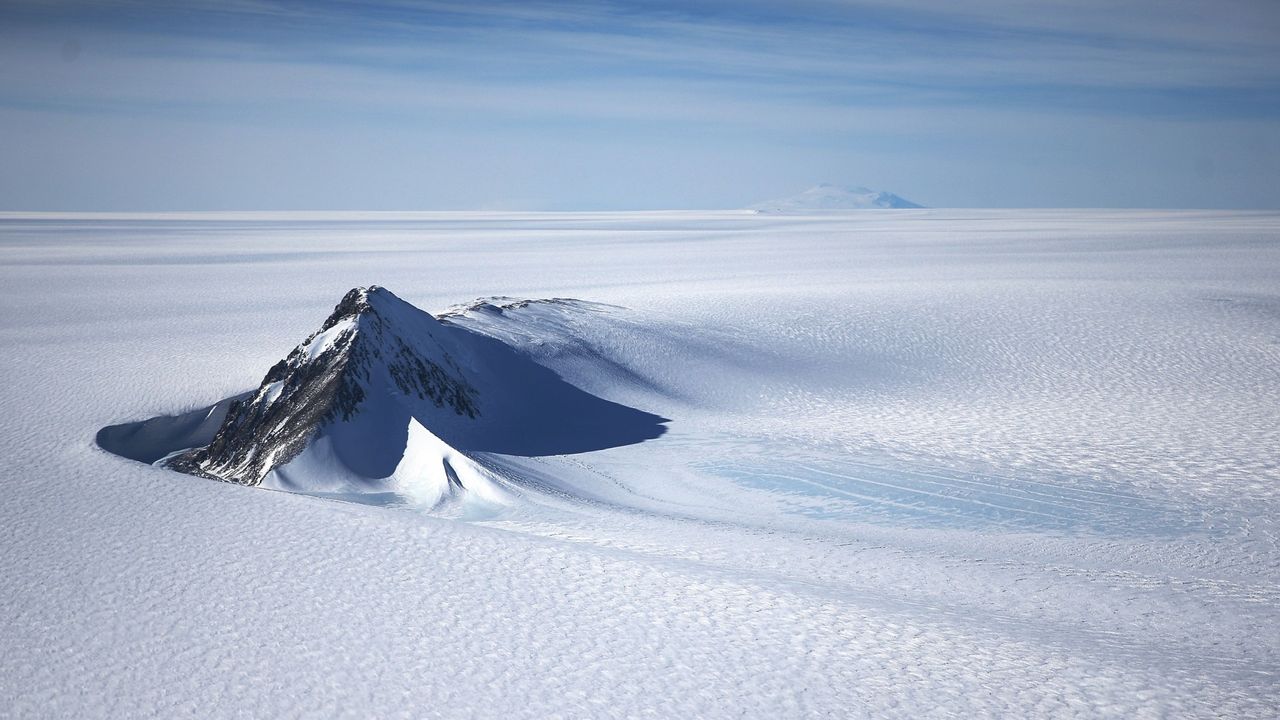
A significant discovery has emerged from beneath Antarctica, unveiling a “gravity hole” that offers scientists insights into the evolution of Earth’s deep interior. This anomaly, known as the Antarctic Geoid Low, is a gentle depression in Earth’s gravity field that reflects the distribution of mass beneath the surface. A new study led by researchers at the University of Florida reconstructed the history of this gravity feature, revealing it to be a long-term signature of dynamic geological processes occurring over the past 70 million years.
The Antarctic Geoid Low is not a void as the term “gravity hole” might imply. Instead, it represents a long-lived imprint of the slow movements of rock deep beneath Antarctica’s ice sheet. According to Alessandro Forte, Ph.D., a professor of geophysics at the University of Florida and co-author of the study, this anomaly serves as a “window into deep Earth movements” that have shaped our planet’s gravity field in unexpected ways.
Understanding the implications of the Antarctic Geoid Low involves examining how gravity varies across the globe. The Earth’s interior is not uniform; hotter mantle rocks rise while cooler, denser slabs sink. These slow but significant movements redistribute mass, subtly altering the planet’s gravity field. In regions like Antarctica, where gravity is slightly weaker, the ocean’s gravity-defined surface, known as the geoid, sits closer to the planet’s center. The Antarctic Geoid Low is a pronounced example of such a gravitational valley and is considered the deepest long-wavelength valley on Earth.
Reconstructing the Gravity Anomaly
Using seismic images derived from earthquake waves, the researchers utilized physics-based models to simulate the evolution of the gravitational anomaly over millions of years. Given that direct observations of the mantle are limited to present-day conditions, the study relied on advanced simulations that tested various hypotheses about the properties of mantle rocks, including their viscosity.
Forte expressed surprise at the coherence of the findings, stating, “The gravity low is not a random, short-lived feature.” The study shows that the anomaly has persisted throughout much of the last 70 million years, with its strength and shape evolving in response to significant changes in the flow of rocks beneath Antarctica. Notably, the gravity low intensified around 34 million years ago, coinciding with Antarctica’s transition into a permanently ice-covered continent.
This timing suggests a link between long-wavelength changes in Earth’s gravity field and regional sea levels, potentially affecting ice-sheet dynamics. Today, the gravity-defined sea surface in the Antarctic geoid low lies about 394 feet (120 meters) below the global average, a significant geophysical difference. While the study does not directly connect gravity shifts to ice growth, it highlights a crucial internal process that may influence sea surface shapes over geological timescales.
Implications for Planetary Science
Antarctica’s gravity anomaly stands out due to its unusually large, long-wavelength amplitude and enduring presence over millions of years. Although other gravity anomalies exist on Earth, the Antarctic Geoid Low is unique because it reflects mantle-driven dynamics. This study, published on December 19, 2025, emphasizes the significance of long-wavelength gravity anomalies in understanding planetary interiors.
The findings extend beyond Earth, offering valuable insights into planetary science. Similar gravitational anomalies on other celestial bodies like Mars and Venus can provide clues about their internal structures and geological histories. Earth is particularly well-positioned for such studies, as its gravity measurements can be cross-referenced with seismic data and geological records.
In conclusion, the research conducted by the University of Florida represents approximately a decade of work and highlights an essential aspect of Earth dynamics. As Forte noted, “Our study shows how deep Earth dynamics can reshape the gravity field over geological time,” emphasizing the need for further investigation into how these processes relate to climate and ice dynamics. The next phase of this research aims to explore these connections further, continuing to enhance our understanding of the Earth’s complex inner workings.

Urgent Tax Savings Alert: Maximize Deductions Before April 15

Trump’s Administration Faces Uncertainty Over Government Shutdowns

Cosmic Defects: The Mystery of the Universe’s Missing Anomalies

Rapid City Parks Department Opens Registration for Bocce Leagues

Samsung Galaxy Watch 9 to Feature Larger 435mAh Battery Soon

Two Dead After Student Boats Capsize Off Okinawa Coast

Healthy Choice Wellness Reports Earnings with Mixed Results

Prince Harry Positions Himself as Royal Family’s Image Reviver

All Points North Lodge Achieves FSPHP-ETA Accreditation

Send Holiday Parcels for £1.99 with New Comparison Service

University of Hawaiʻi Leads $25M AI Project to Monitor Natural Disasters

Maui County Reopens Upgraded Lānaʻi Fifth Street Courts Today!

Daily Codeword Puzzle Launches on October 21, 2025

Congresswoman Under Fire for Misleading Epstein Donation Claims

Interstellar Object 3I/ATLAS Emits Unique Metal Alloy, Says Scientist

Trump Vows to Resolve Afghanistan-Pakistan Crisis “Very Quickly”

Charles Darwin’s Address Book Reveals Hidden Aspects of His Life

Rediscovering Chrysler: 5 Overlooked Models from the 1980s
-
 Lifestyle8 months ago
Send Holiday Parcels for £1.99 with New Comparison Service
-
Science9 months ago
University of Hawaiʻi Leads $25M AI Project to Monitor Natural Disasters
-
 Top Stories8 months ago
Maui County Reopens Upgraded Lānaʻi Fifth Street Courts Today!
-
 Entertainment10 months ago
Daily Codeword Puzzle Launches on October 21, 2025
-
 Lifestyle9 months ago
Congresswoman Under Fire for Misleading Epstein Donation Claims
-
 Science10 months ago
Interstellar Object 3I/ATLAS Emits Unique Metal Alloy, Says Scientist
-
 Top Stories9 months ago
Trump Vows to Resolve Afghanistan-Pakistan Crisis “Very Quickly”
-
 Science9 months ago
Charles Darwin’s Address Book Reveals Hidden Aspects of His Life
-
 Lifestyle8 months ago
Rediscovering Chrysler: 5 Overlooked Models from the 1980s
-

 Science7 months ago
Understanding Generation Z: Strategies for Engaging the Workforce
-

 Entertainment10 months ago
Kelly McCreary Discusses Future of Maggie and Winston in Grey’s Anatomy
-

 Top Stories8 months ago
aespa Faces Backlash Over G-Dragon Interaction at 2025 MAMAs