
Science
Supernova’s Cosmic Rays May Illuminate Earth-like Planet Formation

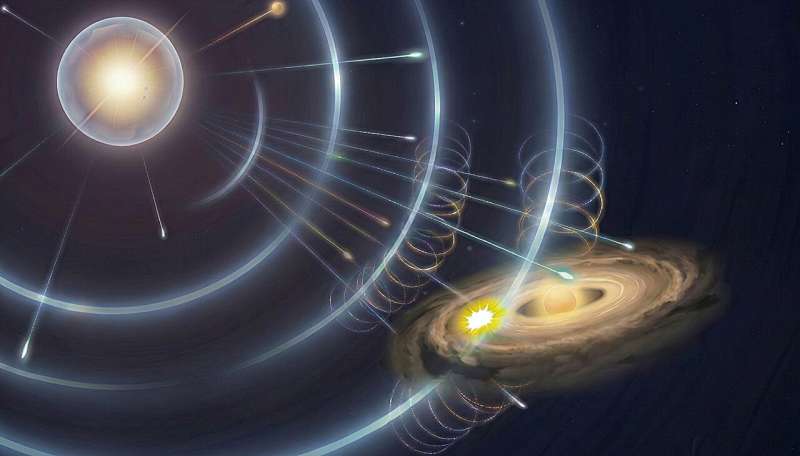
Recent research suggests that cosmic rays from nearby supernovae may play a crucial role in the formation of Earth-like planets. A study published in *Science Advances* by a team led by astrophysicist Ryo Sawada from the Institute for Cosmic Ray Research at the University of Tokyo proposes a new mechanism for the creation of short-lived radioactive elements necessary for planet formation.
For decades, scientists believed that the early solar system was enriched with elements such as aluminum-26, which is essential for forming rocky planets. This enrichment was thought to be the result of a supernova explosion occurring within a specific distance from the forming solar system. However, this classic model relied on what appeared to be an improbable set of circumstances, necessitating an exact distance and timing for the supernova to provide the radioactive material without damaging the protoplanetary disk.
In their investigation, Sawada and his colleagues considered the role of cosmic rays—high-energy particles generated during supernova explosions. They hypothesized that the young solar system may have been immersed in a “cosmic-ray bath,” which could facilitate nuclear reactions that produce the necessary radioactive elements.
New Insights into Planetary Formation
The team utilized numerical simulations to explore this hypothesis. Their findings indicated that cosmic rays could trigger nuclear reactions at distances of about one parsec from a supernova. This distance is common in star clusters where many sun-like stars are born. The study concluded that the production of radioactive elements could occur without the need for a rare coincidental explosion.
This alternative mechanism, termed the “cosmic-ray bath,” suggests a more universal process for the formation of Earth-like planets. As Sawada explained, “If cosmic-ray baths are common, then the thermal histories that shaped Earth’s interior may be common as well.” This could imply that the conditions necessary for forming rocky planets are not as rare as previously thought.
The implications of this research extend beyond just planetary science. If the formation of Earth-like planets does not hinge on a rare supernova encounter, it opens the possibility that many sun-like stars could have similar conditions conducive to life. Ryo Sawada emphasizes that while this study does not guarantee habitability, it reshapes our understanding of how planets like Earth may form.
Broader Implications for Astrophysics
The findings also highlight the interconnectedness of various astrophysical processes. Cosmic-ray acceleration, often studied in high-energy astrophysics, emerges as a significant factor in planetary formation and the potential for habitability. Sawada noted that recognizing this connection can lead to a deeper understanding of our origins.
The study does not claim that every habitable planet will form under these circumstances, as numerous factors—such as the lifetime of the protoplanetary disk, the structure of the star cluster, and stellar dynamics—still play vital roles. Nevertheless, the research provides a compelling narrative that Earth’s formation may not have relied on an extraordinary coincidence.
As researchers continue to explore the cosmos, studies like this one will enhance our understanding of the universe’s potential for hosting life. The exploration of cosmic rays and their effects on planetary systems could lead to further revelations about the conditions that foster habitable environments.
For those interested in the latest scientific advancements, the findings of Ryo Sawada and his team offer a fresh perspective on the origins of Earth-like planets, suggesting that the universe may be more accommodating to life than previously believed.

“Avatar: Fire and Ash” Dominates Box Office with $345 Million

Marilyn Manson Embraces Holiday Spirit Despite Grinch Persona

Lufax and Alerus Financial: A Detailed Comparative Analysis

Dancing With the Stars Crowns Robert Irwin as Season Champion

Browns Fall to Bills, Pressure Mounts on Coach Stefanski

NFL to Showcase Three Exciting Christmas Day Games on Streaming

Reynolds Consumer Products Outperforms Ceconomy in Financial Metrics

Woman Arrested for Allegedly Drowning Child in Kissimmee Pool

Holiday Travel Surge: Chicago Sees Record 263,000 at O’Hare

Send Holiday Parcels for £1.99 with New Comparison Service

University of Hawaiʻi Leads $25M AI Project to Monitor Natural Disasters

Interstellar Object 3I/ATLAS Emits Unique Metal Alloy, Says Scientist

Researchers Achieve Fastest Genome Sequencing in Under Four Hours

Iconic Sand Dollar Social Club Listed for $3 Million in Folly Beach

Afghan Refugee Detained by ICE After Asylum Hearing in New York

McEwen Inc. Secures Tartan Lake Gold Mine Through Acquisition

Peptilogics Secures $78 Million to Combat Prosthetic Joint Infections

Jump for Good: San Clemente Pier Fundraiser Allows Legal Leaps
-
 Lifestyle2 weeks ago
Send Holiday Parcels for £1.99 with New Comparison Service
-
Science2 months ago
University of Hawaiʻi Leads $25M AI Project to Monitor Natural Disasters
-
 Science2 months ago
Interstellar Object 3I/ATLAS Emits Unique Metal Alloy, Says Scientist
-
 Science2 months ago
Researchers Achieve Fastest Genome Sequencing in Under Four Hours
-
 Business2 months ago
Iconic Sand Dollar Social Club Listed for $3 Million in Folly Beach
-
 Politics2 months ago
Afghan Refugee Detained by ICE After Asylum Hearing in New York
-
 Business2 months ago
McEwen Inc. Secures Tartan Lake Gold Mine Through Acquisition
-
 Health2 months ago
Peptilogics Secures $78 Million to Combat Prosthetic Joint Infections
-
 Lifestyle2 months ago
Jump for Good: San Clemente Pier Fundraiser Allows Legal Leaps
-

 Science2 months ago
Mars Observed: Detailed Imaging Reveals Dust Avalanche Dynamics
-

 Health2 months ago
Researcher Uncovers Zika Virus Pathway to Placenta Using Nanotubes
-

 Entertainment2 months ago
Jennifer Lopez Addresses A-Rod Split in Candid Interview