
Sports
Ski Jumping Athletes Share Mental Strategies Before Epic Leaps

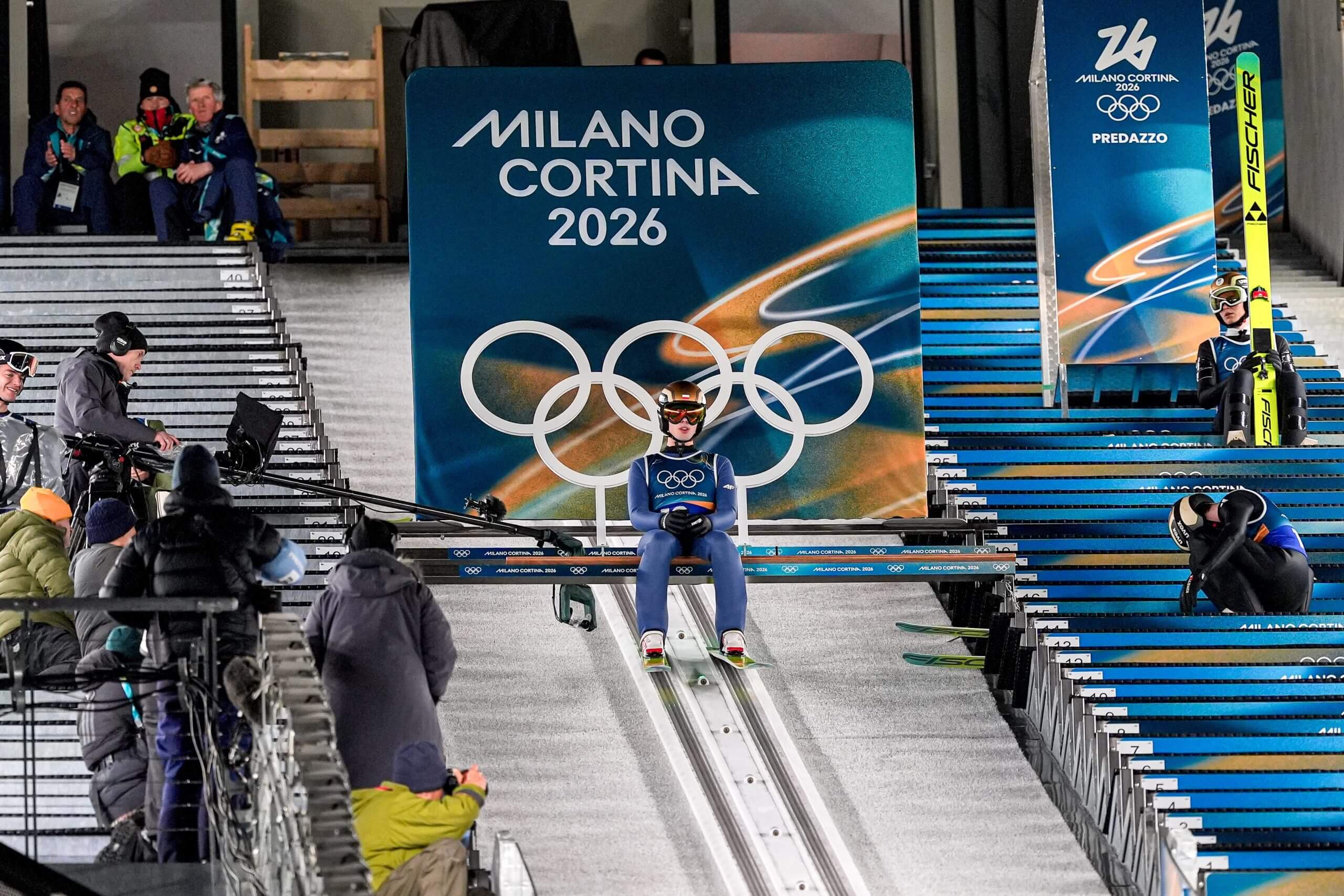
PREDAZZO, Italy — As athletes prepare for their ski jumps, the mental landscape becomes as crucial as the physical one. Canada’s Nicole Maurer shared her insights immediately after her final jump in the women’s large hill event, emphasizing the importance of relaxation. “I know if I get too excited or try too hard, then I’ll get tense,” she explained. “You want to relax. Clear your mind. You want to breathe. When you’re about to jump off a ski-jump at 100 kilometres per hour, ultimately nothing else really matters.”
There are two defining images in ski jumping. The first is the breathtaking flight through the air, but the second is equally striking: the athlete poised at the start gate, helmet and goggles on, displaying a focused, almost grim expression. Known as “the bar,” athletes occupy this space for just a brief moment, averaging around 10 seconds. Below them lies over 100 metres of runway and the uncertainty of soaring up to 250 metres high. Although jumpers may focus on their coach’s starting flag, the reality is that they are utterly alone in that moment.
The pressure is palpable, with many athletes describing ski jumping as a mental game. Dawid Kubacki, a two-time Olympic medallist, noted, “When you are going down the slope, everything is already set. There’s not much you can do.” This raises an intriguing question: what thoughts race through their minds while waiting on the bar?
To explore this, The Athletic interviewed ten jumpers about their pre-jump thoughts. Surprisingly, many reported experiencing a mental void. The atmosphere at the top of the jump is tense, with athletes often cramped for space, surrounded by both their peers and the weight of impending competition.
Newcomer to the Olympics, Paige Jones, shared her unique pre-jump routine. The 23-year-old from Utah uses earplugs during competitions to block out distractions. “If I can hear the announcers, I can predict how far I need to jump,” she explained. “It’s better if I can focus on what I’m doing, rather than the result I want.”
A common thread among jumpers is their focus on technical details, particularly during later jumps. Jones elaborated on her approach: “I’ve been working on setting a balanced position, what my coach and I call ‘smooth operator.’ It’s about not forcing anything, just being relaxed in the air.”
Another athlete, Tate Frantz, has emerged as a promising figure in the U.S. men’s team. He described his strategy of simplifying the mental process. “I’m just trying to think through a couple of simple technique cues I’ve been working on,” he said. “As strange as it sounds, I’m trying to remove myself from the moment as much as possible.” The pressure of high-level events can be overwhelming, and Frantz emphasizes the importance of muscle memory over conscious effort.
His teammate, Jason Colby, echoed this sentiment. “It’s never good if you’re too tense trying to do something perfectly,” he remarked. Colby focuses on maintaining his position and avoiding what his coaches call “floating away.”
Other athletes take an analytical approach, adjusting their strategies based on external conditions. Kevin Bickner, the American record holder, noted, “Conditions can always vary, so the way you think has to be flexible.” He spoke about the importance of adapting to track speed and wind conditions, emphasizing that a good jump is still a good jump, regardless of the challenges faced.
Fear is a natural part of the sport, especially at the Olympic level. “Fear is natural, of course, especially if there’s a big gust of wind or scary conditions,” Frantz acknowledged. He prefers to channel his nerves into a focus on performance rather than safety. German competitor Johannes Rydzek recognized the heightened tension at the Olympics but advised athletes to treat each jump as just another jump.
A significant element in preparation for many athletes is their sports psychologist. Most major ski jumping nations employ one, with the exception of Slovenia, which has excelled in the current Olympics. Finnish skier Niko Kytösaho highlighted the importance of mental resilience, stating, “Everything happens so fast — and we just can’t practice it as much as other disciplines because it takes so long to set up these jumps. Each one is mentally really hard.”
Frantz elaborated on his mental preparation, explaining, “I want to envision how I want to feel, what I want to see, what I want to hear when I’m doing a good jump.” For Jones, her work with a psychologist focuses on controlling anxiety. “I’m definitely an anxious person to begin with,” she admitted, adding that she uses a technique called box breathing to manage her heart rate and maintain composure.
Rydzek practices similar breathing exercises, while Bickner incorporates meditation into his routine. “At the end of the day, that’s the only thing I have control over,” he said.
Ultimately, these athletes seek mental clarity that translates into physical performance. Maurer summarized this sentiment perfectly: “For me, it’s about thinking about nothing. If you think about what you’re going to do in the jump every time you’re on the bar, it could be 10 seconds, it could be one minute, or it could be 20 minutes. I know that if I’m thinking of too many things, it will not be good. I’ll be too stressed. I think I can tell before I’ve even jumped whether or not it’s going to be a good jump.”
As they await the green light, the jumpers understand that mental emptiness can pave the way for successful leaps.

Urgent Tax Savings Alert: Maximize Deductions Before April 15

Trump’s Administration Faces Uncertainty Over Government Shutdowns

Cosmic Defects: The Mystery of the Universe’s Missing Anomalies

Rapid City Parks Department Opens Registration for Bocce Leagues

Samsung Galaxy Watch 9 to Feature Larger 435mAh Battery Soon

Two Dead After Student Boats Capsize Off Okinawa Coast

Healthy Choice Wellness Reports Earnings with Mixed Results

Prince Harry Positions Himself as Royal Family’s Image Reviver

All Points North Lodge Achieves FSPHP-ETA Accreditation

Send Holiday Parcels for £1.99 with New Comparison Service

University of Hawaiʻi Leads $25M AI Project to Monitor Natural Disasters

Maui County Reopens Upgraded Lānaʻi Fifth Street Courts Today!

Interstellar Object 3I/ATLAS Emits Unique Metal Alloy, Says Scientist

Kelly McCreary Discusses Future of Maggie and Winston in Grey’s Anatomy

Daily Codeword Puzzle Launches on October 21, 2025

Congresswoman Under Fire for Misleading Epstein Donation Claims

Trump Vows to Resolve Afghanistan-Pakistan Crisis “Very Quickly”

Researchers Achieve Fastest Genome Sequencing in Under Four Hours
-
 Lifestyle4 months ago
Send Holiday Parcels for £1.99 with New Comparison Service
-
Science5 months ago
University of Hawaiʻi Leads $25M AI Project to Monitor Natural Disasters
-
 Top Stories4 months ago
Maui County Reopens Upgraded Lānaʻi Fifth Street Courts Today!
-
 Science6 months ago
Interstellar Object 3I/ATLAS Emits Unique Metal Alloy, Says Scientist
-
 Entertainment6 months ago
Kelly McCreary Discusses Future of Maggie and Winston in Grey’s Anatomy
-
 Entertainment6 months ago
Daily Codeword Puzzle Launches on October 21, 2025
-
 Lifestyle5 months ago
Congresswoman Under Fire for Misleading Epstein Donation Claims
-
 Top Stories5 months ago
Trump Vows to Resolve Afghanistan-Pakistan Crisis “Very Quickly”
-
 Science6 months ago
Researchers Achieve Fastest Genome Sequencing in Under Four Hours
-

 Business6 months ago
Iconic Sand Dollar Social Club Listed for $3 Million in Folly Beach
-

 Science4 months ago
Charles Darwin’s Address Book Reveals Hidden Aspects of His Life
-

 Politics6 months ago
Afghan Refugee Detained by ICE After Asylum Hearing in New York