
Top Stories
China’s Tianwen-1 Captures Stunning Images of Interstellar Object 3I/ATLAS

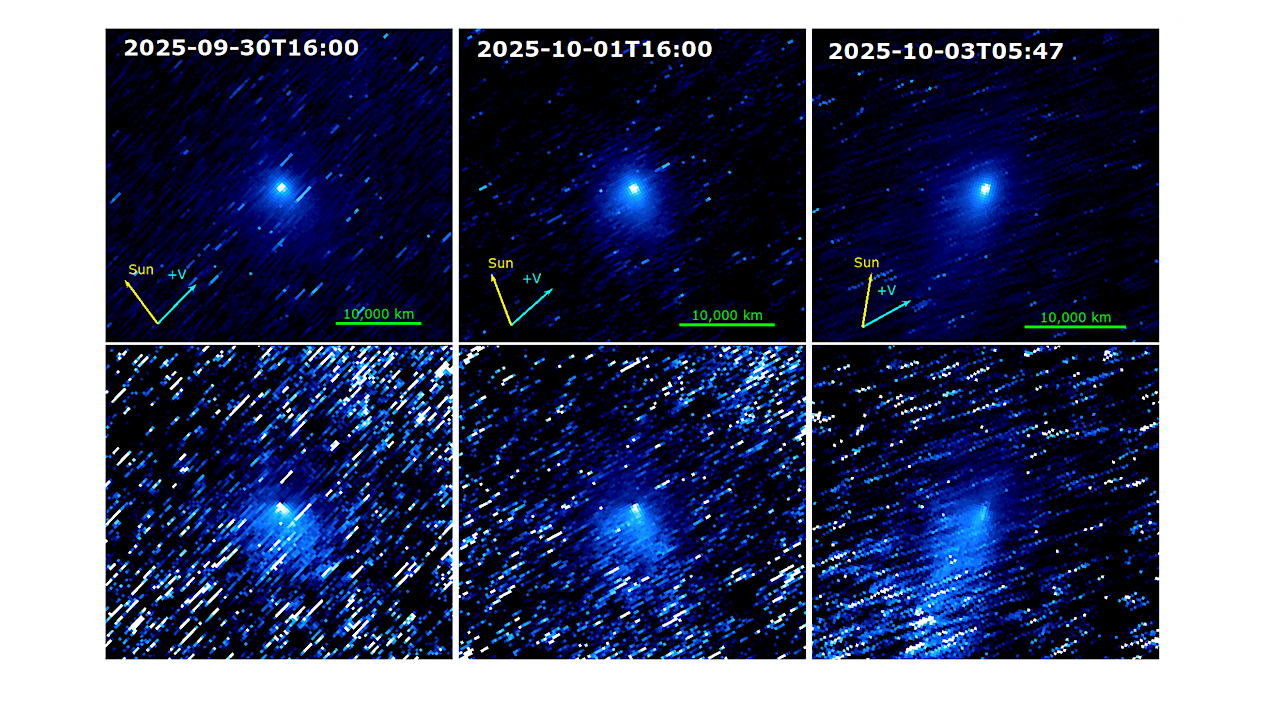
China’s Tianwen-1 Mars orbiter has successfully captured images of the interstellar object 3I/ATLAS during its recent close approach to Mars. This achievement marks China’s first deep-space observation of an astronomical object and represents a significant step in the nation’s space exploration efforts.
The imaging was conducted using the orbiter’s onboard HiRIC CMOS camera, which provided unique observations from a perspective that is significantly out of the object’s orbital plane. This vantage point allows scientists to gain critical insights into the dynamics of dust surrounding the comet. Over three observation periods from September 30 to October 3, 2025, researchers noted distinct changes in the coma and tail morphology of 3I/ATLAS, driven by the evolving geometry of the viewing conditions.
Unique Dust Dynamics Observed
Analysis of the data yielded important findings regarding the dust composition of 3I/ATLAS. Comparison with Finson-Probstein dust dynamical models indicates that the coma is primarily composed of large grains, with a solar radiation pressure parameter β ranging from approximately 10 −3 to 10 −2. This corresponds to grain sizes measuring several hundreds of micrometers. The observed extent of the sunward coma suggests dust ejection velocities between 3 m/s and 10 m/s.
Despite the morphological changes observed during the three epochs, the azimuthally averaged surface brightness profile remained remarkably consistent. It transitioned from a radial slope near -1 close to the nucleus to slightly steeper than -1.5 at greater cometocentric distances. This pattern is indicative of a steady-state dust outflow, driven by solar radiation pressure.
Further analysis reveals an average dust mass loss rate of approximately 1,000 kg/s, with an average Afρ value of around (2.0±0.2)×10^4 cm. These findings suggest that the dust dynamics of 3I/ATLAS are similar to those observed in the earlier interstellar comet 2I/Borisov, both of which appear to originate from the outer regions of their respective parent planetary disks.
Significance of the Observations
The successful imaging of 3I/ATLAS by Tianwen-1 not only enhances understanding of interstellar objects but also establishes a precedent for future observations from Mars. The insights gained could be pivotal for future planetary science research and help refine models of cometary dynamics.
The team involved in this research includes prominent scientists such as Xin Ren, Wei Yan, and others from various institutions. Their work has been documented in a paper submitted to Astrophysical Journal Letters, highlighting the significance of these findings in the broader context of Earth and planetary astrophysics.
This milestone for China’s space program underscores the growing capabilities in deep-space exploration and the potential for international collaboration in astronomical research. As more data becomes available, the implications for our understanding of cometary and interstellar material will continue to expand, offering new avenues for scientific inquiry.

Urgent Tax Savings Alert: Maximize Deductions Before April 15

Trump’s Administration Faces Uncertainty Over Government Shutdowns

Cosmic Defects: The Mystery of the Universe’s Missing Anomalies

Rapid City Parks Department Opens Registration for Bocce Leagues

Samsung Galaxy Watch 9 to Feature Larger 435mAh Battery Soon

Two Dead After Student Boats Capsize Off Okinawa Coast

Healthy Choice Wellness Reports Earnings with Mixed Results

Prince Harry Positions Himself as Royal Family’s Image Reviver

All Points North Lodge Achieves FSPHP-ETA Accreditation

Send Holiday Parcels for £1.99 with New Comparison Service

University of Hawaiʻi Leads $25M AI Project to Monitor Natural Disasters

Maui County Reopens Upgraded Lānaʻi Fifth Street Courts Today!

Interstellar Object 3I/ATLAS Emits Unique Metal Alloy, Says Scientist

Kelly McCreary Discusses Future of Maggie and Winston in Grey’s Anatomy

Daily Codeword Puzzle Launches on October 21, 2025

Congresswoman Under Fire for Misleading Epstein Donation Claims

Trump Vows to Resolve Afghanistan-Pakistan Crisis “Very Quickly”

Researchers Achieve Fastest Genome Sequencing in Under Four Hours
-
 Lifestyle4 months ago
Send Holiday Parcels for £1.99 with New Comparison Service
-
Science5 months ago
University of Hawaiʻi Leads $25M AI Project to Monitor Natural Disasters
-
 Top Stories4 months ago
Maui County Reopens Upgraded Lānaʻi Fifth Street Courts Today!
-
 Science6 months ago
Interstellar Object 3I/ATLAS Emits Unique Metal Alloy, Says Scientist
-
 Entertainment6 months ago
Kelly McCreary Discusses Future of Maggie and Winston in Grey’s Anatomy
-
 Entertainment6 months ago
Daily Codeword Puzzle Launches on October 21, 2025
-
 Lifestyle5 months ago
Congresswoman Under Fire for Misleading Epstein Donation Claims
-
 Top Stories5 months ago
Trump Vows to Resolve Afghanistan-Pakistan Crisis “Very Quickly”
-
 Science6 months ago
Researchers Achieve Fastest Genome Sequencing in Under Four Hours
-

 Business6 months ago
Iconic Sand Dollar Social Club Listed for $3 Million in Folly Beach
-

 Science4 months ago
Charles Darwin’s Address Book Reveals Hidden Aspects of His Life
-

 Politics6 months ago
Afghan Refugee Detained by ICE After Asylum Hearing in New York