
Top Stories
Urgent Breakthrough in Tunnel Excavation Risk Prediction Announced

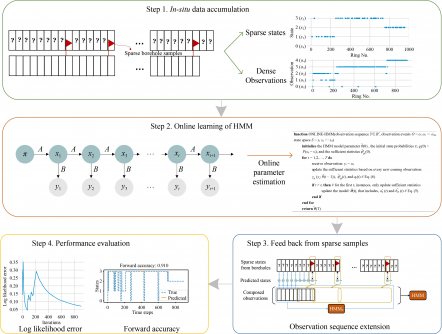
BREAKING: A groundbreaking study has just been released, revolutionizing how geological risks in tunnel excavation are predicted. Researchers from the Huazhong University of Science and Technology and Nanyang Technological University have unveiled the Online Hidden Markov Model (OHMM), a cutting-edge technology designed to enhance safety and efficiency in tunnel construction.
In the world of tunneling, accurate geological risk assessment is critical to prevent catastrophic failures such as collapses and landslides. These incidents not only pose serious safety threats but also lead to significant project delays and cost overruns, potentially impacting millions. The need for reliable predictions has never been more urgent, especially as traditional methods struggle with limitations in data collection and adaptability.
The research team has identified a major gap: conventional machine learning approaches often rely on large datasets gathered prior to construction. However, tunnel projects generate data incrementally, making it challenging to account for new geological uncertainties as excavation progresses. The newly proposed OHMM addresses this issue by integrating online learning, allowing the model to continuously update its parameters with every new data point collected during the excavation process.
The study introduces an innovative observation extension mechanism, utilizing pre-construction borehole samples to extend limited data sequences. This allows for a more comprehensive understanding of the geological conditions that lie ahead of the tunnel boring machine (TBM).
A case study conducted on a tunnel excavation project in Singapore—comprising 915 rings—demonstrated the OHMM’s exceptional predictive capabilities. When tested with just 300 observed rings, the model achieved a remarkable forward prediction accuracy of 0.968. Even with 600 observed rings, it maintained an impressive accuracy of 0.902, significantly outperforming traditional models such as LSTM networks, neural networks, and support vector machines.
The OHMM also exhibited stable prediction capabilities for up to 100 rings ahead. For practical guidance in tunnel excavation, the researchers recommend a foresight distance of 30 rings, striking an optimal balance between prediction accuracy and stability.
This vital research, titled “Geological Risk Prediction Under Uncertainty in Tunnel Excavation Using Online Learning and Hidden Markov Model,” authored by Limao ZHANG, Ying WANG, Xianlei FU, Xieqing SONG, and Penghui LIN, is now available for review. It underscores the urgent need for advanced predictive technologies in the construction industry, promising to enhance safety and efficiency in future tunneling projects.
The full text of the paper can be accessed at: https://doi.org/10.1007/s42524-024-0082-1.
Stay tuned as this story develops, and share this critical advancement in tunnel excavation technology with your network!

Urgent Tax Savings Alert: Maximize Deductions Before April 15

Trump’s Administration Faces Uncertainty Over Government Shutdowns

Cosmic Defects: The Mystery of the Universe’s Missing Anomalies

Rapid City Parks Department Opens Registration for Bocce Leagues

Samsung Galaxy Watch 9 to Feature Larger 435mAh Battery Soon

Two Dead After Student Boats Capsize Off Okinawa Coast

Healthy Choice Wellness Reports Earnings with Mixed Results

Prince Harry Positions Himself as Royal Family’s Image Reviver

All Points North Lodge Achieves FSPHP-ETA Accreditation

Send Holiday Parcels for £1.99 with New Comparison Service

University of Hawaiʻi Leads $25M AI Project to Monitor Natural Disasters

Maui County Reopens Upgraded Lānaʻi Fifth Street Courts Today!

Daily Codeword Puzzle Launches on October 21, 2025

Congresswoman Under Fire for Misleading Epstein Donation Claims

Interstellar Object 3I/ATLAS Emits Unique Metal Alloy, Says Scientist

Trump Vows to Resolve Afghanistan-Pakistan Crisis “Very Quickly”

Charles Darwin’s Address Book Reveals Hidden Aspects of His Life

Rediscovering Chrysler: 5 Overlooked Models from the 1980s
-
 Lifestyle8 months ago
Send Holiday Parcels for £1.99 with New Comparison Service
-
Science9 months ago
University of Hawaiʻi Leads $25M AI Project to Monitor Natural Disasters
-
 Top Stories8 months ago
Maui County Reopens Upgraded Lānaʻi Fifth Street Courts Today!
-
 Entertainment10 months ago
Daily Codeword Puzzle Launches on October 21, 2025
-
 Lifestyle9 months ago
Congresswoman Under Fire for Misleading Epstein Donation Claims
-
 Science10 months ago
Interstellar Object 3I/ATLAS Emits Unique Metal Alloy, Says Scientist
-
 Top Stories9 months ago
Trump Vows to Resolve Afghanistan-Pakistan Crisis “Very Quickly”
-
 Science8 months ago
Charles Darwin’s Address Book Reveals Hidden Aspects of His Life
-
 Lifestyle8 months ago
Rediscovering Chrysler: 5 Overlooked Models from the 1980s
-

 Science7 months ago
Understanding Generation Z: Strategies for Engaging the Workforce
-

 Entertainment10 months ago
Kelly McCreary Discusses Future of Maggie and Winston in Grey’s Anatomy
-

 Top Stories8 months ago
aespa Faces Backlash Over G-Dragon Interaction at 2025 MAMAs