
World
Protests in Iran Escalate as Death Toll Reaches 116

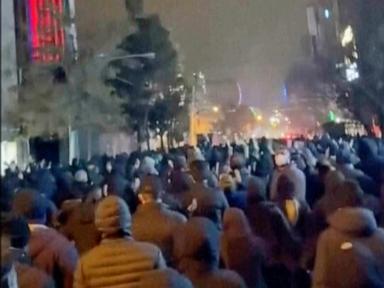
Nationwide protests in Iran have reached a critical juncture, with violence related to the demonstrations resulting in at least 116 deaths, according to reports from activists. The protests, which began on December 28, 2023, have seen thousands take to the streets in cities including Tehran, the capital, and Mashhad, the second-largest city, now entering their third week.
As the situation escalates, the Iranian government has imposed a significant communication blackout, cutting internet access and phone lines, which complicates the ability to assess the situation from abroad. The U.S.-based Human Rights Activists News Agency reported that approximately 2,600 individuals have been detained amidst the unrest. Observers fear that this information blackout may enable hard-liners within Iran’s security forces to intensify their crackdown.
Protests initially sparked by the collapse of the Iranian rial currency, which now trades at over 1.4 million IRR to $1, have transformed into broader demands for political reform and challenges to the ruling theocracy. Videos reportedly from Iran, likely transmitted via Starlink satellite technology, show demonstrators gathering in various neighborhoods, including northern Tehran’s Punak area. Protesters have been seen waving lit mobile phones, banging metal objects, and setting off fireworks as symbols of defiance.
Government Response and Threats of Repression
In response to the protests, Iranian authorities have signaled a forthcoming crackdown. On Saturday, Mohammad Movahedi Azad, Iran’s attorney general, declared that participants in the protests would be regarded as “enemies of God,” a charge that could carry the death penalty. This statement emphasized the severe consequences for those perceived to be aiding the demonstrations.
The Iranian state media has attempted to counter negative narratives by broadcasting correspondents in calm areas of various cities, although Tehran and Mashhad were notably excluded from these broadcasts. Coverage also included pro-government demonstrations in cities such as Qom and Qazvin, in an apparent effort to showcase public support for the regime.
International Reactions and Support for Protesters
The international community is closely monitoring the situation, with U.S. President Donald Trump expressing support for the protesters through social media. He stated, “Iran is looking at FREEDOM, perhaps like never before. The USA stands ready to help!!!” Reports from The New York Times and The Wall Street Journal indicated that military options for a strike on Iran were presented to Trump, though he has not made a final decision.
Iran’s exiled Crown Prince Reza Pahlavi, who called for protests earlier this week, has encouraged demonstrators to reclaim public spaces using national symbols from the pre-revolution era. He has urged protesters to carry the old lion-and-sun flag, symbolizing a historical challenge to the current regime.
As the unrest continues, the Iranian government remains firm in its stance against dissent, with the potential for further violence looming as the protests grow. The situation remains fluid, with the world watching closely as Iranians demand change in the face of increasing repression.

Urgent Tax Savings Alert: Maximize Deductions Before April 15

Trump’s Administration Faces Uncertainty Over Government Shutdowns

Cosmic Defects: The Mystery of the Universe’s Missing Anomalies

Rapid City Parks Department Opens Registration for Bocce Leagues

Samsung Galaxy Watch 9 to Feature Larger 435mAh Battery Soon

Two Dead After Student Boats Capsize Off Okinawa Coast

Healthy Choice Wellness Reports Earnings with Mixed Results

Prince Harry Positions Himself as Royal Family’s Image Reviver

All Points North Lodge Achieves FSPHP-ETA Accreditation

Send Holiday Parcels for £1.99 with New Comparison Service

University of Hawaiʻi Leads $25M AI Project to Monitor Natural Disasters

Maui County Reopens Upgraded Lānaʻi Fifth Street Courts Today!

Daily Codeword Puzzle Launches on October 21, 2025

Congresswoman Under Fire for Misleading Epstein Donation Claims

Interstellar Object 3I/ATLAS Emits Unique Metal Alloy, Says Scientist

Trump Vows to Resolve Afghanistan-Pakistan Crisis “Very Quickly”

Charles Darwin’s Address Book Reveals Hidden Aspects of His Life

Rediscovering Chrysler: 5 Overlooked Models from the 1980s
-
 Lifestyle8 months ago
Send Holiday Parcels for £1.99 with New Comparison Service
-
Science9 months ago
University of Hawaiʻi Leads $25M AI Project to Monitor Natural Disasters
-
 Top Stories8 months ago
Maui County Reopens Upgraded Lānaʻi Fifth Street Courts Today!
-
 Entertainment10 months ago
Daily Codeword Puzzle Launches on October 21, 2025
-
 Lifestyle9 months ago
Congresswoman Under Fire for Misleading Epstein Donation Claims
-
 Science10 months ago
Interstellar Object 3I/ATLAS Emits Unique Metal Alloy, Says Scientist
-
 Top Stories9 months ago
Trump Vows to Resolve Afghanistan-Pakistan Crisis “Very Quickly”
-
 Science8 months ago
Charles Darwin’s Address Book Reveals Hidden Aspects of His Life
-
 Lifestyle8 months ago
Rediscovering Chrysler: 5 Overlooked Models from the 1980s
-
 Science7 months ago
Understanding Generation Z: Strategies for Engaging the Workforce
-

 Entertainment10 months ago
Kelly McCreary Discusses Future of Maggie and Winston in Grey’s Anatomy
-

 Entertainment7 months ago
Landmark Shift as Iconic Anime Series Concludes After 26 Years