
World
Trump Proposes Military Action Against Mexican Cartels Amid Drug Crisis

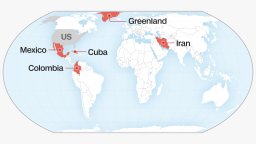
U.S. President Donald Trump has suggested expanding military efforts to combat Mexican drug-trafficking organizations, framing it as a necessary step in addressing the ongoing opioid crisis in the United States. During an appearance on the television show “Fox and Friends,” Trump expressed frustration with the Mexican government’s refusal to accept U.S. intervention, stating, “We have to do something” about the situation at the southern border.
On March 7, 2024, Trump reiterated his commitment to targeting drug cartels, claiming that 97% of drugs entering the U.S. via water routes had been halted. He indicated that the next phase would focus on land-based operations against drug trafficking groups, which he described as a significant threat to national security.
The Complex Reality of Mexican Drug Trafficking
While Trump’s rhetoric frames the Mexican cartels as centralized entities that can be swiftly neutralized, experts highlight a vastly different reality. Over the years, the landscape of Mexican drug trafficking has evolved into a fragmented network of approximately 400 groups, according to Eduardo Guerrero, director of Lantia Intelligence. This fragmentation makes it exceedingly difficult to dismantle the operations effectively.
The most powerful of these organizations, the Jalisco New Generation Cartel, has grown to include around 90 factions, increasing from just 45 a few years ago. Guerrero emphasizes that disrupting these cartels requires a sophisticated strategy that goes beyond targeting individual leaders. Even the removal of high-profile figures, such as Ismael “El Mayo” Zambada, does not guarantee a cessation of the drug trade.
The so-called “kingpin strategy,” which has been in effect for over a decade, has often backfired. While Mexican authorities have arrested or killed numerous cartel leaders with support from U.S. intelligence, the flow of drugs into the U.S. has continued unabated. As Benjamin T. Smith, author of “The Dope: The Real History of the Mexican Drug Trade,” points out, criminal organizations resemble multinational corporations, thriving on persistent consumer demand.
Political and Social Implications
The intertwining of drug cartels with local economies and political structures complicates the situation further. In recent years, cartels have expanded their influence, embedding themselves within local government and police forces. During the 2024 national elections, crime groups actively attempted to install their own candidates, resulting in the deaths of three dozen political hopefuls due to intimidation.
Research indicates that cartels may employ between 160,000 and 185,000 individuals across Mexico, creating a complex economic web that extends beyond illegal activities. This level of integration suggests that simply removing cartel leaders will not dismantle these extensive networks.
The current Mexican administration, led by Claudia Sheinbaum, has maintained a cooperative relationship with the Trump administration while firmly rejecting any U.S. military presence on Mexican soil. Sheinbaum has emphasized the need for Mexico to uphold its sovereignty, stating, “Our position should be firm and clear.”
Trump’s suggestion that Mexico should accept U.S. troops has raised concerns about potential backlash from both the Mexican public and political establishments. Historical memories of U.S. invasions and interventions have led to a strong nationalist sentiment against foreign military presence.
As Trump reiterates his stance on combating drug trafficking, Sheinbaum has already taken measures to address the issue. Since taking office, she has deployed thousands of troops to the U.S.-Mexico border to intercept drugs and migrants and has cooperated with U.S. authorities in transferring drug trafficking suspects.
The complex dynamics of power, crime, and violence in Mexico illustrate that there is no single solution to the crisis. Experts argue that a more nuanced approach is necessary to navigate the intricate landscape shaped by both cartels and government forces.
In conclusion, while Trump’s proposal for military intervention may seem straightforward, the reality of Mexican drug trafficking presents a labyrinth of challenges that require comprehensive strategies rather than blunt force. The ongoing situation reflects deep-rooted issues that transcend simple solutions and necessitate careful consideration of the political, social, and economic factors at play.

Urgent Tax Savings Alert: Maximize Deductions Before April 15

Trump’s Administration Faces Uncertainty Over Government Shutdowns

Cosmic Defects: The Mystery of the Universe’s Missing Anomalies

Rapid City Parks Department Opens Registration for Bocce Leagues

Samsung Galaxy Watch 9 to Feature Larger 435mAh Battery Soon

Two Dead After Student Boats Capsize Off Okinawa Coast

Healthy Choice Wellness Reports Earnings with Mixed Results

Prince Harry Positions Himself as Royal Family’s Image Reviver

All Points North Lodge Achieves FSPHP-ETA Accreditation

Send Holiday Parcels for £1.99 with New Comparison Service

University of Hawaiʻi Leads $25M AI Project to Monitor Natural Disasters

Maui County Reopens Upgraded Lānaʻi Fifth Street Courts Today!

Daily Codeword Puzzle Launches on October 21, 2025

Congresswoman Under Fire for Misleading Epstein Donation Claims

Interstellar Object 3I/ATLAS Emits Unique Metal Alloy, Says Scientist

Trump Vows to Resolve Afghanistan-Pakistan Crisis “Very Quickly”

Charles Darwin’s Address Book Reveals Hidden Aspects of His Life

Rediscovering Chrysler: 5 Overlooked Models from the 1980s
-
 Lifestyle8 months ago
Send Holiday Parcels for £1.99 with New Comparison Service
-
Science9 months ago
University of Hawaiʻi Leads $25M AI Project to Monitor Natural Disasters
-
 Top Stories8 months ago
Maui County Reopens Upgraded Lānaʻi Fifth Street Courts Today!
-
 Entertainment10 months ago
Daily Codeword Puzzle Launches on October 21, 2025
-
 Lifestyle9 months ago
Congresswoman Under Fire for Misleading Epstein Donation Claims
-
 Science10 months ago
Interstellar Object 3I/ATLAS Emits Unique Metal Alloy, Says Scientist
-
 Top Stories9 months ago
Trump Vows to Resolve Afghanistan-Pakistan Crisis “Very Quickly”
-
 Science8 months ago
Charles Darwin’s Address Book Reveals Hidden Aspects of His Life
-
 Lifestyle8 months ago
Rediscovering Chrysler: 5 Overlooked Models from the 1980s
-

 Science7 months ago
Understanding Generation Z: Strategies for Engaging the Workforce
-

 Entertainment10 months ago
Kelly McCreary Discusses Future of Maggie and Winston in Grey’s Anatomy
-

 Entertainment7 months ago
Landmark Shift as Iconic Anime Series Concludes After 26 Years