
World
Trump’s Battleship Plan Raises Concerns Over Nuclear Arms Policy

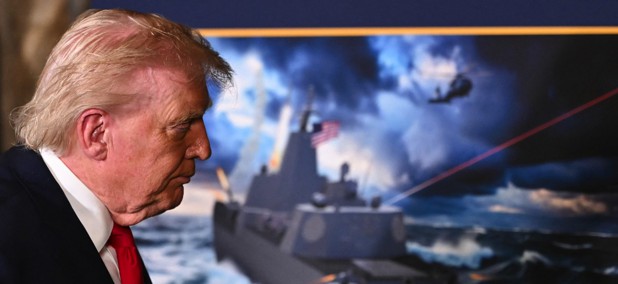
President Donald Trump’s recent proposal for a new class of warships, named after himself, has sparked significant debate due to its inclusion of a nuclear-armed cruise missile. This initiative appears to contradict Trump’s earlier stance, expressed in February 2021, when he stated, “There’s no reason for us to be building brand-new nuclear weapons. We already have so many.” This inconsistency raises critical questions about U.S. nuclear policy and strategy.
The history of nuclear-armed, sea-launched cruise missiles, known as SLCM-N, provides valuable lessons. In 1991, President George H.W. Bush ordered the removal of all nuclear-armed Tomahawk cruise missiles from Navy surface ships and submarines, viewing their forward deployment as destabilizing. Instead, he opted to store these weapons, a decision that sought to mitigate the risks associated with tactical nuclear arms. Two decades later, President Barack Obama, urged by U.S. Navy leaders, dismantled these missiles completely, reinforcing a strategy that limited the Navy’s nuclear capabilities to strategic missiles on specific submarines.
The situation took a turn in 2018 when then-Defense Secretary James Mattis and Joint Chiefs of Staff Chairman General Mark Milley endorsed a Nuclear Posture Review advocating for the development of a new SLCM-N. This initiative was halted by President Biden in 2021; however, Congress intervened, choosing to continue funding the program. Such an occurrence is rare in U.S. history, where Congress has compelled the executive branch to initiate a new nuclear weapons program.
Andrew C. Weber, a Senior Fellow at the Council on Strategic Risks and former Assistant Secretary of Defense for Nuclear, Chemical, and Biological Defense Programs, expressed his support for modernizing the triad of strategic nuclear weapons. Nevertheless, he opposes the development of the SLCM-N for several reasons.
Firstly, Weber emphasizes the need to deter adversaries from contemplating the use of “small, tactical nuclear weapons,” as suggested by Russian President Vladimir Putin. He argues that the United States should aim to create a strategic deterrent that invokes fear of overwhelming retaliation, thereby leveraging its conventional military advantages.
Secondly, the introduction of tactical nuclear weapons increases the potential for their use in regional conflicts, raising the risk of escalation to a full-scale nuclear war. Weber warns that crossing the nuclear threshold could lead to catastrophic consequences, making the prospect of limited nuclear engagement particularly alarming.
Thirdly, the existence of similar conventional weapons complicates the situation. In a conflict scenario, an adversary may struggle to distinguish between conventional and nuclear variants, leading to miscalculations that could trigger unintended nuclear exchanges. This possibility poses a significant threat to global stability.
Weber advises against undermining the United States’ formidable strategic weapons triad in pursuit of what he describes as a “small, tactical” nuclear weapon. He believes that President Trump’s push for a new battleship program should align with his previous statements to enhance national security by investing in more critical capabilities rather than resurrecting a controversial nuclear armament.
In conclusion, the implications of Trump’s battleship proposal extend beyond naval strategy, touching upon the delicate balance of nuclear deterrence and international security. As discussions surrounding the SLCM-N continue, it remains vital for policymakers to consider the historical context and potential consequences of expanding the U.S. nuclear arsenal. The choices made today will undoubtedly shape the future of global military dynamics.

Urgent Tax Savings Alert: Maximize Deductions Before April 15

Trump’s Administration Faces Uncertainty Over Government Shutdowns

Cosmic Defects: The Mystery of the Universe’s Missing Anomalies

Rapid City Parks Department Opens Registration for Bocce Leagues

Samsung Galaxy Watch 9 to Feature Larger 435mAh Battery Soon

Two Dead After Student Boats Capsize Off Okinawa Coast

Healthy Choice Wellness Reports Earnings with Mixed Results

Prince Harry Positions Himself as Royal Family’s Image Reviver

All Points North Lodge Achieves FSPHP-ETA Accreditation

Send Holiday Parcels for £1.99 with New Comparison Service

University of Hawaiʻi Leads $25M AI Project to Monitor Natural Disasters

Maui County Reopens Upgraded Lānaʻi Fifth Street Courts Today!

Daily Codeword Puzzle Launches on October 21, 2025

Congresswoman Under Fire for Misleading Epstein Donation Claims

Interstellar Object 3I/ATLAS Emits Unique Metal Alloy, Says Scientist

Trump Vows to Resolve Afghanistan-Pakistan Crisis “Very Quickly”

Charles Darwin’s Address Book Reveals Hidden Aspects of His Life

Rediscovering Chrysler: 5 Overlooked Models from the 1980s
-
 Lifestyle8 months ago
Send Holiday Parcels for £1.99 with New Comparison Service
-
Science9 months ago
University of Hawaiʻi Leads $25M AI Project to Monitor Natural Disasters
-
 Top Stories8 months ago
Maui County Reopens Upgraded Lānaʻi Fifth Street Courts Today!
-
 Entertainment10 months ago
Daily Codeword Puzzle Launches on October 21, 2025
-
 Lifestyle9 months ago
Congresswoman Under Fire for Misleading Epstein Donation Claims
-
 Science10 months ago
Interstellar Object 3I/ATLAS Emits Unique Metal Alloy, Says Scientist
-
 Top Stories9 months ago
Trump Vows to Resolve Afghanistan-Pakistan Crisis “Very Quickly”
-
 Science8 months ago
Charles Darwin’s Address Book Reveals Hidden Aspects of His Life
-
 Lifestyle8 months ago
Rediscovering Chrysler: 5 Overlooked Models from the 1980s
-

 Science7 months ago
Understanding Generation Z: Strategies for Engaging the Workforce
-

 Entertainment10 months ago
Kelly McCreary Discusses Future of Maggie and Winston in Grey’s Anatomy
-

 Top Stories8 months ago
aespa Faces Backlash Over G-Dragon Interaction at 2025 MAMAs