
World
U.S. Tariff Threat Over Greenland Sparks Global Market Sell-Off

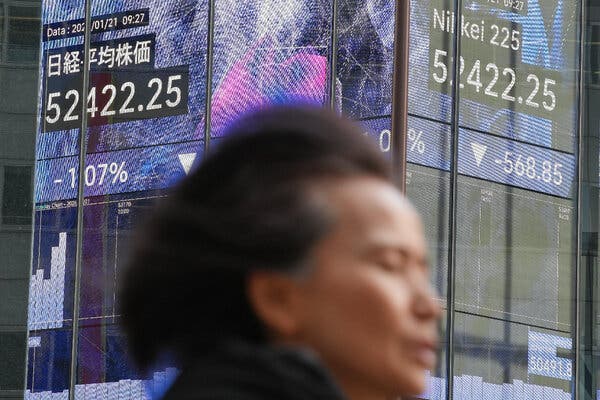
Global markets experienced significant volatility following a sharp sell-off in U.S. assets, triggered by President Donald Trump’s recent threat to impose extensive tariffs on European allies due to a dispute regarding Greenland. This development raised concerns about escalating trade tensions and its potential impact on global economic growth.
Asian markets reacted swiftly on Wednesday, with benchmark indexes showing declines. Taiwan’s Taiex index fell by more than 1.5 percent, while Japan’s Topix dropped by 1 percent. In Europe, trading was mixed; markets in France and Germany recorded slight declines, while stocks in Britain remained relatively flat. Meanwhile, U.S. stock futures indicated a modestly higher opening later in the day.
The U.S. dollar weakened against the Japanese yen but gained ground against the euro, reflecting shifting investor sentiment in response to the unfolding situation. Notably, the price of gold continued its upward trajectory, reaching a new record high of over $4,800 per ounce. Gold traditionally serves as a safe haven for investors during periods of uncertainty, and its rising value underscores the current market apprehension.
According to a survey conducted by the London Bullion Market Association (LBMA), a majority of metals analysts anticipate that gold could surpass $5,000 per ounce for the first time this year. The survey highlighted that “persistent geopolitical uncertainty—from conflicts to institutional tensions—keeps safe-haven demand elevated.” This sentiment reflects widespread anxiety about potential trade disruptions and their ramifications for global markets.
The recent upheaval signals a return to the trade policy-driven volatility that has characterized much of the Trump administration. The slide in stock prices began following Trump’s declaration that he would impose tariffs on eight European nations unless they facilitated a U.S. takeover of Greenland. This threat has reignited fears of retaliatory trade actions that could hinder global economic recovery.
As tensions continue to rise, investors are closely monitoring developments. The prospect of a new cycle of trade restrictions poses risks not only to the U.S. economy but also to international markets already grappling with the effects of previous trade disputes. The implications of these events will likely resonate throughout financial markets in the coming days, as stakeholders assess the potential for further disruption.
In conclusion, the unfolding situation surrounding Greenland and the associated tariff threats from the U.S. has sparked a wave of concern that extends well beyond American borders, affecting markets worldwide. The response from global investors will be crucial as they navigate through this period of heightened uncertainty.

Urgent Tax Savings Alert: Maximize Deductions Before April 15

Trump’s Administration Faces Uncertainty Over Government Shutdowns

Cosmic Defects: The Mystery of the Universe’s Missing Anomalies

Rapid City Parks Department Opens Registration for Bocce Leagues

Samsung Galaxy Watch 9 to Feature Larger 435mAh Battery Soon

Two Dead After Student Boats Capsize Off Okinawa Coast

Healthy Choice Wellness Reports Earnings with Mixed Results

Prince Harry Positions Himself as Royal Family’s Image Reviver

All Points North Lodge Achieves FSPHP-ETA Accreditation

Send Holiday Parcels for £1.99 with New Comparison Service

University of Hawaiʻi Leads $25M AI Project to Monitor Natural Disasters

Maui County Reopens Upgraded Lānaʻi Fifth Street Courts Today!

Daily Codeword Puzzle Launches on October 21, 2025

Congresswoman Under Fire for Misleading Epstein Donation Claims

Interstellar Object 3I/ATLAS Emits Unique Metal Alloy, Says Scientist

Trump Vows to Resolve Afghanistan-Pakistan Crisis “Very Quickly”

Charles Darwin’s Address Book Reveals Hidden Aspects of His Life

Rediscovering Chrysler: 5 Overlooked Models from the 1980s
-
 Lifestyle8 months ago
Send Holiday Parcels for £1.99 with New Comparison Service
-
Science9 months ago
University of Hawaiʻi Leads $25M AI Project to Monitor Natural Disasters
-
 Top Stories8 months ago
Maui County Reopens Upgraded Lānaʻi Fifth Street Courts Today!
-
 Entertainment10 months ago
Daily Codeword Puzzle Launches on October 21, 2025
-
 Lifestyle9 months ago
Congresswoman Under Fire for Misleading Epstein Donation Claims
-
 Science10 months ago
Interstellar Object 3I/ATLAS Emits Unique Metal Alloy, Says Scientist
-
 Top Stories9 months ago
Trump Vows to Resolve Afghanistan-Pakistan Crisis “Very Quickly”
-
 Science8 months ago
Charles Darwin’s Address Book Reveals Hidden Aspects of His Life
-
 Lifestyle8 months ago
Rediscovering Chrysler: 5 Overlooked Models from the 1980s
-
 Science7 months ago
Understanding Generation Z: Strategies for Engaging the Workforce
-

 Entertainment10 months ago
Kelly McCreary Discusses Future of Maggie and Winston in Grey’s Anatomy
-

 Entertainment7 months ago
Landmark Shift as Iconic Anime Series Concludes After 26 Years