
Science
Ancient Pottery Reveals Early Mathematical Concepts in Art

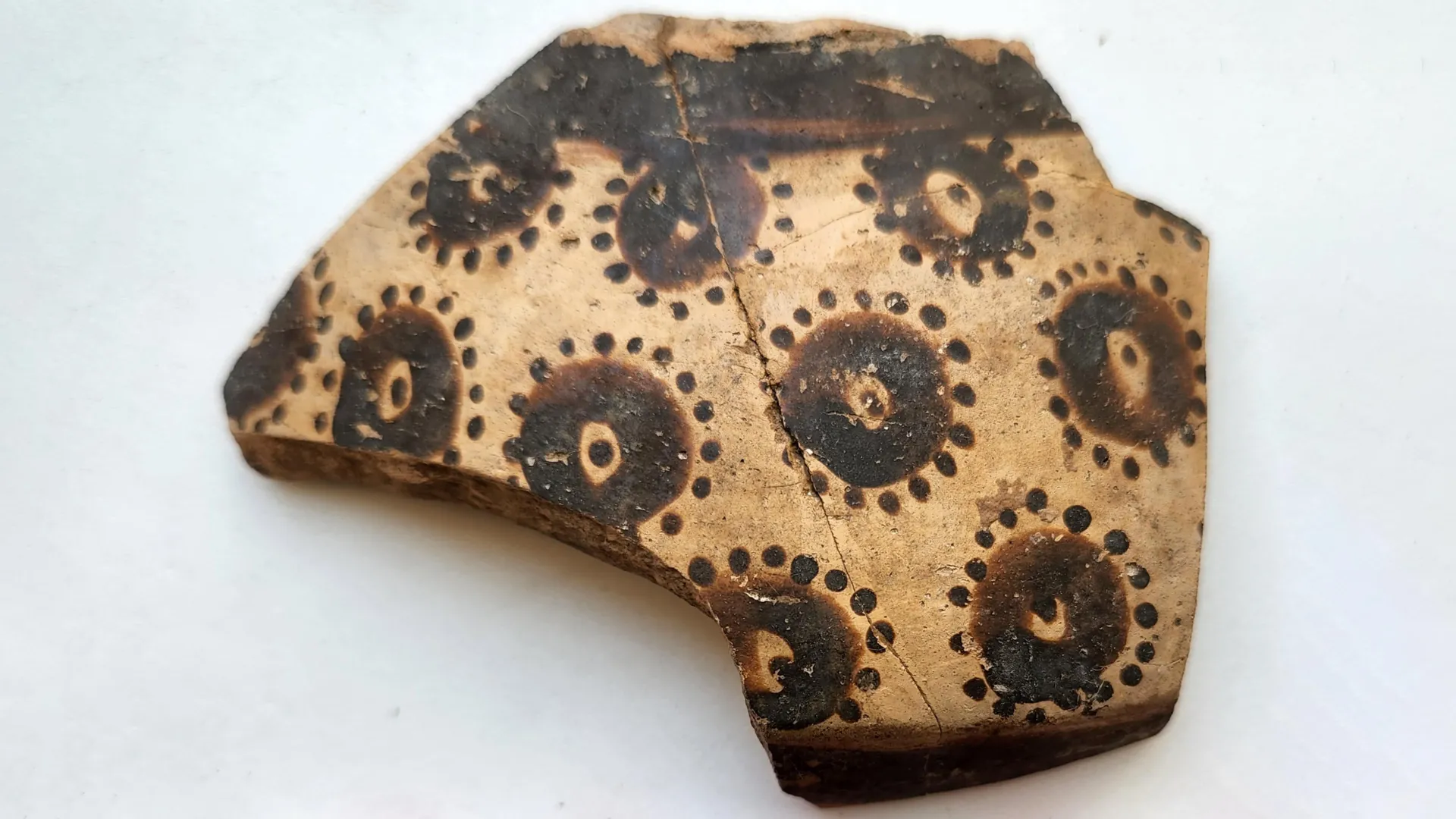
Researchers from the Hebrew University of Jerusalem have uncovered evidence that early farming communities in northern Mesopotamia, dating back over 8,000 years, exhibited advanced mathematical thinking long before the advent of written numbers. A detailed analysis of Halafian pottery, originating from the Halafian culture (circa 6200-5500 BCE), has revealed floral and plant designs that showcase intricate symmetry and numerical patterns.
A study published in the Journal of World Prehistory indicates that these ancient artworks were not merely decorative but also served a mathematical purpose. Professors Yosef Garfinkel and Sarah Krulwich led the research, which traced the consistent use of plant imagery in early human art back to this period. Their findings highlight a sophisticated understanding of geometry among these communities.
Botanical Imagery as a Cultural Shift
Previously, prehistoric artists primarily focused on depicting humans and animals. The introduction of botanical imagery on Halafian pottery represents a significant shift in visual culture. The researchers examined artifacts from 29 archaeological sites, documenting hundreds of plant motifs. These ranged from realistic representations to more abstract interpretations, all demonstrating intentional design rather than random patterns.
As noted by the authors, “These vessels represent the first moment in history when people chose to portray the botanical world as a subject worthy of artistic attention.” This reflects a cognitive evolution linked to the advent of settled village life and a growing appreciation for aesthetics and symmetry.
Numerical Patterns in Floral Designs
A particularly striking aspect of the research involves the arrangement of flowers on the pottery. Many bowls feature floral designs with specific petal counts that follow numerical sequences, including 4, 8, 16, 32, and even 64 flowers grouped together. The researchers argue these patterns were deliberately planned, showcasing an advanced comprehension of spatial division.
According to Professor Garfinkel, “The ability to divide space evenly, reflected in these floral motifs, likely had practical roots in daily life, such as sharing harvests or allocating communal fields.” This research contributes to the field of ethnomathematics, which examines the expression of mathematical concepts through cultural traditions and artistic practices.
The diversity of plant motifs captured in the pottery includes a wide range of forms, yet none depict edible plants. This absence suggests that the designs were not aimed at representing agricultural practices or rituals. Instead, the emphasis on flowers may indicate a connection to positive emotional responses, making them appealing subjects for artistic representation.
The discovery that mathematical reasoning existed before written records challenges traditional views on the origins of mathematics. While formal written mathematical systems emerged later in Sumer, the Halafian pottery provides evidence of an intuitive form of mathematical thought based on visual organization and symmetry.
Professor Krulwich states, “These patterns show that mathematical thinking began long before writing. People visualized divisions, sequences, and balance through their art.” By systematically documenting these designs and their mathematical structures, this study offers fresh insights into how early societies understood nature and organized their communal spaces, demonstrating cognitive abilities that predate formal mathematics.
The findings shed light on how art and mathematics were intertwined in early human culture, revealing a complex understanding of the world that has implications for our understanding of both history and the development of mathematical thought.

Young Marines Honor Heroes at Pearl Harbor Ceremony Today

AP Unveils Stunning Nature Photos Capturing Fragility of Life

AP Unveils Today’s Top Photos Capturing Urgent Global Moments

Sarasota County Acquires 3.59 Acres from WCIND – Urgent Update

Amazon Driver Caught Stealing Cat from Lakewood Family Home

Urgent Alert: CIOs Face Rare Earth Supply Risks Amid China Deal

Community Remembers Gail K. Wold, 87, for Her Lifelong Contributions

Trump Faces Backlash for Response to Rob Reiner’s Murder

Ancient Pottery Reveals Early Mathematical Concepts in Art

University of Hawaiʻi Leads $25M AI Project to Monitor Natural Disasters

Send Holiday Parcels for £1.99 with New Comparison Service

Interstellar Object 3I/ATLAS Emits Unique Metal Alloy, Says Scientist

Researchers Achieve Fastest Genome Sequencing in Under Four Hours

Iconic Sand Dollar Social Club Listed for $3 Million in Folly Beach

Afghan Refugee Detained by ICE After Asylum Hearing in New York

McEwen Inc. Secures Tartan Lake Gold Mine Through Acquisition

Peptilogics Secures $78 Million to Combat Prosthetic Joint Infections

Mars Observed: Detailed Imaging Reveals Dust Avalanche Dynamics
-
Science1 month ago
University of Hawaiʻi Leads $25M AI Project to Monitor Natural Disasters
-
 Lifestyle1 week ago
Send Holiday Parcels for £1.99 with New Comparison Service
-
 Science2 months ago
Interstellar Object 3I/ATLAS Emits Unique Metal Alloy, Says Scientist
-
 Science2 months ago
Researchers Achieve Fastest Genome Sequencing in Under Four Hours
-
 Business2 months ago
Iconic Sand Dollar Social Club Listed for $3 Million in Folly Beach
-
 Politics2 months ago
Afghan Refugee Detained by ICE After Asylum Hearing in New York
-
 Business2 months ago
McEwen Inc. Secures Tartan Lake Gold Mine Through Acquisition
-
 Health2 months ago
Peptilogics Secures $78 Million to Combat Prosthetic Joint Infections
-
 Science2 months ago
Mars Observed: Detailed Imaging Reveals Dust Avalanche Dynamics
-

 Lifestyle2 months ago
Jump for Good: San Clemente Pier Fundraiser Allows Legal Leaps
-

 Health2 months ago
Researcher Uncovers Zika Virus Pathway to Placenta Using Nanotubes
-

 Entertainment2 months ago
Jennifer Lopez Addresses A-Rod Split in Candid Interview