
Science
Trump Praises Space Force but Overlooks Artemis 2 in Address

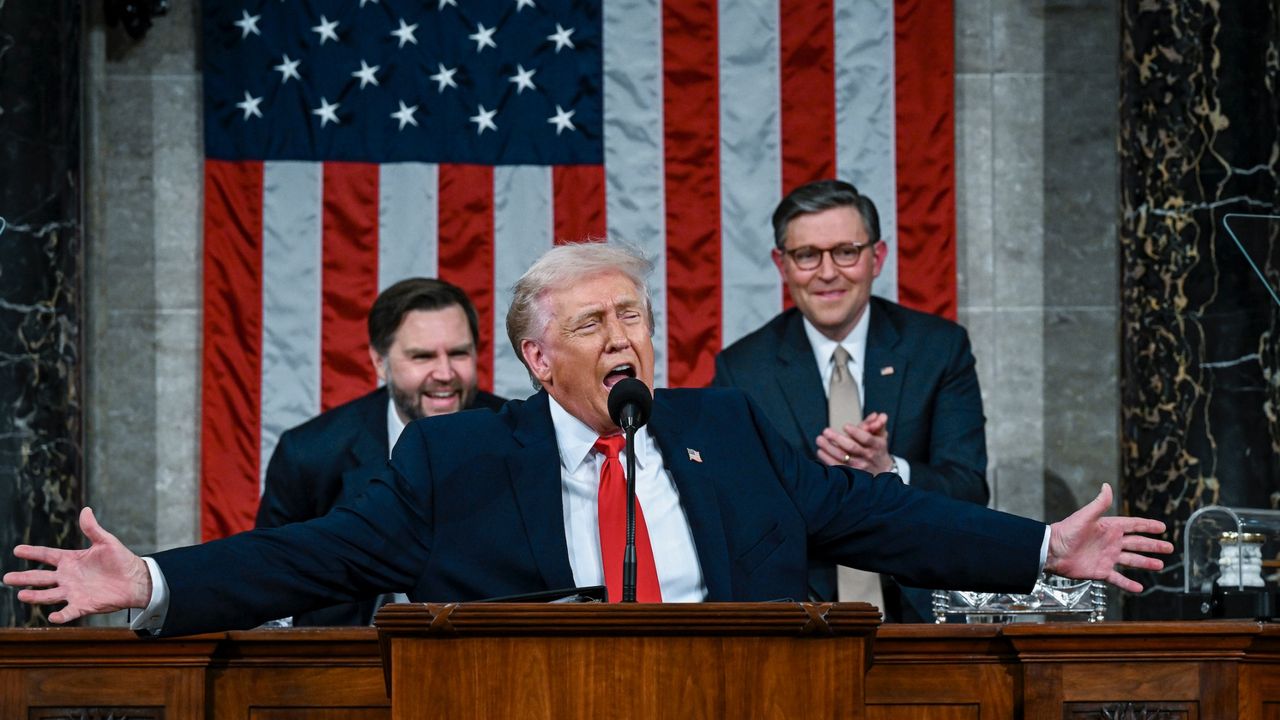
President Donald Trump delivered the longest State of the Union address in recorded history on February 24, 2024, emphasizing the United States’ global leadership. Notably absent, however, was a mention of NASA’s upcoming Artemis 2 mission, which aims to be America’s first crewed lunar flight in more than 50 years.
The address, which lasted over 107 minutes, surpassed the previous record Trump set last year by approximately eight minutes. Despite the lengthy speech, space enthusiasts found little to celebrate, especially since the crew of Artemis 2 was present as guests of Mike Johnson, Speaker of the House of Representatives.
Around 90 minutes into his address, Trump praised the newly established U.S. Space Force, highlighting its importance in modern military operations. “The Space Force is my baby, because we did that. My baby’s becoming so important,” he remarked. He linked the Space Force’s capabilities to recent military successes, including the capture of Venezuelan President Nicolas Maduro in a mission known as Operation Absolute Resolve.
Missed Opportunity for NASA
While Trump celebrated the Space Force, he failed to acknowledge the significance of the Artemis 2 mission, set to launch four astronauts around the moon as early as April 1, 2024. This mission will mark the first crewed flight beyond low Earth orbit since Apollo 17 in 1972. The omission of such a landmark mission is particularly surprising, given that the Artemis 2 astronauts—Reid Wiseman, Victor Glover, Christina Koch, and Jeremy Hansen from the Canadian Space Agency—were in attendance.
During the address, Trump reflected on America’s achievements over its first 250 years, stating, “Americans lifted humanity into the skies on the wings of aluminum and steel, and then we launched mankind into the stars on rockets powered by sheer American will and unyielding American pride.” Despite this grand rhetoric, he did not mention the Artemis program, which aims to establish bases near the moon’s south pole within the next five years.
The Artemis program, initiated in December 2017 during Trump’s first term, was intended to see astronauts land on the moon by late 2024. However, delays have plagued the timeline, with a recent setback announced just days before the State of the Union. NASA had planned to launch Artemis 2 on March 6, but a glitch with the mission’s Space Launch System rocket has necessitated rolling the vehicle off the launch pad for troubleshooting.
Political Context and Previous Speeches
The Artemis 2 crew’s presence at the State of the Union was a missed opportunity for Trump to showcase a significant American achievement in space exploration. The only astronaut visible during NBC’s broadcast of the address was Mark Kelly, a U.S. Senator and former NASA astronaut. Kelly has recently faced scrutiny from the Trump administration due to his participation in a video urging military personnel not to follow illegal orders.
In contrast, last year’s State of the Union featured a more optimistic vision of space exploration. Trump had expressed ambitions for Americans to “pursue our manifest destiny into the stars,” suggesting aspirations to land astronauts on Mars.
The absence of Artemis 2 from this year’s speech raises questions about the current administration’s priorities concerning space exploration. As NASA prepares for the historic mission, the lack of acknowledgment from the President may reflect shifting focus in the political arena, despite the program’s historical significance.

Urgent Tax Savings Alert: Maximize Deductions Before April 15

Trump’s Administration Faces Uncertainty Over Government Shutdowns

Cosmic Defects: The Mystery of the Universe’s Missing Anomalies

Rapid City Parks Department Opens Registration for Bocce Leagues

Samsung Galaxy Watch 9 to Feature Larger 435mAh Battery Soon

Two Dead After Student Boats Capsize Off Okinawa Coast

Healthy Choice Wellness Reports Earnings with Mixed Results

Prince Harry Positions Himself as Royal Family’s Image Reviver

All Points North Lodge Achieves FSPHP-ETA Accreditation

Send Holiday Parcels for £1.99 with New Comparison Service

University of Hawaiʻi Leads $25M AI Project to Monitor Natural Disasters

Maui County Reopens Upgraded Lānaʻi Fifth Street Courts Today!

Daily Codeword Puzzle Launches on October 21, 2025

Congresswoman Under Fire for Misleading Epstein Donation Claims

Interstellar Object 3I/ATLAS Emits Unique Metal Alloy, Says Scientist

Trump Vows to Resolve Afghanistan-Pakistan Crisis “Very Quickly”

Charles Darwin’s Address Book Reveals Hidden Aspects of His Life

Rediscovering Chrysler: 5 Overlooked Models from the 1980s
-
 Lifestyle8 months ago
Send Holiday Parcels for £1.99 with New Comparison Service
-
Science9 months ago
University of Hawaiʻi Leads $25M AI Project to Monitor Natural Disasters
-
 Top Stories8 months ago
Maui County Reopens Upgraded Lānaʻi Fifth Street Courts Today!
-
 Entertainment10 months ago
Daily Codeword Puzzle Launches on October 21, 2025
-
 Lifestyle9 months ago
Congresswoman Under Fire for Misleading Epstein Donation Claims
-
 Science10 months ago
Interstellar Object 3I/ATLAS Emits Unique Metal Alloy, Says Scientist
-
 Top Stories9 months ago
Trump Vows to Resolve Afghanistan-Pakistan Crisis “Very Quickly”
-
 Science9 months ago
Charles Darwin’s Address Book Reveals Hidden Aspects of His Life
-
 Lifestyle8 months ago
Rediscovering Chrysler: 5 Overlooked Models from the 1980s
-

 Science7 months ago
Understanding Generation Z: Strategies for Engaging the Workforce
-

 Entertainment10 months ago
Kelly McCreary Discusses Future of Maggie and Winston in Grey’s Anatomy
-

 Top Stories8 months ago
aespa Faces Backlash Over G-Dragon Interaction at 2025 MAMAs