
Science
Discovering the Secrets Behind Hammerhead Sharks’ Unique Heads

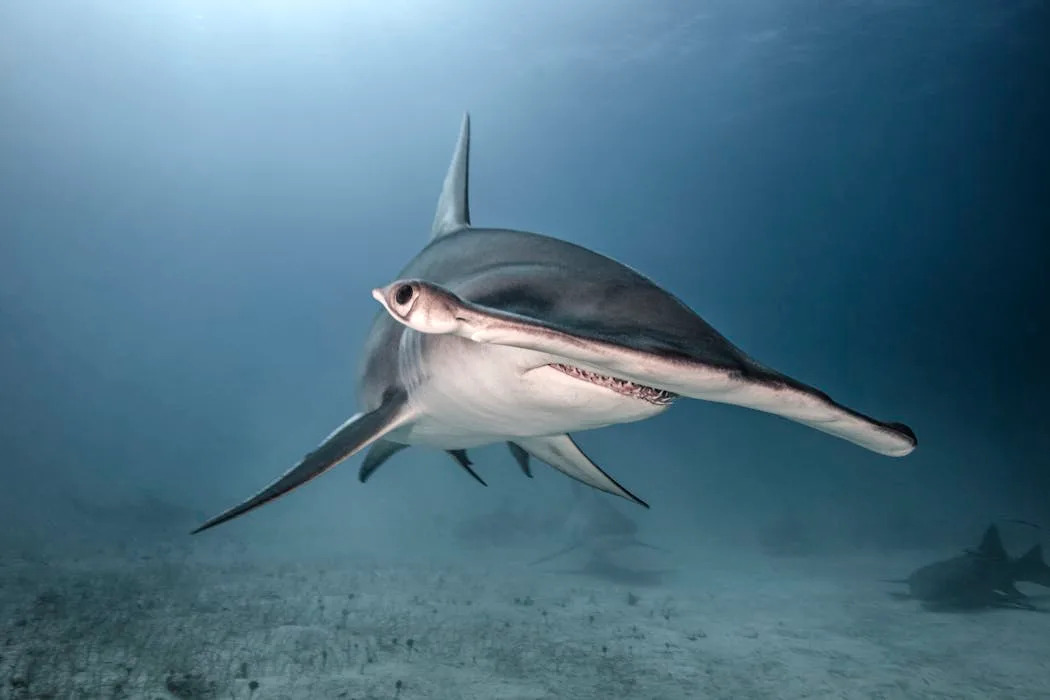
Hammerhead sharks, known for their distinctive hammer-shaped heads, have intrigued scientists and the public alike. These unique structures are thought to provide several advantages, enhancing the sharks’ survival in their marine environments. With their unusual appearance, hammerheads raise questions about their evolutionary history and functionality.
The Advantages of the Hammer Shape
Research suggests that hammerhead sharks benefit from their unique head shape in three significant ways. First, the positioning of their eyes allows for a much wider field of vision. By having their eyes on either end of their hammer-like heads, hammerheads can see in multiple directions simultaneously. This enhanced vision aids in detecting potential prey and predators in their surroundings.
To compensate for the reduced depth perception that comes with wide-set eyes, hammerhead sharks possess special sensory organs known as ampullae of Lorenzini. These organs, located beneath their hammers, can detect electrical signals in the water, enabling the sharks to locate prey buried in the ocean floor. While other shark species have these sensory organs, hammerheads have a greater concentration, allowing for more precise hunting capabilities.
Finally, the hammer shape contributes to the sharks’ agility in the water. Much like a pilot adjusting a plane’s wings for better maneuverability, the broad heads of hammerheads allow for quicker turns. This agility is crucial when pursuing fast-moving prey.
Tracing the Evolution of Hammerhead Sharks
Understanding the evolutionary journey of hammerhead sharks poses challenges due to the scarcity of fossil records. Sharks, unlike many other creatures, lack bones; their bodies are primarily made of cartilage, which decomposes rapidly and seldom fossilizes. Most fossil records available are limited to their teeth, which provide little insight into the evolution of their unique heads.
Currently, there are nine recognized species of hammerhead sharks, each varying in size and head shape. Notable species include the great hammerhead (S. mokarran), the smooth hammerhead (S. zygaena), and the bonnethead (S. tiburo). Previous assumptions held that early hammerhead species had smaller hammers, which evolved over time into the larger hammers seen today.
To explore the evolutionary relationships among hammerhead species, scientists have turned to DNA analysis. A study conducted on eight of the nine species revealed unexpected results. Contrary to earlier beliefs, the older species exhibited larger hammers, while the more recent species displayed smaller ones. This finding challenges traditional views on the gradual evolutionary process, suggesting that significant changes can occur rapidly due to genetic variations.
The evolution of hammerhead sharks exemplifies how some species may thrive despite what might initially appear as deformities. The earliest species, such as the winghead shark (E. blochii), have some of the widest heads. Over time, natural selection has led to a reduction in hammer size, with the most recent species, the bonnethead, featuring the smallest hammer.
Understanding the adaptations and evolutionary history of hammerhead sharks not only sheds light on their survival strategies but also contributes to broader knowledge about marine biology and the complex dynamics of ocean ecosystems. As scientists continue to study these remarkable creatures, new insights will undoubtedly emerge, revealing more about the mysterious world of sharks.
For those curious about marine life and its complexities, the ongoing research into hammerhead sharks offers a fascinating glimpse into the intricacies of evolution and adaptation.

Urgent Tax Savings Alert: Maximize Deductions Before April 15

Trump’s Administration Faces Uncertainty Over Government Shutdowns

Cosmic Defects: The Mystery of the Universe’s Missing Anomalies

Rapid City Parks Department Opens Registration for Bocce Leagues

Samsung Galaxy Watch 9 to Feature Larger 435mAh Battery Soon

Two Dead After Student Boats Capsize Off Okinawa Coast

Healthy Choice Wellness Reports Earnings with Mixed Results

Prince Harry Positions Himself as Royal Family’s Image Reviver

All Points North Lodge Achieves FSPHP-ETA Accreditation

Send Holiday Parcels for £1.99 with New Comparison Service

University of Hawaiʻi Leads $25M AI Project to Monitor Natural Disasters

Maui County Reopens Upgraded Lānaʻi Fifth Street Courts Today!

Daily Codeword Puzzle Launches on October 21, 2025

Congresswoman Under Fire for Misleading Epstein Donation Claims

Interstellar Object 3I/ATLAS Emits Unique Metal Alloy, Says Scientist

Trump Vows to Resolve Afghanistan-Pakistan Crisis “Very Quickly”

Charles Darwin’s Address Book Reveals Hidden Aspects of His Life

Rediscovering Chrysler: 5 Overlooked Models from the 1980s
-
 Lifestyle8 months ago
Send Holiday Parcels for £1.99 with New Comparison Service
-
Science9 months ago
University of Hawaiʻi Leads $25M AI Project to Monitor Natural Disasters
-
 Top Stories8 months ago
Maui County Reopens Upgraded Lānaʻi Fifth Street Courts Today!
-
 Entertainment10 months ago
Daily Codeword Puzzle Launches on October 21, 2025
-
 Lifestyle9 months ago
Congresswoman Under Fire for Misleading Epstein Donation Claims
-
 Science10 months ago
Interstellar Object 3I/ATLAS Emits Unique Metal Alloy, Says Scientist
-
 Top Stories9 months ago
Trump Vows to Resolve Afghanistan-Pakistan Crisis “Very Quickly”
-
 Science8 months ago
Charles Darwin’s Address Book Reveals Hidden Aspects of His Life
-
 Lifestyle8 months ago
Rediscovering Chrysler: 5 Overlooked Models from the 1980s
-

 Science7 months ago
Understanding Generation Z: Strategies for Engaging the Workforce
-

 Entertainment10 months ago
Kelly McCreary Discusses Future of Maggie and Winston in Grey’s Anatomy
-

 Top Stories8 months ago
aespa Faces Backlash Over G-Dragon Interaction at 2025 MAMAs