
Science
Researchers Develop Groundbreaking Coating for Ammonia-Powered Ships

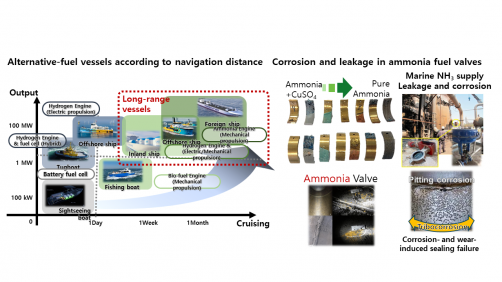
A collaborative research effort led by Dr. Young-Jun Jang and Dr. Jongkuk Kim from the Extreme Materials Research Institute, alongside Dr. Sungmo Moon’s team at the Korea Institute of Materials Science (KIMS), has yielded a significant advancement in marine technology. They have developed South Korea’s first high corrosion- and wear-resistant carbon coating specifically designed to address the challenges posed by ammonia fuel. This innovation is expected to accelerate the commercialization of eco-friendly ammonia-powered vessels.
Traditional marine metals, particularly stainless steel 440C, face severe degradation when exposed to ammonia due to its strong alkalinity and chemical reactivity. Over time, these conditions compromise the integrity of surface oxide layers, leading to localized corrosion and wear. Fuel-contacting components, including engines, valves, pumps, and bearings, exhibit significant vulnerabilities during long-term operation. Therefore, the development of robust corrosion-resistant coatings is essential for the design and certification of ammonia-powered ships.
Significant Reductions in Corrosion and Wear
The newly developed carbon coating technology, known as ta-C:Hx, demonstrates exceptional corrosion resistance. Testing indicates that while conventional marine materials experience corrosion current densities of approximately 48 μA/cm² in ammonia solutions, the innovative coating reduces this to 4 μA/cm², achieving a remarkable reduction of approximately 92%. Furthermore, the corrosive wear rate has plummeted from 1.4 × 10⁻⁶ mm³/N·m for conventional SS440C to just 1.3 × 10⁻⁸ mm³/N·m with the new coating, equating to a 99.1% reduction in tribocorrosion wear tests in ammonia environments.
Existing marine coatings, such as nitride coatings and wet plating layers, are primarily optimized for seawater and general industrial applications. Their long-term effectiveness under ammonia’s highly corrosive conditions has not been sufficiently established. The new carbon coating technology addresses this gap by specifically engineering the coating process for ammonia environments. By utilizing a pulsed bias control in a filtered arc deposition process, the research team significantly minimized defects such as micropores and interfacial irregularities that could otherwise initiate corrosion in harsh environments.
Supporting Sustainable Shipping Initiatives
This technological breakthrough aligns with the 2023 IMO Greenhouse Gas Reduction Strategy, which mandates that a specified percentage of fuels used in international shipping transition to zero-carbon alternatives by 2030. The Maritime Safety Committee has also ratified interim guidelines for ammonia-fueled ships, necessitating verification of corrosion resistance in metallic materials used within fuel systems.
Countries such as Japan, Norway, and Singapore are actively conducting demonstration projects for ammonia-powered vessels, assessing the corrosion and wear performance of metallic components. In South Korea, ammonia-powered ships have been designated a strategic focus within the shipbuilding sector through the “2050 Green Shipping National Action Plan” and the “K-Ammonia Eco-Friendly Ship Promotion Strategy.” Despite receiving Approval in Principle (AiP) for ammonia vessel designs, domestic shipbuilders face significant challenges due to the absence of locally developed surface coating technologies capable of functioning effectively in corrosive environments.
The research team at KIMS has built upon its extensive expertise in carbon coating technologies and environmental corrosion evaluations to produce this new coating. Dr. Young-Jun Jang, the principal investigator, remarked, “If this technology is commercialized, it will provide a practical solution for long-distance operation by significantly improving the efficiency and reliability of key components for eco-friendly shipbuilding and marine vessels.”
Additionally, co-researchers Dr. Jongkuk Kim and Dr. Sungmo Moon emphasized the importance of their collaborative approach, stating, “A key feature of this work is that the technology was advanced through close collaboration among KIMS’s internal technologies and research infrastructure, rather than relying on external technology adoption. We expect this achievement to contribute not only to strengthening the domestic industrial ecosystem but also to expanding into the global market in the future.”
The research, published online on December 1, 2025, in the renowned journal Carbon, received support from KIMS’s in-house research program and the National Research Foundation of Korea through the Nano and Materials Technology Development Program, funded by the Ministry of Science and ICT. The team is currently engaged in process stabilization and reliability evaluations of the coating technology for ammonia environments, while also pursuing additional patent filings and exploring opportunities for technology transfer and commercialization through collaboration with industry partners.

Urgent Tax Savings Alert: Maximize Deductions Before April 15

Trump’s Administration Faces Uncertainty Over Government Shutdowns

Cosmic Defects: The Mystery of the Universe’s Missing Anomalies

Rapid City Parks Department Opens Registration for Bocce Leagues

Samsung Galaxy Watch 9 to Feature Larger 435mAh Battery Soon

Two Dead After Student Boats Capsize Off Okinawa Coast

Healthy Choice Wellness Reports Earnings with Mixed Results

Prince Harry Positions Himself as Royal Family’s Image Reviver

All Points North Lodge Achieves FSPHP-ETA Accreditation

Send Holiday Parcels for £1.99 with New Comparison Service

University of Hawaiʻi Leads $25M AI Project to Monitor Natural Disasters

Maui County Reopens Upgraded Lānaʻi Fifth Street Courts Today!

Daily Codeword Puzzle Launches on October 21, 2025

Congresswoman Under Fire for Misleading Epstein Donation Claims

Interstellar Object 3I/ATLAS Emits Unique Metal Alloy, Says Scientist

Trump Vows to Resolve Afghanistan-Pakistan Crisis “Very Quickly”

Charles Darwin’s Address Book Reveals Hidden Aspects of His Life

Rediscovering Chrysler: 5 Overlooked Models from the 1980s
-
 Lifestyle8 months ago
Send Holiday Parcels for £1.99 with New Comparison Service
-
Science9 months ago
University of Hawaiʻi Leads $25M AI Project to Monitor Natural Disasters
-
 Top Stories8 months ago
Maui County Reopens Upgraded Lānaʻi Fifth Street Courts Today!
-
 Entertainment10 months ago
Daily Codeword Puzzle Launches on October 21, 2025
-
 Lifestyle9 months ago
Congresswoman Under Fire for Misleading Epstein Donation Claims
-
 Science10 months ago
Interstellar Object 3I/ATLAS Emits Unique Metal Alloy, Says Scientist
-
 Top Stories9 months ago
Trump Vows to Resolve Afghanistan-Pakistan Crisis “Very Quickly”
-
 Science8 months ago
Charles Darwin’s Address Book Reveals Hidden Aspects of His Life
-
 Lifestyle8 months ago
Rediscovering Chrysler: 5 Overlooked Models from the 1980s
-

 Science7 months ago
Understanding Generation Z: Strategies for Engaging the Workforce
-

 Entertainment10 months ago
Kelly McCreary Discusses Future of Maggie and Winston in Grey’s Anatomy
-

 Top Stories8 months ago
aespa Faces Backlash Over G-Dragon Interaction at 2025 MAMAs