
Top Stories
South Korean Stocks Plunge Over 8% Amid Oil Shock Fears

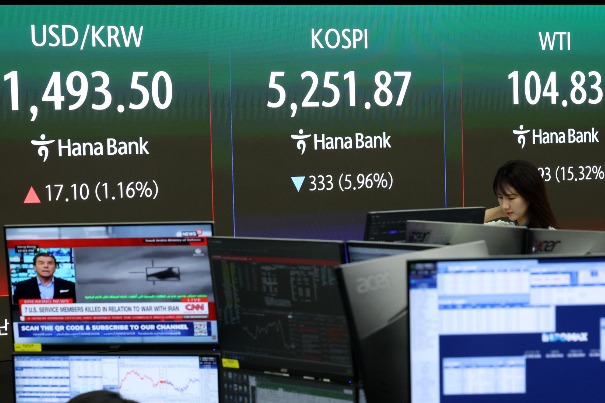
URGENT UPDATE: South Korean stocks are in freefall, with the benchmark Kospi plummeting more than 8% during Monday’s trading session, triggering a 20-minute trading halt. This dramatic decline is driven by soaring oil prices linked to the escalating US-Israel-Iran conflict. As investors rush to flee risk assets, the Kospi closed down 6% at 5,251.87, while the tech-heavy Kosdaq fell 4.5% to 1,102.28.
The market’s turmoil comes just days after a significant rebound, highlighting concerns that the recovery may be more of a W-shaped trajectory rather than a swift return to stability.
Investors reacted swiftly as the Kospi opened down nearly 6%, triggering a sell-side circuit breaker after futures dropped over 5%. When the index fell more than 8% for a minute, the Korea Exchange halted trading across all Kospi-listed shares.
The renewed selloff is exacerbated by a 26% surge in West Texas Intermediate crude prices, which soared to $114.49 a barrel, the highest since July 2022. This spike in oil prices is particularly damaging for South Korea, which heavily relies on Middle Eastern energy imports.
The South Korean won also suffered, trading at 1,495.50 per dollar, nearing the critical 1,500 level. This marks its weakest performance since March 2009. Foreign investors led the selloff, offloading a net 3.2 trillion won (approximately $2.1 billion) in shares, while institutions sold 1.5 trillion won.
The losses rippled through major companies, with SK Hynix down 9.5%, Hyundai Motor off 8.3%, and Samsung Electronics falling 7.8%. The Kosdaq also suffered heavy losses, particularly impacting smaller firms like Rainbow Robotics, which tumbled 11.2%.
Analysts warn that the economic repercussions could deepen if the conflict in the Middle East prolongs. “Given South Korea’s heavy dependence on energy imports from the Middle East, a spike in oil prices could intensify risk-averse sentiment,” stated Lee Sung-hoon, an analyst at Kiwoom Securities Co.
As gasoline prices in South Korea rose to 1,897.7 won per liter, the government faces mounting pressure from consumers feeling the financial strain. The overall mood remains grim, with global markets also showing signs of instability. The Dow Jones Industrial Average fell nearly 1% last Friday, reflecting a broader risk-off trend.
What happens next? Analysts suggest that despite the heavy selloff, some believe the market has entered “deep-value” territory. However, others caution that the volatility may persist, leading to a drawn-out recovery process. “Markets have usually formed a W-shaped bottom in similar situations,” noted Lee Eun-taek from KB Securities Co.
Stay tuned for more updates as this situation develops. Investors and consumers alike are urged to monitor the impact of rising oil prices closely, as the implications for South Korea’s economy remain significant.

Urgent Tax Savings Alert: Maximize Deductions Before April 15

Trump’s Administration Faces Uncertainty Over Government Shutdowns

Cosmic Defects: The Mystery of the Universe’s Missing Anomalies

Rapid City Parks Department Opens Registration for Bocce Leagues

Samsung Galaxy Watch 9 to Feature Larger 435mAh Battery Soon

Two Dead After Student Boats Capsize Off Okinawa Coast

Healthy Choice Wellness Reports Earnings with Mixed Results

Prince Harry Positions Himself as Royal Family’s Image Reviver

All Points North Lodge Achieves FSPHP-ETA Accreditation

Send Holiday Parcels for £1.99 with New Comparison Service

University of Hawaiʻi Leads $25M AI Project to Monitor Natural Disasters

Maui County Reopens Upgraded Lānaʻi Fifth Street Courts Today!

Daily Codeword Puzzle Launches on October 21, 2025

Congresswoman Under Fire for Misleading Epstein Donation Claims

Interstellar Object 3I/ATLAS Emits Unique Metal Alloy, Says Scientist

Trump Vows to Resolve Afghanistan-Pakistan Crisis “Very Quickly”

Charles Darwin’s Address Book Reveals Hidden Aspects of His Life

Rediscovering Chrysler: 5 Overlooked Models from the 1980s
-
 Lifestyle8 months ago
Send Holiday Parcels for £1.99 with New Comparison Service
-
Science9 months ago
University of Hawaiʻi Leads $25M AI Project to Monitor Natural Disasters
-
 Top Stories8 months ago
Maui County Reopens Upgraded Lānaʻi Fifth Street Courts Today!
-
 Entertainment10 months ago
Daily Codeword Puzzle Launches on October 21, 2025
-
 Lifestyle9 months ago
Congresswoman Under Fire for Misleading Epstein Donation Claims
-
 Science10 months ago
Interstellar Object 3I/ATLAS Emits Unique Metal Alloy, Says Scientist
-
 Top Stories9 months ago
Trump Vows to Resolve Afghanistan-Pakistan Crisis “Very Quickly”
-
 Science8 months ago
Charles Darwin’s Address Book Reveals Hidden Aspects of His Life
-
 Lifestyle8 months ago
Rediscovering Chrysler: 5 Overlooked Models from the 1980s
-

 Science7 months ago
Understanding Generation Z: Strategies for Engaging the Workforce
-

 Entertainment10 months ago
Kelly McCreary Discusses Future of Maggie and Winston in Grey’s Anatomy
-

 Entertainment7 months ago
Landmark Shift as Iconic Anime Series Concludes After 26 Years