
World
Archaeologists Uncover Medieval City Beneath Lake Issyk-Kul

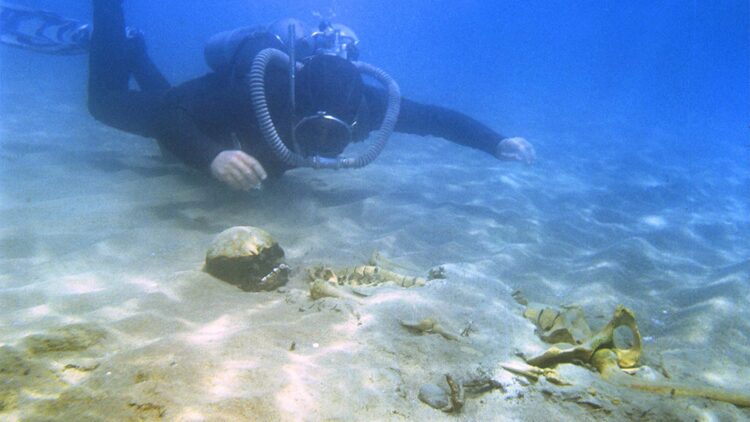
Archaeologists have confirmed the existence of a medieval city submerged beneath the waters of Lake Issyk-Kul in Kyrgyzstan, a discovery that may significantly alter our understanding of the Silk Road’s history. The city, believed to have thrived before its catastrophic decline due to a powerful earthquake, was long thought to be a mere legend. Researchers from various countries have now verified the tales, revealing the remnants of a once-vibrant urban center that played a crucial role in trade and cultural exchange.
Discovering the Lost City
Located at Toru-Aygyr on the northwest shore of Lake Issyk-Kul, the underwater site lies among the snow-capped peaks of the Tien Shan mountains. Archaeologists conducted explorations at depths ranging from one to four meters, uncovering large ceramic vessels, baked brick structures, and components of grain mills. These findings suggest the presence of public buildings such as madrasas, mosques, and ritual baths, indicating that the city served as a hub for traders, pilgrims, and tourists journeying between China and the Islamic world.
The team also identified wooden structures and crumbling stone walls, which imply a well-planned urban design and stable local governance. Using Accelerator Mass Spectrometry (AMS) and dendrochronology, researchers have accurately dated the wood and other materials, revealing that the settlement was likely a major center during the rule of the Kara-Khanid dynasty from the 10th to the 15th century.
A Rich Tapestry of Cultures
The archaeological evidence illustrates a diverse religious landscape, with traces of Buddhism, Tengrianism, and Nestorian Christianity coexisting alongside the rise of Islam. The city’s eventual decline is attributed to a significant earthquake in the 15th century, which led to its partial collapse and subsequent submersion beneath the lake. Interestingly, some residential areas show no signs of human remains, suggesting that parts of the city were abandoned prior to the final catastrophe.
Among the discoveries is a large Muslim cemetery dating back to the 13th and 14th centuries, covering approximately 60,000 square meters and adhering to Islamic burial customs, with bodies oriented toward Mecca. So far, the remains of two individuals—a male and a female—have been found, which may provide insights into their diet, health, and origins.
The Golden Horde played a significant role in establishing Islam as the dominant faith in Central Asia, fostering trade and trust along the Silk Road. Researchers have also discovered medieval ceramics and a large khum, a storage vessel that remains partially buried in sediment, indicating that more artifacts may emerge in future excavations.
As the team continues to investigate, they have unearthed additional graves, likely predating the Islamic era, demonstrating that the area was inhabited for an extended period across various cultural epochs. Structures made from adobe and buried soil layers have also been revealed, providing a more comprehensive understanding of the city’s history.
Preserving History for Future Generations
With the aid of underwater drones and sophisticated navigation systems, archaeologists are mapping the submerged ruins in detail, aiming to preserve this unique site for future generations. Their goal is to create a substantial interdisciplinary project that encompasses funerary studies, urban archaeology, and the tectonic and climatic history of Lake Issyk-Kul.
Researchers believe that a significant portion of the city remains unexplored. The ongoing investigations could reshape our perceptions of Central Asia’s role in global history since the Middle Ages. As more findings come to light, the submerged city of Lake Issyk-Kul may offer invaluable insights into the rich tapestry of cultures that once thrived along this ancient trade route.

Man Dies in Urgent NE OKC House Fire, Investigation Underway

Urgent: Man Dies in NE OKC House Fire, Crews Respond at 7:30 PM

Indigenous Elders Urgently Teach Hunting Amid Climate Crisis

Fallout Season 2 Premieres with Shocking New Threats, Watch Now

Attleboro High Girls Basketball Triumphs Over Canton, 53-48

California DMV DEMANDS Tesla END ‘Autopilot’ Marketing IMMEDIATELY

Stephen King’s 10 Most Gripping Novellas Revealed: Read Now!

Pentagon Escalates Investigation into Sen. Mark Kelly Amid Clash

Dior and Rizzoli Unveil Lady Art Project Book to Mark 10 Years

University of Hawaiʻi Leads $25M AI Project to Monitor Natural Disasters

Interstellar Object 3I/ATLAS Emits Unique Metal Alloy, Says Scientist

Send Holiday Parcels for £1.99 with New Comparison Service

Researchers Achieve Fastest Genome Sequencing in Under Four Hours

Iconic Sand Dollar Social Club Listed for $3 Million in Folly Beach

Afghan Refugee Detained by ICE After Asylum Hearing in New York

McEwen Inc. Secures Tartan Lake Gold Mine Through Acquisition

Peptilogics Secures $78 Million to Combat Prosthetic Joint Infections

Mars Observed: Detailed Imaging Reveals Dust Avalanche Dynamics
-
Science1 month ago
University of Hawaiʻi Leads $25M AI Project to Monitor Natural Disasters
-
 Science2 months ago
Interstellar Object 3I/ATLAS Emits Unique Metal Alloy, Says Scientist
-
 Lifestyle1 week ago
Send Holiday Parcels for £1.99 with New Comparison Service
-
 Science2 months ago
Researchers Achieve Fastest Genome Sequencing in Under Four Hours
-
 Business2 months ago
Iconic Sand Dollar Social Club Listed for $3 Million in Folly Beach
-
 Politics2 months ago
Afghan Refugee Detained by ICE After Asylum Hearing in New York
-
 Business2 months ago
McEwen Inc. Secures Tartan Lake Gold Mine Through Acquisition
-
 Health2 months ago
Peptilogics Secures $78 Million to Combat Prosthetic Joint Infections
-
 Science2 months ago
Mars Observed: Detailed Imaging Reveals Dust Avalanche Dynamics
-

 Lifestyle2 months ago
Jump for Good: San Clemente Pier Fundraiser Allows Legal Leaps
-

 Health2 months ago
Researcher Uncovers Zika Virus Pathway to Placenta Using Nanotubes
-

 Entertainment2 months ago
Jennifer Lopez Addresses A-Rod Split in Candid Interview