
World
Trump Targets Global Relations: A Year of Controversial Policies

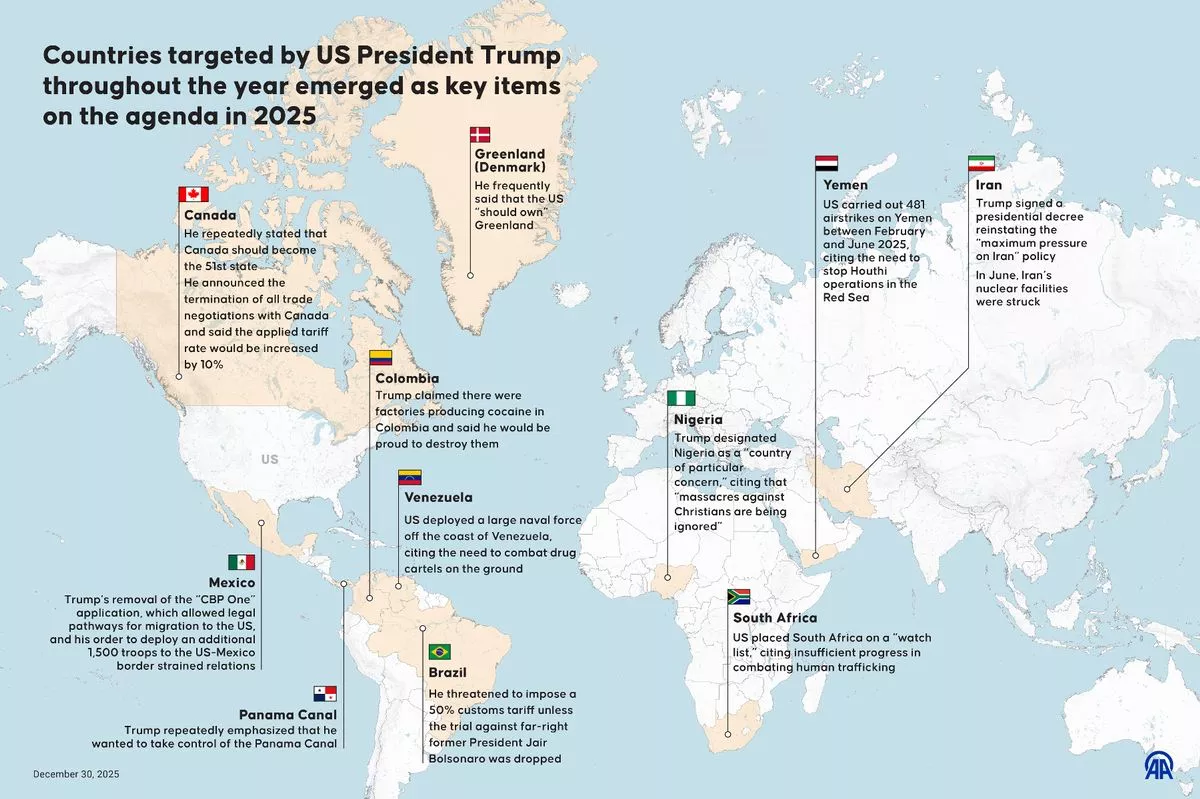
Former President Donald Trump has made headlines since returning to the White House in early 2025, marking a historic non-consecutive presidency. Over the past year, his administration has implemented a series of policies targeting various countries, generating significant controversy both domestically and internationally.
In 2025, Trump focused on tariffs as a centerpiece of his agenda, pledging to strengthen the U.S. economy. Yet, the promised benefits remain unfulfilled. His administration expanded a travel ban to include seven new countries, while imposing additional restrictions on individuals from fifteen others. Notably, the administration announced it would no longer issue visas to travelers holding documents from the Palestinian Authority.
In a late-night address in November, Trump suggested a “permanent pause” on migration from what he referred to as “third-world countries” following violent incidents involving National Guard members in Washington, D.C. As the year draws to a close, the list of targeted nations has grown, raising questions about the implications of his policies.
Tariffs and Trade Tensions
At the beginning of the year, Trump urged Canada to consider joining the United States as the 51st state to avoid increased tariffs. In March, he introduced tariffs on Canadian metals, threatening to raise them by 50%. In response, Ontario Premier Doug Ford warned, “If the U.S. escalates, I will not hesitate to shut off electricity completely.” Later in the year, Trump claimed that trade negotiations with Canada were halted due to a “fraudulent” advertisement campaign featuring former President Ronald Reagan criticizing tariffs.
The administration also revoked the legal status of migrants who entered the U.S. through the CBP One app, established under the previous administration. In March, the app was reinstated to assist undocumented immigrants in self-deportation under a new title, “CBP Home.” Additionally, the deployment of 1,500 troops to the U.S.-Mexico border strained diplomatic relations with Mexico.
Trump’s ambitions extended to the Panama Canal, where he claimed that China had taken control. He stated, “China is operating the Panama Canal, and we didn’t give it to China. We gave it to Panama, and we’re taking it back.” This assertion raised concerns regarding U.S. intentions to influence trade routes and manage maritime security.
Controversial Foreign Relations
In his administration’s dealings with Latin America, Trump accused Colombia of harboring drug factories, labeling the country’s leader a “drug dealer.” In October, he announced the cessation of U.S. subsidies to Colombia, alleging that President Gustavo Petro was fostering drug production. Meanwhile, U.S. airstrikes targeting vessels in the Caribbean, accused of trafficking drugs, have prompted accusations of escalating military engagement.
Trump’s stance on Venezuela remains firm, as his administration refuses to recognize Nicolás Maduro as the legitimate leader. Critics have suggested that these actions constitute acts of war. His support for former Brazilian President Jair Bolsonaro, who is currently facing a 27-year prison sentence for attempted self-coup, drew attention when Trump threatened to impose a 50% customs tariff on Brazil unless the trial was dismissed. Relations improved following discussions with new President Luiz Inacio Lula da Silva.
In Africa, Trump labeled Nigeria a “country of particular concern,” alleging neglect of violence against Christians. The U.S. conducted strikes against ISIS in Nigeria, citing the government’s failure to protect vulnerable populations, and raised alarms about a “genocide” occurring in the region. Conversely, some of Trump’s claims have faced scrutiny regarding their veracity.
The administration also placed South Africa on a “watch list,” indicating a lack of progress in addressing human trafficking. The annual Trafficking in Persons report highlighted that while some efforts were made, such as launching a sub-provincial task team, the overall number of identified victims and prosecutions had decreased.
Between February and June 2025, the U.S. executed over 480 airstrikes in Yemen, justified by the need to counter Houthi operations in the Red Sea. These strikes resulted in more than 220 civilian fatalities, according to analyses of military operations. In June, Trump’s administration reinstated the “maximum pressure on Iran” policy, aimed at thwarting Iran’s nuclear ambitions. This escalated tensions, culminating in U.S. military action against Iranian facilities amid ongoing conflicts in the region.
As Trump’s administration nears the end of its first year, the global landscape remains tense, shaped by a series of controversial decisions that have drawn both domestic and international scrutiny. The implications of these policies will likely continue to affect U.S. relations worldwide as the administration advances into 2026.

Urgent Tax Savings Alert: Maximize Deductions Before April 15

Trump’s Administration Faces Uncertainty Over Government Shutdowns

Cosmic Defects: The Mystery of the Universe’s Missing Anomalies

Rapid City Parks Department Opens Registration for Bocce Leagues

Samsung Galaxy Watch 9 to Feature Larger 435mAh Battery Soon

Two Dead After Student Boats Capsize Off Okinawa Coast

Healthy Choice Wellness Reports Earnings with Mixed Results

Prince Harry Positions Himself as Royal Family’s Image Reviver

All Points North Lodge Achieves FSPHP-ETA Accreditation

Send Holiday Parcels for £1.99 with New Comparison Service

University of Hawaiʻi Leads $25M AI Project to Monitor Natural Disasters

Maui County Reopens Upgraded Lānaʻi Fifth Street Courts Today!

Daily Codeword Puzzle Launches on October 21, 2025

Congresswoman Under Fire for Misleading Epstein Donation Claims

Interstellar Object 3I/ATLAS Emits Unique Metal Alloy, Says Scientist

Trump Vows to Resolve Afghanistan-Pakistan Crisis “Very Quickly”

Charles Darwin’s Address Book Reveals Hidden Aspects of His Life

Rediscovering Chrysler: 5 Overlooked Models from the 1980s
-
 Lifestyle8 months ago
Send Holiday Parcels for £1.99 with New Comparison Service
-
Science9 months ago
University of Hawaiʻi Leads $25M AI Project to Monitor Natural Disasters
-
 Top Stories8 months ago
Maui County Reopens Upgraded Lānaʻi Fifth Street Courts Today!
-
 Entertainment10 months ago
Daily Codeword Puzzle Launches on October 21, 2025
-
 Lifestyle9 months ago
Congresswoman Under Fire for Misleading Epstein Donation Claims
-
 Science10 months ago
Interstellar Object 3I/ATLAS Emits Unique Metal Alloy, Says Scientist
-
 Top Stories9 months ago
Trump Vows to Resolve Afghanistan-Pakistan Crisis “Very Quickly”
-
 Science8 months ago
Charles Darwin’s Address Book Reveals Hidden Aspects of His Life
-
 Lifestyle8 months ago
Rediscovering Chrysler: 5 Overlooked Models from the 1980s
-

 Science7 months ago
Understanding Generation Z: Strategies for Engaging the Workforce
-

 Entertainment10 months ago
Kelly McCreary Discusses Future of Maggie and Winston in Grey’s Anatomy
-

 Top Stories8 months ago
aespa Faces Backlash Over G-Dragon Interaction at 2025 MAMAs