
World
Hubble Telescope Reveals Unexpected Galactic Structure Disruption

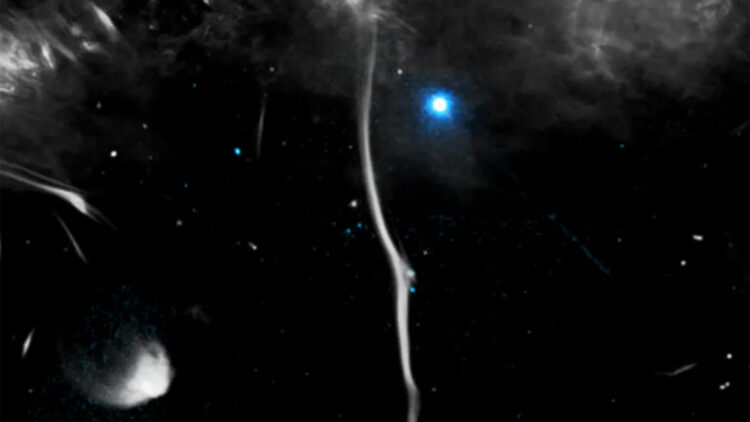
A recent discovery by the Hubble Space Telescope and a team from NASA has revealed an unusual disruption in a critical structure of the Milky Way galaxy, prompting scientists to rethink long-held beliefs about the universe’s evolution. This finding involves a galactic filament, informally dubbed the “Snake,” which appears to have been significantly altered by a fast-moving pulsar.
New Discoveries Challenge Existing Understanding
The Milky Way, while extensively studied, continues to hold many mysteries. The “bones of the universe,” a term used to describe the long, dense filaments of gas, dust, and rock that extend from the galaxy’s spiral arms, have now shown unexpected instability. Traditionally seen as stable components, these filaments provide crucial insight into the locations of stars, black holes, and distant planets.
Researchers have focused on a specific filament, designated as G359.13142-0.20005, which was previously regarded as one of the more stable elements of the galaxy. High-resolution observations using X-ray and infrared telescopes uncovered peculiar black spots resembling shadows in space. Further analysis revealed a break in the filament, suggesting a deformation that was not previously anticipated.
Measuring approximately 230 light-years long, the Snake filament was identified with the assistance of the Chandra X-ray Observatory. Upon deeper investigation, researchers detected a pulsar traversing the filament at speeds estimated between 1,609,000 and 3,218,000 kilometers per hour. This high-speed interaction appears to have caused a significant disruption in the filament’s structure, affecting its radio signals.
The Role of Pulsars in Galactic Dynamics
Pulsars are the remnants of massive stars that have exploded in supernova events. These dense objects possess powerful magnetic fields and rotate at remarkable speeds, emitting regular waves of radiation, akin to cosmic lighthouses. The observed pulsar’s interaction with the Snake filament raises important questions about the dynamics of galactic structures.
While the initial analysis suggested a simple break in the filament, scientists found that the fracture exhibited an unusual sharp angle. This led to simulations that confirmed a powerful external force, such as a pulsar, could indeed bend and redirect a filament in this manner. The findings indicate that the incident is relatively recent in cosmic terms, as evidenced by the unusual curvature and uneven density surrounding the fracture.
The implications of these discoveries are profound. If one major component of a galactic filament can be altered, it raises concerns about the stability of other similar structures within the Milky Way. Astronomers will need to utilize advanced telescopes capable of detecting X-rays and infrared light to map out these features more comprehensively. This approach may uncover additional fractures or deformations that have remained hidden from conventional optical observations.
As researchers continue to explore the complexities of the Milky Way’s structure, this new insight into the dynamics of cosmic filaments is likely to reshape our understanding of the galaxy and its evolution. The ongoing work by NASA and other observatories will be critical in unveiling the mysteries that lie within our universe.

Chargers Eliminate Chiefs from Playoffs as Mahomes Injures Knee

Sen. Cruz Threatens Government Shutdown Over Military Flight Safety

Search Intensifies for Brown University Shooter After Tragedy

Urgent Search for Brown University Shooter Intensifies After Attack

Mapping Antarctic Seabird Breeding: Addressing ‘Absence’ and ‘Ignorance’

Jaxon Newton and Tyler Earn Athlete of the Week Honors

Ukraine Launches Underwater Drone Strike on Russian Submarine

Flour Chicks Bakery Thrives with Fresh Pastries and Local Charm

Nick Reiner Explores Addiction Through Film with “Being Charlie”

University of Hawaiʻi Leads $25M AI Project to Monitor Natural Disasters

Interstellar Object 3I/ATLAS Emits Unique Metal Alloy, Says Scientist

Researchers Achieve Fastest Genome Sequencing in Under Four Hours

Iconic Sand Dollar Social Club Listed for $3 Million in Folly Beach

Afghan Refugee Detained by ICE After Asylum Hearing in New York

McEwen Inc. Secures Tartan Lake Gold Mine Through Acquisition

Peptilogics Secures $78 Million to Combat Prosthetic Joint Infections

Mars Observed: Detailed Imaging Reveals Dust Avalanche Dynamics

Jump for Good: San Clemente Pier Fundraiser Allows Legal Leaps
-
Science1 month ago
University of Hawaiʻi Leads $25M AI Project to Monitor Natural Disasters
-
 Science2 months ago
Interstellar Object 3I/ATLAS Emits Unique Metal Alloy, Says Scientist
-
 Science2 months ago
Researchers Achieve Fastest Genome Sequencing in Under Four Hours
-
 Business2 months ago
Iconic Sand Dollar Social Club Listed for $3 Million in Folly Beach
-
 Politics2 months ago
Afghan Refugee Detained by ICE After Asylum Hearing in New York
-
 Business2 months ago
McEwen Inc. Secures Tartan Lake Gold Mine Through Acquisition
-
 Health2 months ago
Peptilogics Secures $78 Million to Combat Prosthetic Joint Infections
-
 Science2 months ago
Mars Observed: Detailed Imaging Reveals Dust Avalanche Dynamics
-
 Lifestyle2 months ago
Jump for Good: San Clemente Pier Fundraiser Allows Legal Leaps
-

 Health2 months ago
Researcher Uncovers Zika Virus Pathway to Placenta Using Nanotubes
-

 Entertainment2 months ago
Jennifer Lopez Addresses A-Rod Split in Candid Interview
-

 World2 months ago
US Passport Ranks Drop Out of Top 10 for First Time Ever